
Accessories · Scales
The Best Coffee Scale Under $100
Under $100 is the entire sensible range for a home coffee scale. What separates these three is footprint, timer and build - not accuracy, and definitely not features.
The short answer
Buy the Timemore Black Mirror Basic 2: it is the scale that turns up most often in both espresso and pour-over setups, from a coffee-gear brand rather than a generic kitchenware label, in the non-Bluetooth version most people should own. The budget pick is the KitchenTour coffee scale - the cheapest thing here, and buying any scale instead of using the scoop that came with your machine is the upgrade that matters.
We earn a commission if you buy through a link on this page. It costs you nothing extra and it does not change what we recommend. Full disclosure.
All three picks, compared
Every pick on this page in one view, with the live Amazon price and stock on each row. Specs are the figures the maker or the listing publishes — nothing measured or scored by us. Prices are read from Amazon's API and were last checked November 22, 2026; where we have no verified price, the row says so rather than show you an old number.
| # | Scale | Who it's for | Price & availability |
|---|---|---|---|
| 1 | 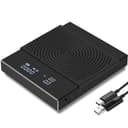 #1 Timemore Black Mirror Basic 2 coffee scale Best overall · Under $100 The mainstream non-Bluetooth Black Mirror · listed as an espresso and pour-over scale with a built-in timer · from a dedicated coffee brand · we hold no verified Timemore spec sheet, so check the listing for resolution and dimensions For the brewer who wants one scale for espresso and pour over. | For the brewer who wants one scale for espresso and pour over.The mainstream non-Bluetooth Black Mirror · listed as an espresso and pour-over scale with a built-in timer · from a dedicated coffee brand · we hold no verified Timemore spec sheet, so check the listing for resolution and dimensions | $44.00In stock, checked November 22, 2026 Check Price on Amazon |
| 2 | 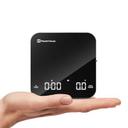 #2 Maestri House S2 espresso scale Best for drip trays · Under $50 Sold specifically as an espresso scale, i.e. slim with a small footprint for the gap under a group head · built-in timer per the listing · no manufacturer spec sheet in our database, so measure your clearance and read the listing For a machine with very little room between spouts and drip tray. | For a machine with very little room between spouts and drip tray.Sold specifically as an espresso scale, i.e. slim with a small footprint for the gap under a group head · built-in timer per the listing · no manufacturer spec sheet in our database, so measure your clearance and read the listing | $25.83In stock, checked November 22, 2026 Check Price on Amazon |
| 3 | 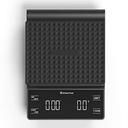 Budget pick · Under $25 The cheapest scale here by a wide margin · listed with a timer · a generic kitchenware brand rather than a coffee one, with no published spec sheet we can verify For replacing the scoop today, for less than the price of a bag of beans. | For replacing the scoop today, for less than the price of a bag of beans.The cheapest scale here by a wide margin · listed with a timer · a generic kitchenware brand rather than a coffee one, with no published spec sheet we can verify | $16.99In stock, checked November 22, 2026 Check Price on Amazon |
Why $100 is the whole category
A coffee scale does two things: it reports a weight and it counts seconds. Neither of those gets meaningfully better above about $50, and what you buy above $100 is connectivity — Bluetooth, an app, shot graphs, flow-rate curves, auto-start and auto-tare. Those are genuinely enjoyable and none of them is the reason anyone's coffee is good or bad. A scale that reads to a tenth of a gram and runs a timer is doing the whole job.
That is why this page is capped at $100 instead of running up to a flagship. It also means the sensible way to shop here is unusual: decide which of three practical things you need — a small enough footprint, a timer, or the lowest possible price — and buy the cheapest scale that has it. There is no quality ladder to climb.
Every pick below was under $100 at our last price check, and the exact date of that check is stamped on the comparison table and on each buy button above the price. Two of the three were under $50. Prices in this category move around a lot with promotions, so trust the live figure on the button over anything written in prose — including ours.
The three things to filter on
1. A tenth of a gram, not a whole gram.A kitchen scale that reads in whole grams is fine for bread and useless for espresso. A double shot dose sits in a range where one gram is a meaningful share of the total — enough to move the ratio, the shot time and the taste — so a scale that cannot tell 18.0 g from 18.9 g cannot tell two different shots apart. This is the specification to filter on and the one cheap scales most often lack, so read the listing for it rather than assuming.
2. A built-in timer, on the same object as the weight. Espresso is a ratio over a time: a shot that hits its yield in fifteen seconds and one that takes forty are different drinks even though the scale reads the same. You need the weight and the clock in one glance while both hands are busy. A phone timer technically works and is the thing everybody abandons inside a week.
3. It has to fit under the cup.This is the constraint that catches people out and the reason espresso-specific scales exist. The gap between a machine's group head and its drip tray is not large, and a chunky kitchen scale with a cup on top of it simply will not go under the spouts. Measure your clearance before you buy anything — it is the one number on this page that depends on your machine rather than on the scale.
What does not matter as much as you think: Bluetooth, apps, shot graphing, flow-rate curves, auto-tare and auto-start. Buy the cheapest scale that does a tenth of a gram, runs a timer and fits under your cup, put the difference into better beans, and revisit in a year if the hobby has taken.
The three picks
Timemore Black Mirror Basic 2 — the safe all-rounder
Who it is for:the brewer who wants one scale to cover espresso and filter coffee and does not want to think about scales again. The Black Mirror line is the one that turns up most often in home espresso setups and in pour-over setups alike, and that is the genuinely useful thing about it: it is a scale you can keep using if espresso does not stick, or use for both from the start. Timemore is a serious coffee-gear brand rather than a generic kitchenware label, and the Basic 2 is their mainstream, non-Bluetooth version — which is exactly the version we would tell most people to buy, for the reasons above. The honest catches: it is the most expensive thing on this page, and it is not an espresso-specific shape, so if your machine has a tight drip tray, measure before you order.
Maestri House S2 — the espresso-shaped one
Who it is for:anyone whose machine has very little room between the spouts and the drip tray — which, on the compact end of the category, is most people. This is sold as an espresso scale rather than a kitchen scale, which in practice means slim and small-footprint, designed to live on a drip tray with a cup on it. It is also the middle price here, under $50 at the last check, which makes it a reasonable default even without the clearance argument. The compromise is the mirror image of the Timemore's: a scale built around an espresso cup is a slightly awkward platform for a pour-over brewer with a carafe on it. If you only pull shots, that is not a compromise at all.
KitchenTour coffee scale — the budget pick
Who it is for:someone who wants to stop guessing today for the price of a bag of beans. This is the budget pick and the cheapest product on the page by a wide margin, and it is the right recommendation for a specific reason: the step from no scale to any scale is enormous, and the step from this scale to the top pick is small. KitchenTour is a generic kitchenware brand rather than a coffee one, we hold no spec sheet for it, and we would not pretend it will last as long or feel as nice as the Timemore. What it will do is give you a dose and a yield you can repeat, which is the entire point. If the hobby takes, you will eventually want something better — and you will have spent less than the difference learning that.
How to use it on day one
Three numbers, and then you are doing what everybody who writes about espresso assumes you already do:
- Dose.Put the empty basket on the scale, tare it, and grind into it until you hit your target — 18 g is a sane starting point for a 54 mm or 58 mm double. Write it down.
- Yield. Put the cup on the scale, tare, start the shot and the timer together, and stop when the liquid in the cup reaches about twice the dose. 18 g in, 36 g out is the default recipe the whole hobby starts from.
- Time. Aim to reach that yield in roughly 25 to 30 seconds. Faster than that means grind finer; slower means grind coarser. That is the entire feedback loop, and how to dial in espresso walks through it properly.
Hold the dose constant while you change anything else. That is the actual reason the scale comes first: change the grind and the dose in the same shot and you have learned nothing, because you cannot attribute the result to either. The longer argument for buying this before any other accessory is on the coffee scales page, and how much coffee goes in a shot covers the dose ranges for different baskets. If you brew filter as well, the same scale runs a pour over ratio, and the kettle half of that setup is on the best gooseneck kettles under $100.
What we know, and how we know it
What we did
- Took the specs from the manufacturer's own documentation. Not from a retailer listing, and not from another blog.
- Priced it from Amazon's API, with the date we checked shown next to the number. If that price is more than 48 hours old, this page stops showing a number at all rather than show you a wrong one.
- Formed a verdict from those specs, the price, and what owners publicly report.
Where we hedged, and why
None of these scales is in our spec database, which covers pump espresso machines and grinders only. We hold no verified manufacturer spec sheet for Timemore's Black Mirror Basic 2, the Maestri House S2 or the KitchenTour, which is why this page does not state a resolution figure, a platform size, a battery type or a capacity for any of them. Read the listing for those and, in particular, confirm the resolution is a tenth of a gram before you buy — that is the one specification that decides whether a scale is useful for espresso at all.
We have not weighed anything on these scales and we have not tested their accuracy, drift or response speed. The ordering here comes from form factor, brand focus and price, plus the argument that the money above about $50 buys connectivity rather than measurement — not from a test we did not run. The "under $100" framing is based on the live price layer at the date stamped on the table above; the button is the authority, not this sentence.
What we did not do
We do not run a lab. We have not pulled thousands of shots on this machine, and we are not going to pretend otherwise. We have not used this unit ourselves. Everything above is sourced research, and it is labeled as such. Where we have used a machine, we say so and show it.
How we're paid
If you buy through a link on this page, we earn a commission. It costs you nothing extra and it does not change what we recommend — we link to the better option for the buyer even when it earns us less. See how we review and our full disclosure.
More on the accessories hub.
Frequently asked questions
What is the best coffee scale under $100?
The Timemore Black Mirror Basic 2. It is the scale that appears most often in both espresso and pour-over setups, it comes from a dedicated coffee-gear brand rather than a generic kitchenware label, and the Basic 2 is the non-Bluetooth version that most people should own. If your machine has very little clearance under the group head, the slimmer Maestri House S2 is the better shape.
Do I need an espresso scale or will a kitchen scale do?
Two things usually rule a kitchen scale out. First, resolution: many read in whole grams, and you cannot tell an 18.0 g dose from an 18.9 g dose on one of those, which are different shots. Second, size: a chunky kitchen scale with a cup on top will not fit between your group head and drip tray. If your kitchen scale reads to a tenth of a gram and fits, use it.
Is a coffee scale worth it?
It is the accessory we would buy first, ahead of a distribution tool, a bottomless portafilter or a puck screen. Espresso is a ratio of dry coffee in to liquid out over a time, and without a scale you know none of those numbers - you are producing a surprise rather than following a recipe. It also makes every other adjustment legible, because you can hold the dose constant while you change one thing.
What resolution does a coffee scale need?
0.1 g. A double-shot dose sits in a range where a whole gram is a meaningful share of the total, enough to shift the ratio, the shot time and the taste. This is the specification to filter on and the one cheap scales most often omit, so check the listing rather than assuming - we hold no verified spec sheet for any scale on this page and will not state figures we cannot source.
Does a coffee scale need a timer?
Yes, and it should be on the same object as the weight. Espresso is a ratio over a time: a shot that reaches its target yield in fifteen seconds gushed and one that took forty choked, even though the scale reads identically. You need both numbers in one glance while your hands are busy. A phone timer works in theory and is the thing everyone stops using after a week.
Is a Bluetooth coffee scale worth the extra money?
Not for the coffee. Bluetooth, apps, shot graphing, flow-rate curves, auto-tare and auto-start are enjoyable and none of them is why a shot tastes good or bad. Buy the cheapest scale that reads to a tenth of a gram, runs a timer and fits under your cup, and put the difference into fresher beans or a better grinder.
How do I use a coffee scale for espresso?
Three numbers. Tare the empty basket and grind to your dose - 18 g is a sane start for a double. Then tare the cup, start the shot and the timer together, and stop at roughly twice the dose in the cup, so 18 g in and 36 g out. Aim to get there in about 25 to 30 seconds: faster means grind finer, slower means grind coarser.
Sources
Specs come from the manufacturer's own documentation. Prices come from Amazon's API. Where a claim comes from what owners report, we link the thread and say so.
- Timemore Black Mirror Basic 2, Maestri House S2 and KitchenTour coffee scale - product category, timer and form factor as published on the Amazon listings, read November 21, 2026. No manufacturer spec sheet is held for any of them, so no resolution, capacity or dimension figures are stated on this page
- Specialty Coffee Association - coffee research and standards
Keep reading
- Coffee scales for espressoThe longer argument for buying this before any other accessory.
- How to dial in espressoThe feedback loop a scale makes possible, step by step.
- How much coffee goes in a shot of espressoDose ranges by basket size, so you know what to weigh to.
- The best gooseneck kettles under $100The other half of a filter setup, in the same price band.
- Best espresso beansWhere to put the money you did not spend on Bluetooth.
- Espresso tampers: get the size right firstThe next accessory decision, and the one people make first by mistake.