
Espresso Machines · Students
The Best Espresso Machines for College Students
Small counter, smaller budget, a roommate asleep six feet away, and a housing contract that may ban heating appliances outright. Those four constraints decide this purchase — not the spec sheet.
The short answer
Check your housing appliance rules first — many dorms ban heating appliances. If a plug-in machine is allowed, the De'Longhi Stilosa is the cheapest real espresso machine worth owning. If it is not, the hand-powered Wacaco Nanopresso needs no outlet at all. For a first apartment, the slim Dedica Duo.
We earn a commission if you buy through a link on this page. It costs you nothing extra and it does not change what we recommend. Full disclosure.
Key takeaways
- Dorm appliance policies, not specs, decide this purchase. Many ban heating appliances and cap what you can plug into a shared circuit.
- If a plug-in machine is out, a hand-powered maker is not a consolation prize — it needs no outlet, makes no noise and cannot trip a breaker.
- Budget for the grinder or plan around it deliberately. Espresso from stale pre-ground coffee is the most common way a student machine ends up unused.
- Footprint and put-away-ability matter more than they would in a kitchen. Depth is usually the constraint, not width.
Read the housing rules first
This is the only buying advice on this page that can save you the entire purchase price. Most university housing contracts regulate appliances in residence halls, and the wording that matters usually covers heating elements and open coils rather than naming coffee equipment. An espresso machine has a heating element by definition. Depending on your building, that can mean a device is restricted to a shared kitchen, permitted only with a wattage limit, or banned in the room outright — and a confiscated machine is a worse outcome than a cheaper one.
So before you spend, find your housing office's appliance policy and check three things: whether heating appliances are allowed in rooms at all, whether there is a stated wattage cap, and whether the rules differ in a shared kitchen. The machines below draw between 1100 W and 1450 W from the wall — enough to matter on a circuit shared with a microwave and a mini fridge — except for one, which draws nothing at all because you provide the pressure with your hand.
All four picks, compared
Every pick on this page in one view, with the live Amazon price and stock on each row. Specs are the figures the maker or the listing publishes — nothing measured or scored by us. Prices are read from Amazon's API and were last checked October 10, 2026; where we have no verified price, the row says so rather than show you an old number.
| # | Pick | Why it's here | Price & availability |
|---|---|---|---|
| 1 | 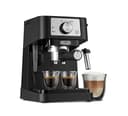 #1 De'Longhi Stilosa (EC260BK) Best value · Plug-in, under $150 Stainless steel boiler · 15 bar · 1 L tank · 1100 W · 8.07" W x 13.5" D x 11.22" H · 8.61 lb · pannarello frother · 1-year warranty plus 1 with registration The cheapest real espresso machine, small enough to put away. | The cheapest real espresso machine, small enough to put away.Stainless steel boiler · 15 bar · 1 L tank · 1100 W · 8.07" W x 13.5" D x 11.22" H · 8.61 lb · pannarello frother · 1-year warranty plus 1 with registration | $99.95In stock, checked October 10, 2026 Check Price on Amazon |
| 2 | 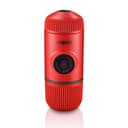 Best with no outlet · Hand-powered Hand-pumped piston, no motor and no heater · pressurized 8 g basket (16 g with the add-on kit) · 80 ml water capacity · 18 bar stated max · 62 x 71 x 156 mm, 336 g · 1-year warranty No plug, no noise, nothing to confiscate — and it forgives pre-ground coffee. | No plug, no noise, nothing to confiscate — and it forgives pre-ground coffee.Hand-pumped piston, no motor and no heater · pressurized 8 g basket (16 g with the add-on kit) · 80 ml water capacity · 18 bar stated max · 62 x 71 x 156 mm, 336 g · 1-year warranty | $55.17In stock, checked October 10, 2026 Check Price on Amazon |
| 3 | 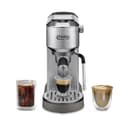 #3 De'Longhi Dedica Duo (EC890M) Best for an apartment · Plug-in, slim Only 15 cm (5.8") wide · Thermoblock · 15 bar · 1.1 L tank · 1450 W · 9.2 lb · 'My LatteArt' cool-touch steam wand · one-touch cold brew The narrowest machine here, and the one that also makes iced coffee. | The narrowest machine here, and the one that also makes iced coffee.Only 15 cm (5.8") wide · Thermoblock · 15 bar · 1.1 L tank · 1450 W · 9.2 lb · 'My LatteArt' cool-touch steam wand · one-touch cold brew | $199.95In stock, checked October 10, 2026 Check Price on Amazon |
| 4 | 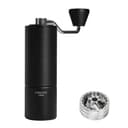 The grinder to pair · Hand grinder 38 mm S2C660 CNC-machined stainless conical burrs · 0.0233 mm per click, 30 clicks per rotation · 20 g catch cup · no power required · warranty not published by Timemore Quiet, outlet-free, and the cheapest grinder that can actually dial espresso in. | Quiet, outlet-free, and the cheapest grinder that can actually dial espresso in.38 mm S2C660 CNC-machined stainless conical burrs · 0.0233 mm per click, 30 clicks per rotation · 20 g catch cup · no power required · warranty not published by Timemore | $99.00In stock, checked October 10, 2026 Check Price on Amazon |
The four constraints
A student buying an espresso machine is solving a different problem from someone kitting out a kitchen, and it is worth naming the constraints explicitly because they rank differently.
- Permission. Covered above, and it is first for a reason. Everything else is moot if the machine is not allowed in the room.
- Footprint — especially depth. Dorm desks and shared counters are shallow. The Stilosa is 13.5 inches deep and the Dedica Duo 12.9, which is more than many desks allow once a monitor is on them. The ability to put a machine away in a cupboard between uses is worth more than an inch of width.
- Noise. A vibratory pump is loud for twenty-five seconds and an electric grinder is loud for ten. At 7am, six feet from a sleeping roommate, that is a real consideration — and the main reason we pair these machines with a hand grinder rather than an electric one.
- Total cost, not machine cost. The machine is rarely the whole bill. Beans, a grinder and a tamper matter, and the honest version of that arithmetic is below.
The machines
De'Longhi Stilosa — the cheapest real machine
| Type | Semi-automatic, no grinder |
|---|---|
| Portafilter | De'Longhi does not publish a portafilter size for this machine, so we're not going to state one. The figures you'll find online come from third-party sellers of aftermarket portafilters, not from De'Longhi. |
| Boiler | Stainless steel boiler — the only De'Longhi here with a real boiler, not a Thermoblock |
| PID temperature control | No |
| Built-in grinder | No — you'll need a separate grinder |
| Milk | Manual — pannarello-style frother |
| Pump pressure | 15 bar |
| Water tank | 1 L |
| Power | 1100 W |
| Dimensions | 8.07" W x 13.5" D x 11.22" H |
| Weight | 8.61 lb (3.9 kg) |
| Warranty | 1 year, plus 1 more with product registration |
| In the box | Portafilter, tamper, single filter, double filter, measuring spoon, ESE pod filter |
Who it is for: the student with an outlet, permission, and the smallest budget that still buys a genuine pump espresso machine.
The Stilosa is the entry point to De'Longhi's manual pump range and the cheapest machine on this site we would recommend without a caveat about build. One spec genuinely stands out and it is De'Longhi's own claim: it has a stainless steel boiler, which makes it the only De'Longhi in our database with a real boiler rather than a Thermoblock. It is small — 8.07 inches wide, 8.61 lb — which means it can live on a shelf and come out when you want it, and the 1 L tank is enough for several drinks between refills. There is a pannarello frother for milk, and an ESE pod filter in the box alongside the single and double filters.
The honest cons.1100 W from the wall, so the housing rules apply. De'Longhi publishes no portafilter diameter for it, which makes buying accessories a guessing game. The pannarello froths rather than texturing microfoam, so latte art is not happening. And De'Longhi itself does not sell the Stilosa on barista control — it sells it on ease, price and footprint, which is exactly why it suits this use. Our full take is in the Stilosa review.
Wacaco Nanopresso — the one that needs no outlet
| Type | Hand-pumped piston, portable — no pump motor, no heater |
|---|---|
| Basket | Pressurized; 8 g (16 g with the add-on Barista Kit) |
| Water capacity | 80 ml |
| Max pressure | 18 bar (261 psi), as stated by Wacaco |
| Grind | Extra-fine |
| Size / weight | 62 × 71 × 156 mm / 336 g (11.9 oz) |
| Heats water? | No — fill with hot water before brewing |
| Warranty | 1 year |
Who it is for: anyone whose housing bans plug-in brewers, anyone sharing a room with a light sleeper, and anyone who moves every August.
This is the pick that solves the dorm problem rather than working around it. There is no motor and no heater: you add hot water, you pump the piston by hand, and you get a small crema-topped shot. It weighs 336 g, it is smaller than a water bottle, it makes essentially no noise, and there is nothing on it for a housing inspection to object to. The pressurized 8 g basket is the feature that matters for a student: it forgives a coarser grind and an inexact dose, so a decent shot from supermarket pre-ground is actually achievable while you decide whether you care enough to buy a grinder.
The honest cons. That forgiveness is also the ceiling — the crema comes from the restrictor rather than the coffee, and 8 g is half a modern double, so it will never taste like a shot from a real machine with a good grinder. You still need hot water from somewhere. The body is mostly polymer, the warranty is one year, and there is no gauge: you pump until it stops. Treat it as a very good solution to a hard constraint, not as the machine you learn espresso on. The wider category is in the best manual espresso machines.
De'Longhi Dedica Duo — for a first apartment
| Type | Semi-automatic, no grinder |
|---|---|
| Portafilter | De'Longhi does not publish a portafilter size for this machine, so we're not going to state one. The figures you'll find online come from third-party sellers of aftermarket portafilters, not from De'Longhi. |
| Boiler | Thermoblock (ALU/stainless) |
| PID temperature control | No |
| Built-in grinder | No — you'll need a separate grinder |
| Milk | Manual — 'My LatteArt' cool-touch steam wand |
| Pump pressure | 15 bar |
| Heat-up time | De'Longhi says the Thermoblock gives 'a quick heat up time' but publishes no figure. |
| Water tank | 1.1 L |
| Power | 1450 W |
| Dimensions | 5.8" W x 12.9" D x 12" H (only 15 cm wide) |
| Weight | 9.2 lb (4.2 kg) |
| Warranty | Not clearly published. De'Longhi's site banner says 3 years; their older product pages say 1 year plus 1 with registration; this model's page states no term at all. |
| In the box | Portafilter, 1-cup filter, 2-cup filter, spoon, tamper, cleaning needle, water-hardness test paper, milk jug (on some models) |
Who it is for: the student who has moved off campus, has their own counter and kitchen rules, and drinks iced coffee as much as hot.
At 15 cm widethe Dedica Duo is the narrowest machine on this site, which is the whole point of it: on a crowded apartment counter width is what you do not have. Two things justify the step up from the Stilosa. The "My LatteArt" cool-touch steam wand can actually texture milk rather than just frothing it, so a flat white is on the table. And it has a one-touch cold brew function, which for a demographic that drinks a lot of iced coffee is a genuinely used feature rather than a spec-sheet one.
The honest cons.1450 W — the thirstiest machine here. It is a Thermoblock, not a boiler, and De'Longhi publishes no heat-up figure beyond calling it quick. De'Longhi's warranty position on this model is genuinely unclear: the site banner says three years, older product pages say one plus one with registration, and this model's page states no term at all. And the cold brew preset is a fast-steep approximation rather than a real overnight cold brew — we take that apart in the cold brew guide. The two De'Longhis go head to head in Dedica Duo vs Stilosa.
The grinder question, honestly
| Type | Manual hand grinder |
|---|---|
| Burrs | 38 mm S2C660 conical, stainless steel, CNC-machined |
| Adjustment | The ESP dial gives 0.0233 mm per click (30 clicks per rotation). The standard C3's 'Classic' dial is nearly four times coarser at 0.0833 mm per click. For espresso that difference is the entire ballgame — make sure you are buying the ESP. |
| Stepless? | No — it clicks between steps (most grinders described as 'stepless' online aren't) |
| Good for espresso? | Yes, with the ESP dial — Timemore: 'ESP and ESP Pro models feature finer control for espresso dialing' |
| Capacity | 20 g catch cup |
| Dimensions | Not published by Timemore. |
| Weight | Not published by Timemore. (The 530 g figure you'll see quoted everywhere comes from retailers, not from Timemore.) |
| Warranty | Not published — timemore.com has no warranty page at all. |
Who it is for: the student who wants the shots to actually taste good, and cannot run a noisy electric grinder at 7am anyway.
None of the machines above has a built-in grinder, and the standard advice — the grinder matters more than the machine — is true but incomplete for this situation. Here is the student version, in order of honesty.
- A hand grinder is the right kind of grinder for a dorm. It needs no outlet, makes almost no noise, packs into a drawer, and puts more of the money into burrs than any electric at the price. The Timemore C3 ESP is the cheapest one that can genuinely dial espresso in — but it must be the ESPversion, because the standard C3's dial is nearly four times coarser and will not do espresso properly.
- If the budget truly will not stretch, buy the machine first and plan around it. Pre-ground coffee in a machine with a pressurized basket — the Nanopresso's, for instance — gives you a drinkable, crema-topped shot. It is a real compromise and it is better than not buying coffee gear at all. Add the grinder next term.
- Do not buy a blade grinder. At this budget the temptation is strong and the result is dust and boulders at once, which is the one thing espresso cannot survive. Burr vs blade explains why in one page.
Noise, mess and shared kitchens
The practical failures of a student espresso setup are rarely about coffee quality. They are about living with the thing. Three that come up repeatedly, and what to do about them.
Noise. A vibratory pump runs for the length of the shot and an electric grinder screams for ten seconds. Neither is loud for long, but both are loud at a bad hour. A hand grinder removes half the problem entirely, and grinding the night before removes the other half at a small cost in freshness.
Mess. Spent espresso pucks are wet grounds that do not belong in a dorm bin liner, and knocking a portafilter against a desk edge will mark it. A small knock box or even a yoghurt pot kept for the purpose solves this; our knock boxes and tamping mats page covers the cheap end. Descaling matters too, and in a hard-water area it matters sooner than you would think — see how often to descale.
Shared kitchens. If the machine has to live in a communal kitchen, assume it will be used by people who have not read the manual, and assume it will be moved. That is another argument for the smallest, cheapest, most put-away-able option rather than the nicest one.
What it really costs
We will not invent a number, because prices move and every card on this page carries its own live figure with the date it was checked. But the shape of the bill is worth stating, because the machine price is the part people plan for and the rest is what surprises them.
You are buying, at minimum: the machine, a grinder (or a standing decision to use pre-ground), and beans on a repeating basis. Beans are the ongoing cost and the one that most affects the cup — fresh beans in a cheap machine beat stale beans in an expensive one every time. A tamper comes in the box with both De'Longhis. A scale is optional at this level; a knock box or equivalent is near-essential in a dorm. Add the four live prices on this page and you have the real total rather than an estimate. If you want that arithmetic laid out properly, our what home espresso really costs guide does it across every tier.
Which one for which student
| If this is you | Buy | Because |
|---|---|---|
| Your housing bans heating appliances | Wacaco Nanopresso | No motor, no heater, no outlet — nothing the policy covers. |
| Light-sleeping roommate, early classes | Nanopresso plus a hand grinder | The quietest espresso setup that exists. |
| You have an outlet, permission and $150 | De'Longhi Stilosa | The cheapest genuine pump machine, with a real stainless boiler. |
| You are in a first apartment with a tight counter | Dedica Duo | 15 cm wide, textures milk properly, and does one-touch cold brew. |
| You drink more iced coffee than hot | Dedica Duo | The cold brew preset is the one feature here aimed squarely at that. |
| You want milk drinks without a second gadget | Stilosa or Dedica Duo | Both have a wand; the Dedica's can texture, the Stilosa's froths. |
| You are moving dorms every year | Nanopresso | 336 g and smaller than a water bottle — it travels in a backpack. |
The verdict
Start with the housing policy, not the shopping list. If plug-in brewers are allowed, the De'Longhi Stilosais the buy: the cheapest real espresso machine, a stainless steel boiler De'Longhi actually publishes, a footprint you can put away, and a frother for milk drinks. Pair it with a hand grinder and you have a setup that makes genuinely good coffee in a very small space.
If plug-in brewers are not allowed — or if the roommate situation makes a pump at 7am a bad idea — the Wacaco Nanopresso is not a compromise so much as a different answer to the same question. No outlet, no noise, 336 g, and a pressurized basket that forgives the pre-ground coffee you will inevitably use in week three. And once you have your own kitchen, the Dedica Duo is the 15 cm-wide machine that handles milk properly and makes iced coffee at a button.
Whichever you choose, spend the marginal money on fresher beans rather than on a bigger machine. If you are weighing this against a pod machine, read upgrading from pods to espresso first, and if the budget is the binding constraint, our best machines under $200 covers the same bracket from a different angle.
What we know, and how we know it
What we did
- Took the specs from the manufacturer's own documentation — De'Longhi's product pages for the Stilosa and Dedica Duo, Wacaco's Nanopresso page, and Timemore's C3-series specifications. Not from a retailer listing, and not from another blog.
- Priced it from Amazon's API, with the date we checked shown next to the number. If that price is more than 48 hours old, this page stops showing a number at all rather than show you a wrong one.
- Formed a verdict from those specs, the price, and what owners publicly report.
Where we hedged, and why
We have not used any of this equipment and we run no lab, so nothing here rests on a test we ran. The two De'Longhi machines and the Timemore grinder are in our spec database and their tables are generated from it; the Wacaco Nanopresso is not, so its table is rendered inline from Wacaco's own product page and captioned with its source.
We do not know your housing rules and we do not pretend to.Our advice is to read your own institution's appliance policy, because these policies vary by building and change year to year. We state the wattage each machine draws — 1100 W for the Stilosa, 1450 W for the Dedica Duo, none for the hand-powered Nanopresso — so you can check those figures against whatever your contract says. We make no claim about what any specific university permits.
Where a maker is silent, so are we: De'Longhi publishes no portafilter diameter for either machine, no heat-up figure for the Dedica beyond calling it quick, and its warranty position on the Dedica Duo is contradictory across its own pages — all stated rather than resolved. Timemore publishes no warranty, weight or dimensions. No price appears in our prose; every number on this page is live from Amazon and carries the date it was checked.
What we did not do
We do not run a lab. We have not pulled thousands of shots on this machine, and we are not going to pretend otherwise. We have not used this unit ourselves. Everything above is sourced research, and it is labeled as such. Where we have used a machine, we say so and show it.
How we're paid
If you buy through a link on this page, we earn a commission. It costs you nothing extra and it does not change what we recommend — we link to the better option for the buyer even when it earns us less. See how we review and our full disclosure.
Frequently asked questions
Are espresso machines allowed in dorm rooms?
It depends entirely on your housing contract, and you should check before buying. University appliance policies typically regulate heating elements and open coils rather than naming coffee equipment, and an espresso machine has a heating element by definition. Some buildings allow them with a wattage cap, some restrict them to shared kitchens, and some ban them in rooms. A hand-powered maker like the Nanopresso has no heater or motor at all.
What is the best cheap espresso machine for a student?
The De'Longhi Stilosa. It is the cheapest genuine pump espresso machine we would recommend, it is the only De'Longhi in our database with a stainless steel boiler rather than a Thermoblock, it measures 8.07 inches wide and weighs 8.61 lb so it can be put away, and it includes a pannarello frother for milk drinks plus an ESE pod filter in the box.
Can you make espresso in a dorm without an outlet?
Yes, with a hand-powered maker. The Wacaco Nanopresso has no motor and no heater — you add hot water and pump the piston by hand, with a stated maximum of 18 bar. It weighs 336 g and makes almost no noise. You still need hot water from somewhere, which usually means a kettle or a shared kitchen, so check whether your rules allow that too.
Do I need a grinder as a student, or can I use pre-ground coffee?
A grinder makes a bigger difference than the machine does, but if the budget genuinely will not stretch, buy the machine and plan around it: pre-ground coffee works acceptably in a pressurized basket like the Nanopresso's, which forgives a coarser grind. When you can, add a hand grinder — it needs no outlet, is quiet enough for a shared room, and the Timemore C3 ESP is the cheapest that can dial espresso in. Do not buy a blade grinder.
Will an espresso machine trip the breaker in a dorm?
It can, on a circuit already carrying a mini fridge and a microwave. The Stilosa draws 1100 W and the Dedica Duo 1450 W, which is a meaningful load on a shared room circuit. If your building has a stated wattage limit, compare it against those figures before buying, and avoid running the machine at the same time as other high-draw appliances.
Is an espresso machine or a pod machine better for college?
A pod machine is quieter, faster and tidier; a real machine makes better coffee and costs far less per cup over time. If convenience and your roommate's sleep are the binding constraints, pods win. If you want espresso as something you learn and your housing allows the appliance, the Stilosa plus a hand grinder is the better long-run buy — our upgrading-from-pods guide covers the switch honestly.
Sources
Specs come from the manufacturer's own documentation. Prices come from Amazon's API. Where a claim comes from what owners report, we link the thread and say so.
- De'Longhi EC260BK Stilosa product page (stainless steel boiler, 15 bar, 1 L tank, 1100 W, dimensions and weight, pannarello frother, ESE pod filter in the box)
- De'Longhi EC890M Dedica Duo product page (15 cm width, Thermoblock, 15 bar, 1.1 L tank, 1450 W, 9.2 lb, 'My LatteArt' wand, one-touch cold brew)
- Wacaco Nanopresso product page (hand-pumped piston, pressurized 8 g basket, 80 ml capacity, 18 bar stated maximum, 336 g, 1-year warranty)
- Timemore Chestnut C3 series official specifications (38 mm S2C660 stainless conical burrs, ESP dial at 0.0233 mm per click)
Keep reading
- The best machines under $200The same budget bracket, ranked without the dorm constraints.
- The best machines for small kitchensIf the constraint is counter space rather than housing rules.
- The best manual espresso machinesThe hand-powered category the Nanopresso comes from, in full.
- Upgrading from pods to espressoThe honest comparison if a pod machine is the alternative.
- What home espresso really costsThe total bill, including the parts people forget to budget for.
- The best grinders under $100Where a student grinder budget lands, hand and electric.