
Espresso Machines · Materials
The Best Espresso Machines Without Plastic (In the Water Path)
No home espresso machine is plastic-free, and anyone who tells you otherwise has not looked at the water tank. What you can actually choose is the material the hot water touches — and that choice is real.
The short answer
No home espresso machine is plastic-free, so the honest target is a metal hot-water path. The Rancilio Silvia has a 0.3 L insulated brass boiler and a commercial brass group; the current Gaggia Classic Pro E24 uses lead-free brass for both at half the money; the De'Longhi Stilosa is the cheapest with a real stainless boiler.
We earn a commission if you buy through a link on this page. It costs you nothing extra and it does not change what we recommend. Full disclosure.
Key takeaways
- No home espresso machine is plastic-free. Water tanks, hoses, fittings and parts of most housings use polymers, and no maker in this bracket publishes a full material list.
- What you can verify and choose is the hot-water path: the boiler, the group the water passes through, and the portafilter.
- Brass boiler plus brass group is the traditional commercial answer. A stainless boiler is the next best. An aluminium Thermoblock is what most cheap machines use instead.
- Gaggia's current Classic Pro E24 specifies lead-free brass — and earlier Classic generations used an aluminum boiler, so the generation you buy matters.
The honest answer first
People search for an espresso machine "without plastic" for sensible reasons: they do not want hot water sitting in a polymer, they have had a tank or a fitting go brittle, or they simply want a machine built from materials that last. The answer we have to give you is that the fully plastic-free home espresso machine does not exist at any price you would recognise as a home machine. Water tanks are polymer almost universally. So are many internal hoses, several fittings, and large parts of most control panels.
What is real, and what you can verify from manufacturer specifications rather than marketing, is the material of the hot-water path: the boiler that heats the water, the group the water passes through on its way to the coffee, and the portafilter that holds the puck. Those are the surfaces hot water actually dwells on, they vary enormously between machines, and they are published. That is the shopping list this page uses, because it is the part of the question that has a truthful answer.
All three machines, compared
Every pick on this page in one view, with the live Amazon price and stock on each row. Specs are the figures the maker or the listing publishes — nothing measured or scored by us. Prices are read from Amazon's API and were last checked October 10, 2026; where we have no verified price, the row says so rather than show you an old number.
| # | Machine | Why it's here | Price & availability |
|---|---|---|---|
| 1 | 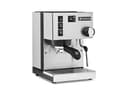 Most metal · Prosumer, 58 mm 0.3 L insulated brass boiler · commercial brass group · articulating stainless steam wand · 58 mm chrome-plated portafilter, traditional 8 g and 16 g baskets · 30.8 lb · 1000 W Brass boiler and brass group — the traditional all-metal brew path. | Brass boiler and brass group — the traditional all-metal brew path.0.3 L insulated brass boiler · commercial brass group · articulating stainless steam wand · 58 mm chrome-plated portafilter, traditional 8 g and 16 g baskets · 30.8 lb · 1000 W | $995.00In stock, checked October 10, 2026 Check Price on Amazon |
| 2 | 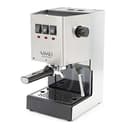 #2 Gaggia Classic Pro E24 (RI9380) Best value · Semi-automatic, 58 mm Lead-free brass single boiler and group on the current E24 generation · commercial stainless steam wand · 58 mm portafilter · solenoid valve · 2.1 L tank · 1350 W The same brass-path idea as the Silvia for roughly half the money. | The same brass-path idea as the Silvia for roughly half the money.Lead-free brass single boiler and group on the current E24 generation · commercial stainless steam wand · 58 mm portafilter · solenoid valve · 2.1 L tank · 1350 W | $450.83In stock, checked October 10, 2026 Check Price on Amazon |
| 3 | 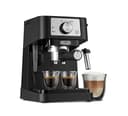 #3 De'Longhi Stilosa (EC260BK) Cheapest real boiler · Entry, under $150 Stainless steel boiler — the only De'Longhi in our database with a real boiler rather than a Thermoblock · 15 bar · 1 L tank · 1100 W · 8.61 lb A metal boiler at the bottom of the market, where Thermoblocks are the norm. | A metal boiler at the bottom of the market, where Thermoblocks are the norm.Stainless steel boiler — the only De'Longhi in our database with a real boiler rather than a Thermoblock · 15 bar · 1 L tank · 1100 W · 8.61 lb | $99.95In stock, checked October 10, 2026 Check Price on Amazon |
What to look at: boiler, group, wand
Three components decide whether your hot water meets metal or polymer, and all three are usually published.
- The boiler.This is where water is heated and where it dwells longest. Brass is the traditional commercial material and brings thermal mass with it; stainless is the other good answer; an aluminium Thermoblock is the cheap, fast alternative. Of the machines in our database, the Silvia specifies a 0.3 L insulated brass boiler, the current Gaggia Classic Pro E24 specifies lead-free brass, and the De'Longhi Stilosa specifies a stainless steel boiler.
- The group. The block the water passes through into the portafilter. A commercial brass group — on both the Silvia and the Classic Pro — is a solid lump of metal that also stabilises temperature. On machines built around a Thermoblock, the group is usually a much lighter assembly.
- The steam wand. Here the distinction is visible from the outside. A commercial-style stainless wand is bare metal. A panarello is a sleeve fitted over the wand — which on cheaper machines is plastic — that aerates milk automatically. The Silvia has an articulating stainless wand and no panarello; the Gaggia ships a stainless commercial wand with a panarello attachment in the box, so you can simply not fit it.
Everything else — tank, hoses, drip tray, control knobs, housing panels — varies by model and is rarely documented in material terms. If you want the full spec sheets rather than our summary, every figure on this page is in the machine tables below.
Why Thermoblocks are the usual answer
Most machines under a few hundred dollars do not have a boiler at all. They have a Thermoblock: a metal block with a channel through it that heats water as it passes, rather than holding a reservoir of hot water. De'Longhi publishes the material for theirs as ALU/stainless — aluminium with stainless — on both the Dedica Duo and the Magnifica Start, which is the clearest statement of the pattern you will get from a maker in this bracket.
A Thermoblock is not a plastic part, so if your concern is specifically polymer in the water path, it is not the villain. But it is aluminium rather than brass or stainless, it holds very little water, and it is the reason cheap machines heat up in seconds and struggle to hold temperature through back-to-back shots. If you are weighing the thermal argument rather than the material one, we take it apart in Thermoblock vs boiler.
The three machines
Rancilio Silvia — the most metal in the water path
| Type | Semi-automatic, no grinder |
|---|---|
| Portafilter | 58 mm — the commercial size, so baskets and tampers are easy to find |
| Boiler | Single boiler (brew + steam), 0.3 L insulated brass. Note: Rancilio's own US site calls it a 'heat exchange boiler' — that is an error on their part; their manual lists a single dual-use boiler. |
| PID temperature control | No |
| Built-in grinder | No — you'll need a separate grinder |
| Milk | Manual — commercial-style articulating stainless wand, not a panarello |
| Pump pressure | Not published by Rancilio. The "9 bar" figure you'll see quoted is a retailer's number, not theirs. |
| 3-way solenoid valve | Yes — dumps pressure off the puck after the shot, so the used puck comes out dry |
| Water tank | 2 L |
| Power | 1000 W |
| Dimensions | 9.2" W x 11.4" D x 13.4" H |
| Weight | 30.8 lb (14 kg) — by far the heaviest machine here |
| Warranty | Not published. Rancilio states no warranty duration on any official page, spec sheet or manual we could find. |
| In the box | 58 mm chrome-plated portafilter, 8 g and 16 g traditional (non-pressurized) baskets, cleaning tools. No pressurized basket, and no tamper is listed. |
Who it is for: the buyer who wants commercial materials in a home footprint and is willing to learn a machine that offers no electronic help at all.
Rancilio sells the Silvia on thermal mass and longevity, and the specification backs that up: a 0.3 L insulated brass boiler, a commercial brass group, an articulating stainless steam wand rather than a panarello, a 58 mm chrome-plated portafilter and traditional non-pressurized baskets. At 30.8 lb it is by far the heaviest machine we list, which is what that much brass weighs. For this page it is the clearest answer available: from boiler to group to portafilter, the hot water meets metal.
The honest cons.It is the most expensive machine here several times over. There is no PID, no display and no shot timer — Rancilio is explicit that it is a manual, skill-forward machine, and points buyers who want those features at the separate Silvia Pro X. Rancilio publishes no bar rating anywhere, so the ubiquitous "9 bar" figure is retailer language rather than a manufacturer claim, and they publish no warranty duration on any official page we could find. Our full take is in the Rancilio Silvia review.
Gaggia Classic Pro E24 — the same idea for half the money
| Type | Semi-automatic, no grinder |
|---|---|
| Portafilter | 58 mm — the commercial size, so baskets and tampers are easy to find |
| Boiler | Single boiler (brew + steam), lead-free brass on the current E24 generation. Earlier Evo Pro and Classic 2019 units used an aluminum boiler — Gaggia's own service manual confirms it. Check which one you're buying. |
| PID temperature control | No |
| Built-in grinder | No — you'll need a separate grinder |
| Milk | Manual — commercial-style stainless steam wand (a panarello attachment is also in the box) |
| Pump pressure | 15 bar |
| 3-way solenoid valve | Yes — dumps pressure off the puck after the shot, so the used puck comes out dry |
| Pre-infusion | No |
| Water tank | 2.1 L |
| Power | 1350 W1350 W per gaggia.com and Gaggia's service manual. Gaggia's North American site says 1425 W. We're citing the two that agree. |
| Dimensions | 8" W x 9.5" D x 14.2" H |
| Weight | ~18-19 lb — Gaggia's global and North American sites disagree (8.1 kg vs 19 lb), so we give the range |
| Warranty | 1 year parts and labor (wear parts excluded) |
| In the box | Three baskets — 1 pressurized 'Crema perfetta' (pre-installed), 1 traditional single, 1 traditional double — plus a plastic tamper, a scoop, and a panarello frothing attachment |
Who it is for: most people reading this page — a brass boiler and group, a 58 mm commercial-format portafilter and a stainless wand, at a price that is not prosumer.
The Classic Pro is the value answer to this question, with one critical condition attached. The current E24 generation specifies a lead-free brass boiler, and the group and the commercial stainless steam wand follow the same commercial-format logic as the Silvia's. It also has a solenoid valve, which is the part that makes a dry puck and a clean group possible. For the money, nothing else we list puts this much metal between the pump and your cup.
The generational landmine.This matters more than any other sentence on the page. Gaggia's own service manual specifies an aluminumboiler for the Classic 2019 and Classic Evo Pro generations. The current E24 is lead-free brass. Both claims circulate online as "the Gaggia Classic Pro spec", and only one is true per generation — so if the boiler material is your reason for buying, read the model code on the listing and confirm you are getting an E24 (RI9380).
The other honest cons.No PID and no pre-infusion. A plastic tamper is in the box, along with a pressurized "Crema perfetta" basket pre-installed and traditional baskets to graduate to — Gaggia advises exactly that progression, and if you care about materials you will probably want the traditional baskets from day one (see pressurized vs non-pressurized baskets). Gaggia's own sources disagree on wattage: 1350 W on gaggia.com and in the service manual, 1425 W on their North American site, so we cite the two that agree.
De'Longhi Stilosa — the cheapest real boiler
| Type | Semi-automatic, no grinder |
|---|---|
| Portafilter | De'Longhi does not publish a portafilter size for this machine, so we're not going to state one. The figures you'll find online come from third-party sellers of aftermarket portafilters, not from De'Longhi. |
| Boiler | Stainless steel boiler — the only De'Longhi here with a real boiler, not a Thermoblock |
| PID temperature control | No |
| Built-in grinder | No — you'll need a separate grinder |
| Milk | Manual — pannarello-style frother |
| Pump pressure | 15 bar |
| Water tank | 1 L |
| Power | 1100 W |
| Dimensions | 8.07" W x 13.5" D x 11.22" H |
| Weight | 8.61 lb (3.9 kg) |
| Warranty | 1 year, plus 1 more with product registration |
| In the box | Portafilter, tamper, single filter, double filter, measuring spoon, ESE pod filter |
Who it is for: the buyer on an entry budget who still wants the water heated in a metal boiler rather than passed through an aluminium block.
Here is the genuinely interesting spec at the bottom of the market, and it is De'Longhi's own claim rather than our inference: the Stilosa has a stainless steel boiler, which makes it the only De'Longhi in our database with a real boiler instead of a Thermoblock. The pricier Dedica Duo and Magnifica Start are both ALU/stainless Thermoblocks. If the water-path material is what you are shopping for, the cheapest De'Longhi is — unusually — the better answer than the dearer ones.
The honest cons.It is an entry machine and De'Longhi sells it as one: on ease, price and footprint rather than barista control. Milk is handled by a pannarello-style frother rather than a bare commercial wand. De'Longhi publishes no portafilter diameter for it at all, which makes accessory buying a guessing game. And the 1 L tank is small. Our review is at the Stilosa review.
Is brass a problem? The lead question
If you came to this page worried about materials, you deserve the counter-argument too, because "brass" is not automatically the clean answer. Brass is a copper-zinc alloy and some traditional brass formulations contained lead to improve machinability — which is why older machines attract that question, and why modern makers advertise the alloy.
That is exactly why the Gaggia specification is worded the way it is: the current Classic Pro E24's boiler is specified as lead-free brass. We are quoting Gaggia there, not testing anything. Rancilio specifies brass for the Silvia's boiler and group without naming a formulation, so we cannot tell you more than that. If the lead question is your reason for shopping, the honest move is to buy a current-generation machine whose maker states the alloy, rather than a vintage machine of unknown provenance — and, on any machine, to discard the first flush of water after a long idle, which is standard practice anyway.
What we cannot verify
We would rather draw the boundary of our knowledge than blur it, so here is what this page does not tell you.
- Tank and hose materials. No maker in this bracket publishes a material disclosure for the water tank, the internal tubing or the fittings. We assume polymer because that is the industry norm, and we are not going to specify which polymer on any of these machines, because none of them says.
- Housing composition."Stainless steel" in marketing copy often describes visible panels rather than the whole shell. We make no housing claim for any machine here.
- Leaching. We have run no chemical analysis of any kind and have no measurements of anything migrating from any material into coffee. This page is about which materials the makers specify, not about health outcomes, and we will not imply a result we cannot support.
Which one for which buyer
| If this is you | Buy | Because |
|---|---|---|
| You want the most metal in the water path, cost aside | Rancilio Silvia | Insulated brass boiler, commercial brass group, stainless wand. |
| You want a brass brew path at a sane price | Gaggia Classic Pro E24 | Lead-free brass boiler and group — confirm the E24 generation. |
| Your budget is under about $150 | De'Longhi Stilosa | A stainless steel boiler where rivals use aluminium Thermoblocks. |
| You specifically want a bare metal steam wand | Silvia or Classic Pro | Both have commercial stainless wands; the panarello is optional on the Gaggia. |
| You want the machine ready in seconds | None of these | Thermal mass and fast heat-up are opposite purchases. |
| You want a PID and a shot timer | None of these | Neither 58 mm machine here has a PID; the Stilosa has no electronics to speak of. |
| Your real concern is scale and water quality | Any of these, plus water treatment | What is in your water matters more day to day than what the boiler is made of. |
The verdict
If the budget allows it, the Rancilio Silvia is the clearest answer this market offers: an insulated brass boiler, a commercial brass group, a stainless articulating wand and a chrome-plated 58 mm portafilter, in 30.8 lb of machine Rancilio explicitly sells on thermal mass. Accept that it gives you no electronic help, and that Rancilio publishes neither a bar rating nor a warranty term.
For most people the answer is the Gaggia Classic Pro E24. It brings the same lead-free brass boiler and group logic and a commercial stainless wand for roughly half the money — on the strict condition that you confirm the E24 generation, because the earlier Classic and Evo Pro used an aluminum boiler by Gaggia's own service manual. On an entry budget, the De'Longhi Stilosa's stainless steel boiler is a real advantage over the Thermoblock machines above it in De'Longhi's own range.
And keep the whole question in proportion: on any of these machines, what is dissolved in your water will affect both the coffee and the machine's lifespan more than the boiler alloy will. Start with water for espresso, then the best Italian espresso machines if traditional build is what drew you here.
What we know, and how we know it
What we did
- Took the specs from the manufacturer's own documentation — Gaggia's Classic E24 spec page and service manual, Rancilio's Silvia spec sheet, and De'Longhi's Stilosa product page. Not from a retailer listing, and not from another blog.
- Priced it from Amazon's API, with the date we checked shown next to the number. If that price is more than 48 hours old, this page stops showing a number at all rather than show you a wrong one.
- Formed a verdict from those specs, the price, and what owners publicly report.
Where we hedged, and why
We have not used these machines, we run no lab, and we have performed no material testing of any kind. Every material statement on this page is the manufacturer's own, generated from our spec database: brass for the Silvia's boiler and group, lead-free brass for the current Gaggia Classic Pro E24, stainless steel for the Stilosa's boiler, ALU/stainless for De'Longhi's Thermoblocks.
We make no health claim and no leaching claim. This page compares specified materials in the hot-water path. It does not assert that any material in any machine releases anything into coffee, because we have not measured that and we are not qualified to adjudicate it. Readers with a specific health concern should treat this as a materials comparison only.
We also state what nobody publishes: tank, hose and fitting materials, and true housing composition. We assume polymer in tanks and tubing because it is the industry norm, and we deliberately do not name a polymer for any machine. Gaggia's own wattage sources conflict (1350 W on gaggia.com and in the service manual, 1425 W on their North American site) and Rancilio's US site miscalls the Silvia's boiler a heat exchanger when their own manual lists a single dual-use boiler — both noted rather than resolved. No price appears in our prose; every number here is live from Amazon with the date it was checked.
What we did not do
We do not run a lab. We have not pulled thousands of shots on this machine, and we are not going to pretend otherwise. We have not used this unit ourselves. Everything above is sourced research, and it is labeled as such. Where we have used a machine, we say so and show it.
How we're paid
If you buy through a link on this page, we earn a commission. It costs you nothing extra and it does not change what we recommend — we link to the better option for the buyer even when it earns us less. See how we review and our full disclosure.
Frequently asked questions
Is there an espresso machine with no plastic at all?
Not in the home market. Water tanks are polymer almost universally, and so are many internal hoses, fittings and control panels — and no maker in this bracket publishes a full material disclosure. What you can choose and verify is the hot-water path: the boiler, the group and the portafilter. Brass and stainless are available there; the rest of the machine will contain polymer.
Which espresso machine has a brass boiler?
Of the machines in our spec database, the Rancilio Silvia has a 0.3 L insulated brass boiler with a commercial brass group, and the current Gaggia Classic Pro E24 (RI9380) specifies a lead-free brass boiler and group. Note the generation on the Gaggia: its own service manual specifies an aluminum boiler for the earlier Classic 2019 and Classic Evo Pro.
Is a Thermoblock plastic?
No. A Thermoblock is a metal block with a channel that heats water as it flows through, rather than holding a reservoir. De'Longhi publishes theirs as ALU/stainless — aluminium with stainless. So if your concern is specifically polymer in the water path, a Thermoblock is not the problem; it is simply aluminium rather than brass or stainless, holds very little water, and holds temperature less well through consecutive shots.
Is brass safe for an espresso machine?
Brass is the traditional commercial material for boilers and groups. The historical concern is that some older brass formulations contained lead for machinability, which is why modern makers advertise the alloy — Gaggia specifies lead-free brass for the current Classic Pro E24. We are quoting manufacturers rather than testing anything, and we make no health claim. If the question matters to you, buy a current-generation machine whose maker states the alloy.
What is the cheapest espresso machine with a metal boiler?
The De'Longhi Stilosa. De'Longhi specifies a stainless steel boiler for it, which makes it the only De'Longhi in our database with a real boiler rather than a Thermoblock — including the pricier Dedica Duo and Magnifica Start, which are both ALU/stainless Thermoblocks. On this one specification the cheapest machine in the range beats the dearer ones.
Does the boiler material change how the coffee tastes?
Not directly in any way we can demonstrate. What brass and stainless boilers bring is thermal mass, which helps hold a stable brew temperature through and between shots — and temperature stability does affect extraction. That is a thermal argument rather than a flavour-of-the-metal argument, and it is the reason heavy brass machines take a long time to warm up properly.
Sources
Specs come from the manufacturer's own documentation. Prices come from Amazon's API. Where a claim comes from what owners report, we link the thread and say so.
- Gaggia Classic E24 official spec page (lead-free brass boiler on the current generation, 58 mm portafilter, commercial steam wand, solenoid, 1350 W)
- Gaggia North America — Classic Pro listing (states 1425 W, against gaggia.com's 1350 W)
- Rancilio Silvia official spec sheet (0.3 L insulated brass boiler, commercial brass group, articulating stainless wand, 58 mm chrome-plated portafilter, 30.8 lb, 1000 W)
- De'Longhi EC260BK Stilosa product page (stainless steel boiler, 15 bar, 1 L tank, 1100 W)
Keep reading
- Thermoblock vs boilerThe thermal side of the same decision, in detail.
- The best Italian espresso machinesTraditional build and commercial-format hardware, by origin.
- Rancilio Silvia reviewThe all-brass machine on this page, reviewed from the spec sheet up.
- Gaggia Classic Pro reviewIncluding the generational boiler trap you must check before buying.
- Water for espressoWhat is dissolved in your water matters more day to day than the boiler alloy.
- Pressurized vs non-pressurized basketsWhy the basket that ships in the Gaggia box is not the one you want.