
Grinders · Hand grinders
The Best Hand Grinders for Espresso and Pour Over
A good hand grinder outgrinds most sub-$200 electrics — you just have to be willing to do the cranking.
The short answer
A good hand grinder rivals electrics costing far more, but espresso is the hardest thing to ask of one. For espresso, buy the 1Zpresso J-Ultra; the K-Ultra is the all-rounder, the Kingrinder K6 the budget pick, the Timemore C3 ESP the cheapest capable option, and the 1Zpresso Q Air a filter-leaning travel grinder.
We earn a commission if you buy through a link on this page. It costs you nothing extra and it does not change what we recommend. Full disclosure.
All five hand grinders, compared
Every pick on this page in one view, with the live Amazon price and stock on each row. Specs are the figures the maker or the listing publishes — nothing measured or scored by us. Prices are read from Amazon's API and were last checked October 12, 2026; where we have no verified price, the row says so rather than show you an old number.
| # | Hand grinder | Why it's here | Price & availability |
|---|---|---|---|
| 1 | 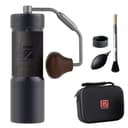 Best for espresso · Espresso-tuned 48 mm coated burrs · 8 microns per click, external ring · 35-40 g catch cup · about 700 g · 1-year limited warranty The finest adjustment 1Zpresso publishes — the one to buy if espresso is the job. | The finest adjustment 1Zpresso publishes — the one to buy if espresso is the job.48 mm coated burrs · 8 microns per click, external ring · 35-40 g catch cup · about 700 g · 1-year limited warranty | $199.00In stock, checked October 12, 2026 Check Price on Amazon |
| 2 | 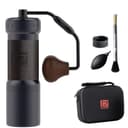 Best all-rounder · Filter and espresso Stainless conical 'K Burr' · 20 microns per click, 100+ clicks per rotation · 35-40 g catch cup · 700 g · 1-year limited warranty · carrying case included Wider useful range than the J-Ultra: excellent at filter, very good at espresso. | Wider useful range than the J-Ultra: excellent at filter, very good at espresso.Stainless conical 'K Burr' · 20 microns per click, 100+ clicks per rotation · 35-40 g catch cup · 700 g · 1-year limited warranty · carrying case included | $259.00In stock, checked October 12, 2026 Check Price on Amazon |
| 3 | 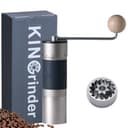 Best value for espresso · Espresso-capable Stainless steel burrs (size not published) · 16 microns per click, 60 clicks per rotation, 4 rotations · 25-35 g hopper · 1-year warranty External fine adjustment at a price that undercuts the established names. | External fine adjustment at a price that undercuts the established names.Stainless steel burrs (size not published) · 16 microns per click, 60 clicks per rotation, 4 rotations · 25-35 g hopper · 1-year warranty | $109.00In stock, checked October 12, 2026 Check Price on Amazon |
| 4 | 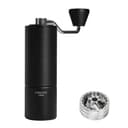 Cheapest capable option · Espresso-capable 38 mm S2C660 conical stainless burrs · 0.0233 mm (23 microns) per click, 30 clicks per rotation · 20 g catch cup · warranty not published by Timemore The cheapest hand grinder we'd put in front of a machine — buy the ESP, not the C3. | The cheapest hand grinder we'd put in front of a machine — buy the ESP, not the C3.38 mm S2C660 conical stainless burrs · 0.0233 mm (23 microns) per click, 30 clicks per rotation · 20 g catch cup · warranty not published by Timemore | $99.00In stock, checked October 12, 2026 Check Price on Amazon |
| 5 | 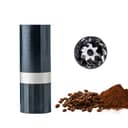 Best for travel and filter · Filter-first Stainless conical burrs (size not published) · 30 clicks per rotation · 15-20 g catch cup · 365 g · 14.5 x 15 x 4.6 cm · 1-year limited warranty Smaller than a soda can and brilliant at pour-over; espresso is a stretch, not its job. | Smaller than a soda can and brilliant at pour-over; espresso is a stretch, not its job.Stainless conical burrs (size not published) · 30 clicks per rotation · 15-20 g catch cup · 365 g · 14.5 x 15 x 4.6 cm · 1-year limited warranty | $69.00In stock, checked October 12, 2026 Check Price on Amazon |
Why a hand grinder at all
A manual grinder trades your arm for your wallet, and the trade is often a good one. Because a hand grinder spends nothing on a motor, a housing or a hopper, the money goes almost entirely into the burrs and the adjustment mechanism — the two parts that actually decide grind quality. The result is that a $100 to $150 hand grinder can produce a grind that rivals an electric costing two or three times as much. They are also small, silent, and need no power, which is why they turn up in tiny kitchens, on holidays, and in the bags of people who are serious about coffee and unwilling to travel without good grind.
The catch is labor. You are the motor, and espresso — the finest grind you will ever ask for — is the hardest work. Whether that is a pleasant morning ritual or a chore you will resent by Wednesday is a genuine personal question, and it is the one to answer honestly before you buy. If the answer is "chore," an electric espresso grinder is the right call instead, and there is no shame in it.
What makes a hand grinder espresso-capable
Most hand grinders can make a decent pour-over or French press grind. Far fewer can do espresso well, and the reason is the adjustment mechanism. Espresso lives in a tiny, fine band of grind sizes, and small changes matter enormously — a couple of clicks can be the difference between a shot that gushes and one that chokes. An espresso-capable hand grinder needs fine, well-defined adjustment steps in that low range, so you can creep up on the right setting instead of jumping over it. That is why the microns-per-click figure in the table above is the most useful number on the page: 8 microns on the J-Ultra against 23 on the Timemore C3 ESP is the difference between nudging a shot and guessing at it. Why the steps matter more than whether a dial is clicked or continuous is the subject of stepped vs stepless grinders.
This is why brand alone tells you little. The same maker will sell a filter-focused grinder with coarse steps and an espresso-tuned one with fine steps, and only the second belongs in front of a machine. It is also why you will see the letters "ESP" or the word "espresso" called out in the models below: within a lineup, that is usually the tell that the burrs and the adjustment have been set up for the fine end. Buy the espresso variant, not the general one, if espresso is the goal — a grinder tuned for filter can always be beaten into an espresso grind, badly, but the reverse works far better.
The honest bit: the effort
Grinding a double shot of espresso by hand takes real work — commonly on the order of 30 to 60 seconds of firm cranking, because fine grinding needs high torque and there is a lot of coffee to get through at that setting. It is not brutal, but it is not nothing, and it is every single time you want a coffee. Filter grinds are far easier and faster. Be realistic about which you will be making most: a hand grinder is a joy for the occasional careful espresso and for filter coffee, and a slog if you want three flat whites before work every day. That is not a knock on the grinders — it is just the physics of the thing, and pretending otherwise is how people end up with a nice hand grinder in a drawer and a resentful relationship with their morning.
The five we'd shortlist
As with every product page here: we have not used these specific grinders, and where a manufacturer publishes little we will not invent it. The two grinders below that also appear in our main espresso grinder guide — the J-Ultra and the C3 ESP — are the ones we have researched most closely; for the rest we are naming picks from reputation and from what they are. Every figure in the comparison table is one the maker or the Amazon listing publishes, read on October 2, 2026; where a figure is not published, the table says so rather than fill the gap. Check the listing for the current model and adjustment details before buying.
1Zpresso J-Ultra — the espresso one to buy
1Zpresso's espresso-tuned, finest-adjusting hand grinder, with an external numbered dial that moves in very fine increments — the kind of adjustment that lets you creep up on a shot rather than jump over it. It is the hand grinder we point espresso drinkers at first, and the one we cover in detail in the main grinder guide. If you want one manual grinder that will genuinely satisfy an espresso machine, this is it. 1Zpresso publishes a stated warranty, which — as we note elsewhere — several competitors do not.
1Zpresso K-Ultra — the all-rounder
The K-Ultra is 1Zpresso's do-everything grinder: an external adjustment dial and a wider useful range that makes it strong across pour-over, French press and espresso rather than optimized purely for the fine end like the J-Ultra. If you brew more than one way and want a single hand grinder that is excellent at filter and very good at espresso, the K-Ultra is the versatile pick. It typically comes with a carrying case, which tells you the other thing it is good at — traveling. If it is down to these two, we put the published numbers side by side in J-Ultra vs K-Ultra — the 8-versus-20 microns per click is the whole decision.
Kingrinder K6 — the budget espresso pick
Kingrinder has built a strong reputation for doing most of what the pricier 1Zpresso grinders do for noticeably less money, and the K6 is their espresso-capable model with an external numbered adjustment. It is the value play in this list: not quite the fit and finish of the 1Zpresso, but a genuine espresso-capable metal hand grinder at a price that undercuts the established names. If the J-Ultra's price gives you pause and you still want fine espresso adjustment, start here — and if you are weighing it against the cheaper Timemore, that is Kingrinder K6 vs Timemore C3 ESP.
Timemore Chestnut C3 ESP — the cheapest one worth owning for espresso
The Timemore C3 comes in two versions and the distinction is the whole point: the plain C3 is filter-focused, and only the C3 ESP has the finer adjustment that makes espresso workable — buy the ESP, or you will be fighting the grinder. With that caveat honored, the C3 ESP is the cheapest hand grinder we would put in front of an espresso machine at all. Timemore publishes remarkably little about it (no dimensions, no weight, and a warranty quoted mostly by retailers rather than the maker), which we cover in the main guide; if that bothers you, the 1Zpresso is the grinder that states its warranty.
1Zpresso Q Air — the travel and filter option
The Q Air is the small, light, travel-sized 1Zpresso — genuinely tiny, the kind that packs away easily for a trip. Be clear about what it is for: it shines at pour-over, French press and cold brew, and it is more of a filter grinder than a dedicated espresso tool. It can be pushed to espresso, but it is not the one to buy for espresso — that is the J-Ultra. Buy the Q Air if you want a brilliant little grinder for travel and filter coffee and treat espresso as an occasional stretch.
What we know, and how we know it
What we did
- Took the specs from the manufacturer's own documentation. Not from a retailer listing, and not from another blog.
- Priced it from Amazon's API, with the date we checked shown next to the number. If that price is more than 48 hours old, this page stops showing a number at all rather than show you a wrong one.
- Formed a verdict from those specs, the price, and what owners publicly report.
Where we hedged, and why
Two of these grinders — the 1Zpresso J-Ultra and the Timemore C3 ESP — are in our spec database and covered in full in the main espresso grinder guide, including the specifications each maker does and does not publish. The other three are not in that database. For the comparison table above we read their figures off the maker's own product page (1Zpresso K-Ultra, 1Zpresso Q Air) and off the manufacturer specifications on the Amazon listing (Kingrinder K6) on October 2, 2026, and we quote only what is actually published there — which is why two rows say "size not published" against the burrs rather than repeat a number from somewhere else. The write-ups below still position those three from reputation and from what they plainly are. Confirm the current model and its adjustment on the listing.
We have not used any of these grinders ourselves, and there is no grind-consistency test behind this page.
What we did not do
We do not run a lab. We have not pulled thousands of shots on this machine, and we are not going to pretend otherwise. We have not used this unit ourselves. Everything above is sourced research, and it is labeled as such. Where we have used a machine, we say so and show it.
How we're paid
If you buy through a link on this page, we earn a commission. It costs you nothing extra and it does not change what we recommend — we link to the better option for the buyer even when it earns us less. See how we review and our full disclosure.
If the cranking does not appeal, the electric alternatives — including the sub-$200 options — are in the best grinders under $200 guide and the main grinders for espresso guide. And whichever way you grind, a scale is what makes the shot repeatable. More on the grinders hub.
Frequently asked questions
Can a hand grinder really make espresso?
Yes — a good one, tuned for it. Espresso is the hardest grind to make: it needs fine, precise, repeatable adjustment and real torque to turn. Hand grinders with fine, well-defined adjustment steps in the espresso range (like the 1Zpresso J-Ultra or the Timemore C3 ESP) do it genuinely well. Filter-focused hand grinders with coarse steps can be pushed to espresso but make dialing it in a fight.
Is a hand grinder better than a cheap electric?
For grind quality at a given price, often yes. A hand grinder spends nothing on a motor or housing, so the money goes into the burrs and adjustment — the parts that decide grind quality. A $100–$150 hand grinder can out-grind electrics costing far more. The trade-off is labor: you're the motor, and espresso grinds take real cranking. If you won't enjoy that, a good electric is the better buy.
How much effort is it to hand-grind espresso?
Real but manageable: commonly 30 to 60 seconds of firm cranking per double shot, because fine espresso grinding needs high torque. Filter grinds are much quicker and easier. It's every time you want a coffee, so be honest about volume — a hand grinder is a pleasure for occasional careful espresso and daily filter, and a slog if you want several milk drinks before work every morning.
What's the difference between the Timemore C3 and C3 ESP?
The adjustment. The plain C3 is set up for filter grinds, while the C3 ESP has finer adjustment that makes the espresso range workable. If you want to grind for an espresso machine, buy the ESP specifically — the standard C3 will leave you fighting to land a fine, repeatable espresso setting. It's the single most important thing to get right when buying this grinder.
Which hand grinder should I buy for espresso?
For espresso specifically, the 1Zpresso J-Ultra is our pick — it's espresso-tuned with very fine external adjustment, and 1Zpresso states a warranty. If you want an all-rounder that's also strong at filter, the K-Ultra; for value, the Kingrinder K6; for the cheapest capable option, the Timemore C3 ESP. The 1Zpresso Q Air is a travel and filter grinder rather than a dedicated espresso tool.
How fine do hand grinders adjust for espresso?
Fine enough, if you buy the right one — and the makers publish the figure, so you can check before you spend. The 1Zpresso J-Ultra moves 8 microns per click on its external ring, the Kingrinder K6 16 microns (60 clicks per rotation, up to four rotations), the 1Zpresso K-Ultra 20 microns with over 100 clicks per rotation, and the Timemore C3 ESP 0.0233 mm — about 23 microns — across 30 clicks per rotation. Smaller numbers mean you can nudge a shot rather than step over it.
How much coffee does a hand grinder hold?
One dose at least, two only on the bigger ones. The 1Zpresso J-Ultra and K-Ultra take 35 to 40 g in the magnetic catch cup, the Kingrinder K6 holds 25 to 35 g of beans, the Timemore C3 ESP 20 g, and the travel-sized 1Zpresso Q Air 15 to 20 g. A double shot is usually around 18 g of coffee, so every grinder here does a double in one go — but if you make two drinks back to back, the larger capacities save you a refill.
Which hand grinder is best for travel?
The 1Zpresso Q Air, if filter coffee is what you drink on the road: 1Zpresso lists it at 365 g and 14.5 x 15 x 4.6 cm — smaller than a soda can — and says it nests inside an AeroPress plunger, with 15 to 20 g of capacity. It's set up for pour-over rather than espresso. If you want one grinder that travels and still does espresso, the K-Ultra ships with a carrying case and has a foldable handle.
Do hand grinders come with a warranty?
It varies, and it's worth checking. 1Zpresso states a one-year limited warranty on the J-Ultra, K-Ultra and Q Air. The Kingrinder K6 listing states a one-year warranty, noting that shipping for replacement parts may fall to the customer depending on the case. Timemore publishes no warranty at all for the C3 ESP — the figures you'll see quoted come from retailers, not the maker. That gap is a real reason to prefer the 1Zpresso if support matters to you.
Sources
Specs come from the manufacturer's own documentation. Prices come from Amazon's API. Where a claim comes from what owners report, we link the thread and say so.
- 1Zpresso — official product information
- 1Zpresso J-Ultra — official product page (burrs, 8 microns per click, capacity, warranty)
- 1Zpresso K-Ultra — official product page (K Burr, 20 microns per click, 35-40 g catch cup, 700 g)
- 1Zpresso Q Air — official product page (30 clicks per rotation, 15-20 g, 365 g, dimensions)
- Timemore Chestnut C3 series — official specifications (38 mm burrs, ESP dial at 0.0233 mm per click)
- KINGrinder K6 — manufacturer specifications on the Amazon listing (16 microns per click, 60 clicks per rotation, 25-35 g hopper, 1-year warranty), read October 2, 2026
- Specialty Coffee Association — coffee research and standards
Keep reading
- 1Zpresso J-Ultra vs Timemore C3 ESPPremium vs budget hand grinder for espresso, head to head.
- Hand vs electric grindersWhen the arm work is worth it, and when it isn't.
- The best grinders for espressoThe full guide — electric and manual — including the J-Ultra and C3 ESP in depth.
- Best grinders under $200If the cranking doesn't appeal, the electric options in this price band.
- The best coffee scales for espressoHowever you grind, the scale is what makes the shot repeatable.
- All grindersPairing guides, budget tiers and the case for spending here first.