
Grinders · Moka pot
The Best Coffee Grinder for a Moka Pot
A moka pot brews at roughly one to two bar, not nine. That single fact decides the grind — and it is why both 'espresso grind' and 'drip grind' are the wrong answers to this question.
The short answer
Buy the Baratza Encore ESP: moka grind sits just coarser than espresso, and the Encore ESP's fine 1-20 micro-step range covers exactly that band with a number you can return to. The Timemore C3 ESP is the cheapest grinder worth owning for moka, and the 1Zpresso K-Ultra covers moka plus filter.
We earn a commission if you buy through a link on this page. It costs you nothing extra and it does not change what we recommend. Full disclosure.
Key takeaways
- Moka grind is finer than drip and coarser than espresso. Both common shortcuts — 'use espresso grind' and 'use drip grind' — produce a worse cup.
- You never tamp a moka basket, so the grind has to sit evenly on its own. Clumpy, uneven grounds channel instead.
- Too fine and the basket chokes or the brew turns bitter; too coarse and it runs thin and sour.
- A burr grinder with controllable fine steps is what this needs. A blade grinder is the wrong tool for a moka pot specifically, because it produces both dust and boulders in one batch.
What grind a moka pot wants
Start with the physics, because it explains every recommendation below. A moka pot is a steam pressure brewer: heat the base, and steam pushes water up through the coffee at roughly one to two bar. An espresso machine works at about nine. That is a factor of five, and it means the fine, tightly packed puck an espresso machine needs would simply strangle a moka pot — or force water around the edges of the basket instead of through it.
So the target is a grind finer than drip, coarser than espresso, filled level into the basket and never tamped. We walk through the whole method, including the pre-boiled water trick and why you pull it off the heat the moment it gurgles, in our moka pot guide. The grinder's job is to put you reliably in that band.
What to look for in the grinder
Three things matter, and a fourth one does not.
- Burrs, not blades. A burr grinder sets a gap and every bean passes through it; a blade grinder chops for a duration you guess, producing dust and boulders in the same batch. For an untamped basket that is the difference between an even bed and a channelled one. The mechanics are in burr vs blade.
- Controllable steps near the fine end.Moka sits close enough to espresso that coarse adjustment overshoots it. You want a grinder whose steps are small in that part of the range — which is exactly what the Baratza's split dial provides.
- A dose you can repeat. A moka basket is filled level, so the dose is fixed by the pot. A grinder that gives you the same output every time — by weight on a scale, or by programmed time on the Breville — makes the brew repeatable.
- Not single-dosing, particularly. Moka drinkers tend to brew the same coffee, the same way, every day. The retention and single-dose debate matters far less here than it does for espresso.
All four picks, compared
Every pick on this page in one view, with the live Amazon price and stock on each row. Specs are the figures the maker or the listing publishes — nothing measured or scored by us. Prices are read from Amazon's API and were last checked October 17, 2026; where we have no verified price, the row says so rather than show you an old number.
| # | Grinder | Why it's here | Price & availability |
|---|---|---|---|
| 1 | 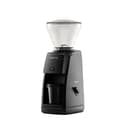 Best overall · Electric, hopper-fed 40 mm Etzinger M2 conical · 40 settings split 1-20 espresso / 21-40 filter · factory-calibrated · 300 g hopper, 120 g bin · 70 W, 550 RPM · 1-year warranty Fine, small steps exactly where moka grind lives — plus a filter range. | Fine, small steps exactly where moka grind lives — plus a filter range.40 mm Etzinger M2 conical · 40 settings split 1-20 espresso / 21-40 filter · factory-calibrated · 300 g hopper, 120 g bin · 70 W, 550 RPM · 1-year warranty | $199.95In stock, checked October 17, 2026 Check Price on Amazon |
| 2 | 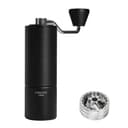 Best under $100 · Budget 38 mm S2C660 stainless conical · ESP dial, 0.0233 mm per click, 30 clicks per rotation · 20 g catch cup · no published warranty The cheapest burr grinder we would use for moka — buy the ESP dial. | The cheapest burr grinder we would use for moka — buy the ESP dial.38 mm S2C660 stainless conical · ESP dial, 0.0233 mm per click, 30 clicks per rotation · 20 g catch cup · no published warranty | $99.00In stock, checked October 17, 2026 Check Price on Amazon |
| 3 | 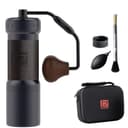 #3 1Zpresso K-Ultra Manual Coffee Grinder Best all-rounder · Hand, all-round Stainless conical 'K Burr' set · external dial, 20 microns per click, 100+ clicks per rotation · 35-40 g magnetic catch cup · 700 g · case included Covers moka plus pour over, French press and travel. | Covers moka plus pour over, French press and travel.Stainless conical 'K Burr' set · external dial, 20 microns per click, 100+ clicks per rotation · 35-40 g magnetic catch cup · 700 g · case included | $259.00In stock, checked October 17, 2026 Check Price on Amazon |
| 4 | 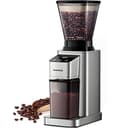 #4 SHARDOR Conical Burr Coffee Grinder Cheapest electric · Under $100 Conical burrs (not blades) · multiple grind settings · built-in timer · no published burr diameter If you will not grind by hand and the budget stops here. | If you will not grind by hand and the budget stops here.Conical burrs (not blades) · multiple grind settings · built-in timer · no published burr diameter | $69.98In stock, checked October 17, 2026 Check Price on Amazon |
| 5 | 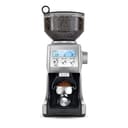 #5 Breville Smart Grinder Pro (BCG820) Most repeatable dose · Mid Stainless conical (no published diameter) · 60 stepped settings · grind time programmable in 0.2 s steps · 18 oz hopper · 165 W Programmable dose by time, and 60 steps across the whole range. | Programmable dose by time, and 60 steps across the whole range.Stainless conical (no published diameter) · 60 stepped settings · grind time programmable in 0.2 s steps · 18 oz hopper · 165 W | $199.95In stock, checked October 17, 2026 Check Price on Amazon |
The four picks
Baratza Encore ESP — the right steps in the right place
| Type | Electric |
|---|---|
| Burrs | 40 mm conical steel (M2), made by Etzinger in Liechtenstein |
| Adjustment | 40 stepped settings, adjusted by twisting the hopper. Dual range: 1-20 espresso, 21-40 filter. |
| Stepless? | No — it clicks between steps (most grinders described as 'stepless' online aren't) |
| Good for espresso? | Yes, and it is the headline use — Baratza: 'delivers the grind resolution you need to brew creamy, syrupy shots of espresso' |
| Capacity | 300 g hopper, 120 g grounds bin |
| Motor | 70 W, 550 RPM. Grinds 1.3-2.2 g/sec. |
| Dimensions | 13 x 15 x 34 cm (W x D x H) |
| Weight | 7 lb (3.1 kg) |
| Warranty | 1 year |
Who it is for: the moka drinker who wants an electric grinder, a numbered setting to return to, and a grinder that will outlive the pot.
Baratza's split dial is the quiet reason this is the pick. Settings 1-20 are fine micro-steps intended for espresso, and moka grind sits just at the coarse end of that band — so you are adjusting in small increments precisely where you need to be, rather than stepping over the target. Settings 21-40 then cover drip and French press for the days you are not using the moka. The burrs are published (40 mm conical steel M2, made by Etzinger in Liechtenstein), every unit is factory-calibrated, and Baratza publishes parts and repair guides.
The honest cons. Stepped rather than stepless, so occasionally the setting you want sits between two clicks — less of a problem for moka than for espresso. At 70 W and 550 RPM it grinds 1.3-2.2 g per second, which is leisurely. And it is hopper-fed, so some coffee stays in the machine between sessions.
Timemore Chestnut C3 ESP — the cheapest one worth owning
| Type | Manual hand grinder |
|---|---|
| Burrs | 38 mm S2C660 conical, stainless steel, CNC-machined |
| Adjustment | The ESP dial gives 0.0233 mm per click (30 clicks per rotation). The standard C3's 'Classic' dial is nearly four times coarser at 0.0833 mm per click. For espresso that difference is the entire ballgame — make sure you are buying the ESP. |
| Stepless? | No — it clicks between steps (most grinders described as 'stepless' online aren't) |
| Good for espresso? | Yes, with the ESP dial — Timemore: 'ESP and ESP Pro models feature finer control for espresso dialing' |
| Capacity | 20 g catch cup |
| Dimensions | Not published by Timemore. |
| Weight | Not published by Timemore. (The 530 g figure you'll see quoted everywhere comes from retailers, not from Timemore.) |
| Warranty | Not published — timemore.com has no warranty page at all. |
Who it is for: the buyer who wants to stop using pre-ground coffee today without spending much, and brews one or two pots a day.
A 38 mm S2C660 stainless conical burr and a dial that moves 0.0233 mm per click is more grinder than the price suggests, and for moka it is plenty — you are not fighting for the last few microns the way an espresso drinker is. A 20 g catch cup covers a standard three-cup moka dose comfortably. Buy the ESPversion: the standard C3's "Classic" dial is nearly four times coarser at 0.0833 mm per click, which makes finding the moka band fiddlier than it needs to be.
The honest cons. Timemore publishes no warranty page at all, and no weight or dimensions for this grinder — the 530 g figure you will see quoted comes from retailers. And it is a hand grinder: one pot is pleasant, three is a workout.
1Zpresso K-Ultra — if the moka is one of several brewers
| Burrs | Stainless conical, 1Zpresso's 'K Burr' set |
|---|---|
| Adjustment | External dial, 20 microns per click, more than 100 clicks per rotation |
| Stepless | No — clicked |
| Capacity | 35-40 g magnetic catch cup |
| Weight | 700 g |
| Warranty | 1 year limited |
| In the box | Carrying case included |
Who it is for: the household where the moka shares a shelf with a V60, a French press and a suitcase.
Twenty microns per click with more than a hundred clicks per rotation is the specification that makes this grinder flexible: moka, pour over and French press are all a couple of turns apart on a numbered external dial, so you can note a setting per brewer and move between them without ceremony. The included case makes it the travel answer too — a moka pot and a hand grinder is a complete coffee kit that fits in a carry-on.
The honest cons. It costs more than the pot it is grinding for, several times over. And it is still a hand grinder, with the effort that implies.
SHARDOR — the budget electric, with caveats
Who it is for: the buyer who will not grind by hand and whose budget stops well short of the Baratza.
This is the sub-$100 electric we would point a moka owner at, for one structural reason: it has conical burrs rather than blades, plus multiple settings and a timer. That puts it ahead of every blade grinder at the price, and for moka — which is more forgiving than espresso — it is a workable tool.
The honest cons.Its adjustment is coarser than a dedicated espresso grinder's, it is happiest at drip and French press, and no burr diameter is published for it. Expect to land in the moka band rather than fine-tune within it. If you can stretch to the Baratza, do.
Where to start on each grinder
We will not invent a setting number per grinder, because the right number depends on your beans, their roast date and your pot — and because a published dial number from us would be a guess dressed up as data. What we can give you is the method:
- Start one or two steps coarser than your espresso setting, or three to four steps finer than your drip setting, depending on which you know.
- Fill the basket level and do not tamp. If the brew stalls or tastes harsh and bitter, go coarser. If it runs fast, thin and sour, go finer.
- Change one thing at a time, and note the setting. On the Baratza and the Breville you have a number; on the hand grinders you have clicks from zero.
- The Breville Smart Grinder Pro adds a programmable grind time in 0.2-second increments, which is the easiest way to get the same dose into the basket every morning.
Breville publishes 60 settings spanning "the finest espresso to the coarsest French Press grind," which comfortably includes the moka band, and both portafilter cradles are in the box if you also own an espresso machine. The honest caveat: Breville publishes no burr diameter for it anywhere, and dosing by time drifts as beans age and the hopper empties.
The pot itself
If you are buying the grinder and the pot together, the classic is the classic for a reason — we cover sizing, the aluminium-versus-steel question and the pressure-valve variants in the moka pot guide. One sizing note worth repeating: moka pots are sold by "cups" of about 50 ml, so a six-cup pot makes roughly 300 ml, and a pot brews properly only when the basket is full. Buy the size you actually drink.
Which one for which buyer
| If this is you | Buy | Because |
|---|---|---|
| The moka is your main brewer and you want electric | Baratza Encore ESP | Fine micro-steps right where moka grind sits, plus a filter range. |
| You are moving off pre-ground today, cheaply | Timemore C3 ESP | Real conical burrs and a fine dial under $100. |
| You also brew V60 and French press | 1Zpresso K-Ultra | 100+ clicks per rotation covers every method on a numbered dial. |
| You travel with the moka pot | 1Zpresso K-Ultra | Case included, 700 g, no power needed. |
| You refuse to grind by hand, on a budget | SHARDOR | Conical burrs and a timer, with coarser adjustment. |
| You want the same dose every single morning | Breville Smart Grinder Pro | Programmable grind time in 0.2-second increments. |
| You also own an espresso machine | Encore ESP or Smart Grinder Pro | Both cover espresso and moka; the Breville grinds into a portafilter. |
| You were about to buy a blade grinder | None of the above — but not that | An untamped basket cannot fix an uneven grind. |
The verdict
The Baratza Encore ESP is the best grinder for a moka pot because its dial is divided in exactly the right place: fine, small steps across 1-20 where moka grind lives, coarser steps across 21-40 for drip and press. Add factory calibration, published Etzinger burrs and real repair documentation, and it is a grinder you will still be using long after this pot is scorched.
On a budget, the Timemore C3 ESP is the honest answer and the single biggest upgrade available to a moka drinker who currently buys pre-ground. If the moka is one brewer among several, the 1Zpresso K-Ultra covers them all from one numbered dial. And if you will not grind by hand, the SHARDOR is the cheapest burr grinder we would accept here — with coarser adjustment than anything above it.
If this page has you wondering whether to go further and buy a real espresso machine, the honest comparison is in espresso machine vs moka pot.
What we know, and how we know it
What we did
- Took the specs from the manufacturer's own documentation — Baratza's Encore ESP product page, Timemore's Chestnut C3 series specifications, 1Zpresso's K-Ultra product page and Breville's BCG820 product page. Not from a retailer listing, and not from another blog.
- Priced it from Amazon's API, with the date we checked shown next to the number. If that price is more than 48 hours old, this page stops showing a number at all rather than show you a wrong one.
- Formed a verdict from those specs, the price, and what owners publicly report.
Where we hedged, and why
We have not brewed with these grinders side by side, we run no lab, and we have measured no particle distributions. Every specification here is the manufacturer's: the 1-20 / 21-40 split and the 40 mm Etzinger M2 burrs from Baratza, the 0.0233 mm ESP click and 38 mm S2C660 burr from Timemore, 20 microns per click and 100+ clicks per rotation from 1Zpresso, and 60 settings with 0.2-second grind-time steps from Breville.
We deliberately publish no grinder setting numbers for moka. The right click or setting depends on your beans, their roast date and your pot, and a number from us would be a guess presented as data. Instead we give you the direction to move and the taste signals to move on. Breville publishes no burr diameter for the BCG820 and SHARDOR publishes none for its grinder, so neither is compared on burr size. The 1-2 bar figure for moka brewing and the 9 bar espresso reference are standard published descriptions of the two methods, not measurements we took. No price appears in our prose; every number here is live from Amazon with the date it was checked.
What we did not do
We do not run a lab. We have not pulled thousands of shots on this machine, and we are not going to pretend otherwise. We have not used this unit ourselves. Everything above is sourced research, and it is labeled as such. Where we have used a machine, we say so and show it.
How we're paid
If you buy through a link on this page, we earn a commission. It costs you nothing extra and it does not change what we recommend — we link to the better option for the buyer even when it earns us less. See how we review and our full disclosure.
Frequently asked questions
What grind size is best for a moka pot?
Finer than drip, coarser than espresso. A moka pot brews at roughly one to two bar rather than the nine bar of an espresso machine, so an espresso-fine grind chokes the basket or forces water around the edges, while a drip grind runs through too fast and tastes thin. Fill the basket level and never tamp it.
Can I use espresso grind in a moka pot?
You can, but it is usually too fine. Espresso grind in a moka pot tends to stall the brew, push water around the puck instead of through it, or over-extract into something harsh and bitter. If you only have one grinder and it is set for espresso, go two or three steps coarser for the moka.
Do I need a burr grinder for a moka pot?
It matters more than people assume. You cannot tamp a moka basket, so the grounds have to sit evenly on their own — and a blade grinder produces dust and boulders in the same batch, which channels. A burr grinder sets a gap every bean passes through. The cheapest burr grinder worth owning here is the Timemore C3 ESP; the cheapest electric is the SHARDOR.
Can one grinder do both moka and espresso?
Yes, and it is an easier pairing than espresso plus pour over, because the two grinds sit close together. The Baratza Encore ESP is the clearest example: its fine 1-20 range covers espresso at one end and moka at the other, with small steps throughout. The Breville Smart Grinder Pro's 60 settings span the whole range too.
How much coffee does a moka pot need?
As much as fills the basket level — the pot sets the dose, not you. That is why a moka pot only brews properly when it is the right size for what you drink: a six-cup pot makes roughly 300 ml, since moka 'cups' are about 50 ml. A 20 g catch cup, like the Timemore's, covers a three-cup dose comfortably.
Should I buy a cheap electric or a good hand grinder?
For moka specifically, either works, which is not true of espresso. The hand grinder gives you better burrs and finer adjustment per dollar; the electric saves you the effort. If you brew one or two pots a day, the Timemore C3 ESP is the better grinder for the money. If you brew more than that, or simply will not turn a handle, the SHARDOR is the honest budget electric.
Sources
Specs come from the manufacturer's own documentation. Prices come from Amazon's API. Where a claim comes from what owners report, we link the thread and say so.
- Baratza Encore ESP product page (40 mm Etzinger M2 conical; 40 settings split 1-20 espresso / 21-40 filter; factory-calibrated; 70 W, 550 RPM)
- Timemore Chestnut C3 series official specifications (38 mm S2C660 conical; ESP dial 0.0233 mm per click against the Classic dial's 0.0833 mm; 20 g catch cup)
- 1Zpresso K-Ultra official product page (20 microns per click, 100+ clicks per rotation, 35-40 g catch cup, case included)
- Breville BCG820 product page (60 settings from finest espresso to coarsest French press; grind time programmable in 0.2 s increments; no burr diameter published)
- National Coffee Association — how to brew coffee (grind guidance by brew method)
Keep reading
- How to brew with a moka potThe method itself, including why you pull it off the heat early.
- Grind size chartWhere moka sits relative to espresso, drip and French press.
- Burr vs blade grindersWhy an untamped basket makes grind uniformity matter.
- Espresso machine vs moka potIf this page has you considering the upgrade.
- The best grinders under $100The budget end of this list, in full.
- The best grinder for French pressThe coarse-end version of this page.