
Grinders · Reference
Coffee Grind Size Chart, by Brew Method
From espresso to cold brew, finest to coarsest, with the honest caveat nobody prints on a chart: no two grinders agree on what setting 12 means.
The short answer
Finest to coarsest: espresso, then moka pot, then AeroPress, then pour over, then drip, then French press, then cold brew coarsest of all. Contact time is what sets the order — the longer water touches coffee, the coarser the grind. Use the chart for direction, then adjust by taste.
We earn a commission if you buy through a link on this page. It costs you nothing extra and it does not change what we recommend. Full disclosure.
Key takeaways
- Contact time sets grind size. The longer water sits on coffee, the coarser the grind — which is why espresso (25 seconds) is finest and cold brew (12 hours or more) is coarsest.
- The order, finest first: espresso, moka pot, AeroPress, pour over, drip, French press, cold brew.
- Grinder settings are not transferable."Setting 12" means nothing across brands. Use the chart for direction and your own dial for distance.
- Taste is the real instrument: sour and thin means go finer, bitter and harsh means go coarser.
- A grinder that covers the whole chart needs a maker-claimed range at both ends — the Baratza Encore ESP, Breville Smart Grinder Pro and 1Zpresso K-Ultra all do.
The grind size chart
Ordered finest to coarsest. The texture column is a descriptive comparison, not a measurement — see why micron numbers don't transfer below for the reason we do not print a micron range per row.
| Brew method | Grind | Feels like | Why |
|---|---|---|---|
| Espresso | Fine | Powdered sugar, just short of flour — it clumps when you squeeze it | Pressurised water crosses a compressed puck in about 25 seconds and needs resistance. |
| Moka pot | Fine-medium | Table salt | Low steam pressure, short contact — finer than filter, coarser than espresso. |
| AeroPress | Fine to medium-coarse | Anything from table salt to sea salt, depending on your recipe | The only method where you choose the contact time, so the grind follows the recipe. |
| Pour over (V60, Kalita, Chemex) | Medium | Coarse sand | Gravity drains the bed over two to four minutes; the grind controls the drawdown. |
| Drip / auto filter | Medium | Coarse sand, a touch coarser for a flat basket | Similar contact time to pour over, but the machine controls the pour, not you. |
| French press | Coarse | Sea salt or breadcrumbs | Four minutes of full immersion, and a mesh filter that lets fines straight into the cup. |
| Cold brew | Coarsest | Cracked peppercorns | Twelve to twenty-four hours of immersion; anything fine turns it muddy and bitter. |
Why the order is what it is
There is one idea underneath the whole chart, and once you have it you never need to look the chart up again: grind size is how you control extraction speed. Grinding finer makes more surface area and slows water down; grinding coarser makes less surface area and lets water through faster. So every brew method needs a grind that balances against its own contact time and pressure.
Espresso has the shortest contact time of anything — roughly 25 to 30 seconds — and the highest pressure, so it needs the finest grind to create enough resistance and extract enough in that window. French press has the longest contact time of the hot methods, four minutes of complete immersion, so it needs a coarse grind or it over-extracts into bitterness. Cold brew pushes that to twelve hours or more and therefore goes coarsest of all. Everything else lands in between on the same logic.
That is also why you cannot fix a bad grinder by adjusting the recipe. If a grinder produces both dust and boulders in the same dose, the dust over-extracts while the boulders under-extract, and you get bitterness and sourness in the same cup no matter where you set the dial — which is the entire argument in burr vs blade.
Each method, in detail
Espresso — fine
The finest grind in normal use and the least forgiving. Squeeze a correct espresso grind between your fingers and it holds together slightly, like powdered sugar. A hair too coarse and the shot gushes thin and sour in 15 seconds; a hair too fine and it chokes to a drip and tastes harsh. This is the only method where adjustment resolution really matters, and it is why espresso grinders are sold on microns per click. Dialing it in is a routine rather than a number — ours is in how to dial in espresso, and the common failure modes are in why your shot is choking and why espresso is pouring too fast.
Moka pot — fine-medium
A moka pot builds modest steam pressure, nothing like an espresso machine's, so it wants a grind between espresso and filter: about table salt. Grind it at espresso fineness and the pot struggles and the coffee turns bitter and sulphurous; grind it at filter coarseness and it runs thin. The method guide is at moka pot, properly, and if you were hoping a moka pot replaces an espresso machine, the honest answer is in espresso machine vs moka pot.
AeroPress — your choice
The AeroPress is the exception that proves the rule. Because you decide how long the coffee steeps before you press, you can run a fine grind with a short steep or a medium-coarse grind with a long one, and both work. Treat grind and time as one dial with two ends: finer needs shorter, coarser needs longer. Start where the recipe you are following says and move from there. Our guide is at the AeroPress method, and how it compares to the other immersion brewer is in AeroPress vs French press.
Pour over — medium
Coarse sand, and then adjust by how fast the bed drains. If your V60 finishes in 90 seconds and tastes thin, go finer; if it stalls past four minutes and tastes harsh, go coarser. Flat- bottom brewers like the Kalita Wave generally prefer a touch finer than a conical V60, and a thick-filter Chemex a touch coarser — but start medium and let the drawdown tell you. The pour-over guide covers the brewers, and the best grinder for pour over covers the grinders.
Drip / auto filter — medium
Essentially the pour-over grind, because the contact time is similar; a flat basket usually wants a shade coarser than a cone. The difference is that the machine controls the water, so the grind is the main variable you still own. If your drip coffee is weak, go finer before you add more coffee.
French press — coarse
Sea salt, not sand. Two reasons, and the second is the one people forget. First, four minutes of full immersion over-extracts a fine grind into bitterness. Second, a press uses a metal mesh rather than paper, so fines pass straight into the cup — a grind with too much dust gives you sludge at the bottom and a gritty mouthful at the end. The French press guide has the method.
Cold brew — coarsest
Coarser than French press, because the immersion is measured in hours rather than minutes. Cracked-peppercorn coarse is the target. Fine grinds in cold brew do not just over-extract, they make filtering miserable and leave the concentrate cloudy and muddy. Our cold brew guide covers the ratio and the steep.
Why micron numbers don't transfer
Most grind charts you will find online print a micron range for each brew method. We do not, and the reason is worth understanding because it will save you money and frustration.
There is no cross-brand standard for grinder settings. Setting 12 on one grinder is not setting 12 on another; two grinders with identical published ranges will sit in different places on this chart at the same number. What makers do publish is how far the burrs move per click of their own adjustment, and those figures are real and useful: 1Zpresso states 8 microns per click for the J-Ultra and 20 for the K-Ultra, and Timemore states 0.0233 mm per click for the C3 ESP dial. Those tell you the resolution of a given grinder. They do not tell you the absolute particle size at a given number, and nobody publishes a calibration between brands.
And particle size is a distribution, not a value.Even a very good grinder produces a spread of particle sizes around a target, not one size. A single micron figure for "pour over" implies a precision that does not exist outside a lab with a particle analyser — which we do not have, and neither does the site that printed the number you read.
How to adjust by taste
Two symptoms, two directions. This works for every brew method on the chart.
Thin, sour, sharp, watery — go finer. The water got through too quickly and did not extract enough. On espresso the shot will also have run fast; on pour over the bed will have drained early.
Harsh, bitter, drying, hollow — go coarser. The water spent too long in contact and pulled out too much. On espresso the shot will have dripped slowly; on pour over the brew will have stalled.
Change one thing at a time, and change it meaningfully. Nudging a stepped grinder by a single click rarely produces a difference you can taste outside the espresso range; two or three clicks will. Keep the dose and the water weight fixed while you do it — this is what a coffee scale is actually for, and the reason we recommend one before any grinder upgrade. If your espresso tastes wrong in a way grind alone will not fix, start with why your espresso tastes sour or why your espresso is bitter.
What a grinder needs to cover the chart
If you brew more than one way, you need a grinder whose usable range spans the chart rather than one optimized for a single row of it. Three things to check before you buy:
A maker-claimed range at both ends.Not an inference from the number of settings — an actual statement. Baratza splits the Encore ESP's dial into an espresso band and a filter band; Breville claims the Smart Grinder Pro runs "from the finest espresso to the coarsest French Press grind". Those are the claims worth buying on.
Settings you can read and return to. Switching between methods means switching back, so a numbered dial you can return to exactly is worth more day to day than stepless adjustment. Stepless is an espresso-specialist feature; stepped vs stepless explains when it matters.
Burrs, and enough range per turn. Burrs are non-negotiable. And if you move between espresso and French press regularly, a grinder that crosses the range in a couple of turns beats one that needs twenty — which is the practical case for a wider-stepping grinder over a hair-fine one if filter is in your week.
Three grinders that cover the whole chart
These are the three on this site whose makers claim a usable range at both ends of the chart. All three are stepped — deliberately, because repeatable numbers matter more than infinite adjustment when you are switching methods.
Grinders that span the chart
Every pick on this page in one view, with the live Amazon price and stock on each row. Specs are the figures the maker or the listing publishes — nothing measured or scored by us. Prices are read from Amazon's API and were last checked October 5, 2026; where we have no verified price, the row says so rather than show you an old number.
| # | Grinder | Range the maker claims | Price & availability |
|---|---|---|---|
| 1 | 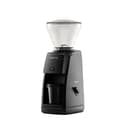 Best all-round · Electric, hopper-fed 40 mm conical steel (M2, Etzinger) · 40 stepped settings, 1-20 espresso / 21-40 filter · 300 g hopper · 70 W at 550 rpm · factory-calibrated · 1-year warranty Two labelled bands: a fine espresso range and a coarser filter range on one dial. | Two labelled bands: a fine espresso range and a coarser filter range on one dial.40 mm conical steel (M2, Etzinger) · 40 stepped settings, 1-20 espresso / 21-40 filter · 300 g hopper · 70 W at 550 rpm · factory-calibrated · 1-year warranty | $199.95In stock, checked October 5, 2026 Check Price on Amazon |
| 2 | 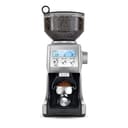 #2 Breville Smart Grinder Pro (BCG820) Most settings · Electric, programmable Stainless conical burrs (diameter not published by Breville) · 60 stepped settings · grind time programmable in 0.2-second steps · 18 oz hopper · 165 W · 1-year warranty Breville claims “the finest espresso to the coarsest French Press grind” across 60 steps. | Breville claims “the finest espresso to the coarsest French Press grind” across 60 steps.Stainless conical burrs (diameter not published by Breville) · 60 stepped settings · grind time programmable in 0.2-second steps · 18 oz hopper · 165 W · 1-year warranty | $159.95In stock, checked October 5, 2026 Check Price on Amazon |
| 3 | 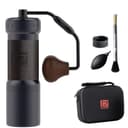 Best hand grinder · Hand, all-round Stainless conical “K Burr” · 20 microns per click, 100+ clicks per rotation · 35-40 g catch cup · 700 g · 1-year limited warranty · carrying case Wide span per rotation — you cross from filter to coarse in a fraction of a turn. | Wide span per rotation — you cross from filter to coarse in a fraction of a turn.Stainless conical “K Burr” · 20 microns per click, 100+ clicks per rotation · 35-40 g catch cup · 700 g · 1-year limited warranty · carrying case | $259.00In stock, checked October 5, 2026 Check Price on Amazon |
Baratza Encore ESP — the labelled bands
| Type | Electric |
|---|---|
| Burrs | 40 mm conical steel (M2), made by Etzinger in Liechtenstein |
| Adjustment | 40 stepped settings, adjusted by twisting the hopper. Dual range: 1-20 espresso, 21-40 filter. |
| Stepless? | No — it clicks between steps (most grinders described as 'stepless' online aren't) |
| Good for espresso? | Yes, and it is the headline use — Baratza: 'delivers the grind resolution you need to brew creamy, syrupy shots of espresso' |
| Capacity | 300 g hopper, 120 g grounds bin |
| Motor | 70 W, 550 RPM. Grinds 1.3-2.2 g/sec. |
| Dimensions | 13 x 15 x 34 cm (W x D x H) |
| Weight | 7 lb (3.1 kg) |
| Warranty | 1 year |
The most chart-friendly grinder here, because Baratza has done the mapping for you: settings 1-20 are fine micro-steps for espresso and 21-40 are coarser macro-steps for filter, on a 40 mm Etzinger-made conical burr set that is calibrated at the factory. If you pull shots on weekdays and brew a press at the weekend, that split dial is exactly the right tool. Who it is for: the multi-method household that wants a motor and a hopper. The trade-off is that it is stepped and adjusted by twisting the hopper, and that hopper-stored beans stale faster than beans in a bag.
Breville Smart Grinder Pro — the widest span
| Type | Electric |
|---|---|
| Burrs | Stainless steel conical |
| Adjustment | 60 stepped settings. Grind time is separately programmable in 0.2-second increments. |
| Stepless? | No — it clicks between steps (most grinders described as 'stepless' online aren't) |
| Good for espresso? | Yes — Breville: '60 precise grind settings from the finest espresso to the coarsest French Press grind' |
| Capacity | 18 oz (Breville publishes ounces only — no gram figure exists) |
| Motor | 165 W. RPM not published. |
| Dimensions | 8.5" W x 6.3" D x 15.3" H |
| Weight | 6.39 lb (2.9 kg) |
| Warranty | 1 year |
Sixty settings and an explicit maker claim to span the whole chart, plus a grind timer programmable in 0.2-second steps so you can save a dose per method rather than weighing every time. It also grinds straight into a portafilter, with both 50-54 mm and 58 mm cradles in the box. Who it is for: someone who brews three or four ways and wants a one-button dose for each. The honest limits: Breville publishes no burr diameter for this grinder anywhere, so we will not state one, and dosing by time is less precise than dosing by weight because bean density varies.
1Zpresso K-Ultra — the hand grinder that spans it
| Burrs | Stainless conical, 1Zpresso’s “K Burr” set |
|---|---|
| Adjustment | External dial, 20 microns per click, more than 100 clicks per rotation |
| Capacity | 35–40 g magnetic catch cup |
| Weight | 700 g |
| Warranty | 1 year limited |
1Zpresso's declared all-rounder, and the one to pick if you would rather not own a motor. At 20 microns per click with more than 100 clicks per rotation, it crosses the filter half of the chart in a fraction of a turn and reaches the espresso end if you want it. Who it is for: the brewer who switches methods and values a small, numbered, packable grinder. The trade-off is the cranking, and that 20-micron steps are coarse for daily espresso — if espresso is your main drink, read J-Ultra vs K-Ultra first.
The short version
Finest to coarsest: espresso, moka pot, AeroPress, pour over, drip, French press, cold brew. The order comes from contact time — the longer water sits on the grounds, the coarser you grind. Use the chart to know which direction to move and roughly how far; use your own taste to find the exact setting, because no two grinders agree on numbers and nobody publishes a calibration between them.
If one grinder has to cover several rows of the chart, buy one whose maker actually claims a range at both ends: the Baratza Encore ESP with its labelled espresso and filter bands, the Breville Smart Grinder Pro with 60 steps and a dose timer, or the 1Zpresso K-Ultra if you would rather crank than plug in. And whichever you pick, write your settings down — a notebook beside the grinder beats any chart on the internet, including this one. More on the grinders hub.
What we know, and how we know it
What we did
- Took the specs from the manufacturer's own documentation — Baratza, Breville and 1Zpresso product pages, plus SCA and NCA brewing guidance. Not from a retailer listing, and not from another blog.
- Priced it from Amazon's API, with the date we checked shown next to the number. If that price is more than 48 hours old, this page stops showing a number at all rather than show you a wrong one.
- Formed a verdict from those specs, the price, and what owners publicly report.
Where we hedged, and why
We deliberately publish no micron range per brew method. There is no cross-brand standard that maps a grinder setting to an absolute particle size, particle size is a distribution rather than a single value, and we have no particle analyser. The texture comparisons in the chart — table salt, coarse sand, sea salt — are descriptive references to help you recognise a grind in the hand, not measurements. The ordering and the reasoning behind it follow from how each brew method works: contact time and pressure.
The only micron figures on this page are ones a manufacturer publishes about its own adjustment resolution — 1Zpresso's 8 and 20 microns per click, Timemore's 0.0233 mm per click — and we are explicit that those describe a grinder's step size, not an absolute grind size.
We have not used the three grinders recommended here; two are in our spec database and their tables are generated from it, and the K-Ultra's figures are rendered inline from 1Zpresso's product page. Range claims are attributed to the makers who make them. Breville publishes no burr diameter for the BCG820, so we state none. No price appears in our prose — every number is live from Amazon with the date it was checked.
What we did not do
We do not run a lab. We have not pulled thousands of shots on this machine, and we are not going to pretend otherwise. We have not used this unit ourselves. Everything above is sourced research, and it is labeled as such. Where we have used a machine, we say so and show it.
How we're paid
If you buy through a link on this page, we earn a commission. It costs you nothing extra and it does not change what we recommend — we link to the better option for the buyer even when it earns us less. See how we review and our full disclosure.
Frequently asked questions
What is the correct grind size for each brew method?
From finest to coarsest: espresso is fine (like powdered sugar), moka pot fine-medium (table salt), AeroPress anywhere from fine to medium-coarse depending on your steep time, pour over and drip medium (coarse sand), French press coarse (sea salt), and cold brew coarsest of all. The order follows contact time: the longer water stays in touch with the coffee, the coarser you grind to avoid over-extraction.
Why don't you give micron numbers for each grind size?
Because they would imply a precision that does not exist. There is no cross-brand standard mapping a grinder setting to an absolute particle size, so the same number on two grinders lands in different places. Particle size is also a distribution rather than a single value — even a good grinder produces a spread. The micron figures makers do publish, like 1Zpresso's 8 microns per click, describe a grinder's adjustment resolution, not an absolute grind size.
How do I know if my grind is too fine or too coarse?
Taste it. Thin, sour, sharp or watery means the water got through too fast and did not extract enough — go finer. Harsh, bitter, drying or hollow means it spent too long in contact — go coarser. Change one variable at a time and move meaningfully: outside the espresso range, a single click on a stepped grinder rarely produces a difference you can taste, while two or three will.
Can I use the same grind size for espresso and French press?
No, and it is the single biggest grind mistake. Espresso needs a fine grind because pressurised water crosses a compressed puck in about 25 seconds and needs resistance; French press needs a coarse one because the coffee sits in full immersion for four minutes and its metal mesh lets fines straight into the cup. Using an espresso grind in a press gives you bitter, gritty, sludgy coffee.
What grind size does a moka pot need?
Fine-medium — roughly table salt, between espresso and filter. A moka pot builds modest steam pressure, nothing like an espresso machine's nine bars, so an espresso-fine grind makes it struggle and turns the coffee bitter, while a filter-coarse grind brews thin and weak. Start at table salt coarseness and adjust by taste from there.
Which grinder covers every brew method?
Look for a grinder whose maker explicitly claims a usable range at both ends rather than inferring it from the number of settings. The Baratza Encore ESP splits its 40 settings into an espresso band (1-20) and a filter band (21-40); Breville claims the Smart Grinder Pro spans 'the finest espresso to the coarsest French Press grind' across 60 steps; and the 1Zpresso K-Ultra crosses the filter range in a fraction of a dial rotation by hand.
Sources
Specs come from the manufacturer's own documentation. Prices come from Amazon's API. Where a claim comes from what owners report, we link the thread and say so.
- National Coffee Association — how to brew coffee
- Specialty Coffee Association — coffee research and standards
- Baratza Encore ESP product page (dual range: settings 1-20 espresso, 21-40 filter; 40 mm Etzinger M2 conical)
- Breville BCG820 product page (60 settings “from the finest espresso to the coarsest French Press grind”, programmable grind time)
- 1Zpresso K-Ultra — official product page (20 microns per click, 100+ clicks per rotation)
- 1Zpresso J-Ultra — official product page (8 microns per click)
- Timemore Chestnut C3 series — official specifications (ESP dial at 0.0233 mm per click)
Keep reading
- How to dial in espressoThe routine for the finest row of the chart, where grind matters most.
- The best grinder for pour overWhat to buy for the medium end of the chart, hand or electric.
- Burr vs blade grindersWhy a blade grinder can't hit any row on this chart reliably.
- Stepped vs stepless grindersWhen infinite adjustment earns its money, and when numbered clicks are better.
- Coffee scalesFix dose and water weight before you start moving the grind, or you're chasing two variables.
- Cold brew at homeThe coarsest row on the chart, and the ratio that goes with it.