
Guides · Brew methods
AeroPress vs French Press
Both steep coffee in water and both are called immersion brewers. One pushes the result through paper, the other through a metal mesh — and almost every difference between them comes from that single choice.
The short answer
Buy the AeroPress if you want a clean, grit-free cup, brew for one, or travel — the paper filter and short brew do that. Buy a French press if you brew for two or more, want a heavier body, and prefer four minutes of hands-off steeping to pressing by hand. The beans can be identical.
Key takeaways
- Both are immersion brewers — the coffee steeps in the water rather than having water poured through it. That part is genuinely the same.
- The filter is the whole difference. Paper (AeroPress) traps oils and fines for a clean cup; metal mesh (French press) lets them through for a heavier, more sedimented one.
- AeroPress: one mug at a time, about two minutes, no sediment, nearly unbreakable, and the most forgiving brewer about grind size.
- French press: four mugs at a time, four minutes hands-off, heavier body, grit in the last sip, glass carafe to look after.
- Neither is espresso. Both are great coffee, and if you want crema and milk drinks you need a machine.
The short answer
Buy an AeroPress if you brew for one, want the cleanest possible cup with no grit, travel with your coffee, or want the brewer that is hardest to get wrong. Buy a French press if you brew for two or more people at once, like a heavier, rounder body in the cup, and would rather leave coffee steeping for four minutes while you do something else than stand there pressing it.
Both brew the same beans. Neither is a compromise. The honest framing is that they produce two different renderings of the same coffee, and the right one is whichever rendering — and whichever routine — you prefer.
What they have in common
More than most comparisons admit, which is why the differences are worth being precise about.
Both are immersion brewers. You combine coffee and water, you wait, you separate them. That is a fundamentally different approach from pour over, where water passes through a bed continuously and never sits — covered in the pour-over guide. Immersion tends to be more forgiving, because the whole dose steeps in the whole volume of water rather than depending on how evenly you pour.
Neither uses meaningful pressure. The AeroPress is often described as pressurised, and that overstates it considerably: pressing the plunger pushes water through the coffee and the paper, which speeds up the separation, but it is nothing like the nine bars an espresso machine applies. There is no crema and no emulsified-oil body from pressure in either brewer. If that is what you are after, see espresso vs coffee.
Both are cheap, simple and durable. Neither needs power, neither has moving parts that wear out quickly, and both will outlive most kitchen appliances.
Both work with the same grinder. Neither demands espresso-grade adjustment resolution, so a modest burr grinder serves both — see how to choose a coffee grinder.
The filter changes everything
Here is the mechanism, and once you have it you can predict every other difference on this page.
The AeroPress uses a paper micro-filter. Paper traps coffee oils and the very smallest particles — the fines — so what reaches your cup is the dissolved coffee and very little else. The consequences follow directly: a clean, bright cup; no sediment at the bottom; lighter body; and a filter you throw away, which makes cleaning trivial.
The French press uses a metal mesh. Mesh has far larger openings than paper, so oils pass straight through and so do a proportion of the fines. The consequences, again, follow directly: a heavier, rounder, more textured cup; sediment in the last mouthful; more of the coffee's oily mouthfeel preserved; and a filter you wash rather than discard.
Head to head
| AeroPress | French press | |
|---|---|---|
| Filter | Paper micro-filter (reusable metal available) | Stainless steel mesh |
| Batch size | One mug at a time | A 34 oz / 8-cup press makes about four mugs |
| Brew time | Roughly one to two minutes, including the press | About four minutes, hands-off |
| Body | Lighter and cleaner — paper traps the oils | Heavier and rounder — oils pass through the mesh |
| Sediment | None to speak of | Some, and it collects in the last mouthful |
| Grind latitude | Wide — fine to medium-coarse, depending on your steep | Narrow — coarse, or it turns bitter and gritty |
| Effort at the end | You press it by hand | You plunge gently; mostly waiting |
| Cleaning | Eject the puck, rinse — about ten seconds | Scoop or rinse wet grounds out, wash the mesh |
| Durability | Plastic, essentially unbreakable | Usually a glass carafe — breakable, but parts are replaceable |
| Consumables | Paper filters, one per brew | None |
| Travel | Excellent, especially the Go version | Poor — glass in a bag is a matter of when, not whether |
What each one tastes like
We will describe this in terms of what the equipment does rather than pretending to a blind tasting we did not run.
The AeroPress cup is clean. With oils and fines held back by paper, what comes through reads as clearer and brighter — closer to a good pour over than to a press. Many people find an interesting single-origin coffee more legible this way: the acidity and the aromatics are less buried under body.
The French press cup is heavy. Oils through the mesh give a rounder, fuller, slightly viscous mouthfeel, and the suspended fines add texture. For a darker roast or a chocolatey blend, that weight is exactly the point. It also makes a press a kinder brewer for a coffee you would not call delicate.
If you want to try both characters with one brewer, the AeroPress is the one that flexes: a reusable metal filter is available for it, which lets more oil and fines through and produces a heavier, more press-like result. The French press cannot go the other way — you cannot make a mesh behave like paper.
Grind, dose and effort
Grind.French press wants coarse — sea salt rather than sand — and it is fairly unforgiving about it. The AeroPress works anywhere from fine to medium-coarse, because you control the steep time: finer needs shorter, coarser needs longer. Treat grind and time as one dial with two ends. That latitude is the AeroPress's great practical advantage, especially with a cheap grinder.
Dose. Both are ratio-driven brews; follow the recipe you are using and weigh the coffee and the water rather than scooping. This matters far more than which brewer you own, and it is what a coffee scale is for.
Effort. The AeroPress asks for about thirty seconds of attention at the end: you press it, with your body weight, and on a fine grind that takes real force. A French press asks for almost nothing — stir, wait four minutes, plunge gently. If you want to start coffee and walk away, the press is the one. If you want coffee in your hand ninety seconds after you start, the AeroPress is.
Cleaning. The AeroPress wins this convincingly: unscrew the cap, push the compressed puck into the bin, rinse. A French press means scooping or rinsing wet grounds out of a carafe — which is messy and, if you do it in the sink, hard on your plumbing — and then washing a three-part mesh.
What to buy
We earn a commission if you buy through a link on this page. It costs you nothing extra and it does not change what we recommend. Full disclosure.
Four brewers, two per method. All four make genuinely good coffee, and in both cases technique matters more than which model you choose.
Four brewers, compared
Every pick on this page in one view, with the live Amazon price and stock on each row. Specs are the figures the maker or the listing publishes — nothing measured or scored by us. Prices are read from Amazon's API and were last checked October 5, 2026; where we have no verified price, the row says so rather than show you an old number.
| # | Brewer | Why you'd pick it | Price & availability |
|---|---|---|---|
| 1 | 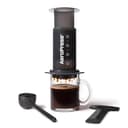 #1 AeroPress Original Coffee Press Best overall · AeroPress, home Paper micro-filter · one mug per brew · roughly 1-2 minutes · wide grind latitude · reusable metal filter available separately The cleanest cup here, the widest grind latitude, and ten-second cleaning. | The cleanest cup here, the widest grind latitude, and ten-second cleaning.Paper micro-filter · one mug per brew · roughly 1-2 minutes · wide grind latitude · reusable metal filter available separately | $39.95In stock, checked October 5, 2026 Check Price on Amazon |
| 2 | 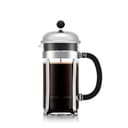 #2 Bodum Chambord French Press (34 oz) Best French press · French press, 8-cup Borosilicate glass carafe · three-part stainless mesh filter · 34 oz / 8-cup · made in Portugal · replacement beakers and filters widely available The archetype: about four mugs hands-off, and you can buy the parts that break. | The archetype: about four mugs hands-off, and you can buy the parts that break.Borosilicate glass carafe · three-part stainless mesh filter · 34 oz / 8-cup · made in Portugal · replacement beakers and filters widely available | $39.69In stock, checked October 5, 2026 Check Price on Amazon |
| 3 | 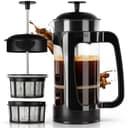 Least sediment · French press, filtered Double micro-filter catching more fines than a single mesh · glass carafe · press body with a mesh to keep clean Fixes the single most common French press complaint: grit in the last mouthful. | Fixes the single most common French press complaint: grit in the last mouthful.Double micro-filter catching more fines than a single mesh · glass carafe · press body with a mesh to keep clean | $39.94In stock, checked October 5, 2026 Check Price on Amazon |
| 4 | 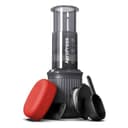 #4 AeroPress Go Travel Coffee Press Best for travel · AeroPress, travel Same brewing method as the Original · packs inside its own mug and lid · paper micro-filters Same cup, in a kit that nests and survives a bag. | Same cup, in a kit that nests and survives a bag.Same brewing method as the Original · packs inside its own mug and lid · paper micro-filters | $49.95In stock, checked October 5, 2026 Check Price on Amazon |
AeroPress Original — the one to buy
If you brew for one or two and want the cleanest cup for the least money and fuss, buy this. It is the standard version, it lives happily on a counter, and the paper filter is what delivers the grit-free clarity the method is known for. Who it is for: a single drinker, a bright single-origin coffee, a small kitchen, anyone with a cheap grinder. The honest cons: one mug at a time, and paper filters are a consumable you have to remember to restock. The method, step by step, is in the AeroPress guide.
Worth adding at the same time, because the brewer ships with a modest supply and you will get through them at one per brew. They are cheap, they last ages, and the paper is part of what gives the AeroPress its clean cup.
Bodum Chambord — the French press to buy
The archetype, and the safe right answer if you buy one press. A borosilicate glass carafe, a proper three-part stainless mesh filter, and a chrome frame that has looked the same for decades; it is made in Portugal rather than to the cheapest possible spec, and replacement beakers and filters are easy to find — which genuinely matters for an object with a glass carafe. The 34 oz / 8-cup is the standard household size, about four mugs. Who it is for: a household brewing for two or more, and anyone who likes a heavier cup. The honest cons: glass breaks, sediment is part of the deal, and the grind has to be coarse. The method is in the French press guide.
Espro P3 — if the grit is what put you off
The most common French press complaint is sediment in the bottom of the cup, and Espro built the P3 to address exactly that: a double micro-filter that catches far more fines than a single mesh, for a noticeably cleaner brew. Who it is for: someone who has tried a press, liked the body and bounced off the grit — this is the press that narrows the gap to an AeroPress without giving up the immersion routine. The honest cons: a modest premium over the Bodum, a slightly less traditional feel, and a filter assembly to keep clean.
AeroPress Go — if your coffee travels
Same method, same cup, different packaging: the Go nests inside its own mug and lid, which is the version to own if you camp, travel or want good coffee at a desk. A glass French press in a bag is a question of when, not whether, so for travel this comparison is not close. Who it is for: the traveller. The honest con: if it will live on your kitchen counter, the Original is the better buy. We put it in context with the portable espresso devices in the best portable espresso maker for travel.
Which one for which drinker
| If this is you | Buy | Because |
|---|---|---|
| You brew for yourself | AeroPress Original | One mug is exactly its batch size, and cleaning takes ten seconds. |
| You brew for two or more at once | Bodum Chambord | A 34 oz press makes about four mugs in one four-minute steep. |
| Sediment in the cup bothers you | AeroPress Original | Paper catches the fines a metal mesh lets straight through. |
| You want press body without the grit | Espro P3 | Its double micro-filter catches far more fines than a single mesh. |
| You want to start coffee and walk away | Bodum Chambord | Four minutes hands-off, then a gentle plunge. |
| Your grinder is cheap or inconsistent | AeroPress Original | The widest grind latitude of any method here, thanks to the paper filter. |
| You camp, travel or brew at a desk | AeroPress Go | It nests in its own mug and will not break in a bag. |
| You want crema, or a latte | Neither — you want espresso | Neither brewer makes pressure; a milk drink needs a machine. |
The verdict
If we had to own one, it would be the AeroPress Original. It makes the cleanest cup here, it is the most forgiving brewer there is about grind — which matters enormously if your grinder is modest — it cleans in ten seconds, and it is essentially unbreakable. The costs are honest and small: one mug at a time, paper filters to restock, and thirty seconds of pressing.
But if your kitchen makes coffee for more than one person, buy a French press and do not look back. A Bodum Chambord brews about four mugs in a single hands-off four minutes, gives you a rounder, heavier cup that suits darker roasts beautifully, and has replaceable parts. If you have tried a press and the grit in the last mouthful is what put you off, the Espro P3 is the version that fixes precisely that. And if your coffee travels, the AeroPress Go settles it.
One last honest note: neither of these is espresso, and no amount of pressing turns one into the other. If what you actually want is crema and milk drinks, start with espresso vs coffee and then upgrading from drip to espresso. More brew-method guides are on the brew methods hub.
What we know, and how we know it
What we did
- Took the specs from the manufacturer's own documentation — AeroPress's and Bodum's own sites, plus NCA and SCA brewing guidance. Not from a retailer listing, and not from another blog.
- Priced it from Amazon's API, with the date we checked shown next to the number. If that price is more than 48 hours old, this page stops showing a number at all rather than show you a wrong one.
- Formed a verdict from those specs, the price, and what owners publicly report.
Where we hedged, and why
We have not run a blind tasting of these brewers and we run no lab, so the taste descriptions here are derived from what the filters do, not from a scored comparison. Paper traps oils and fine particles and metal mesh does not — that is a property of the materials, and the cleaner-versus-heavier characterisation follows from it. We do not claim a measured extraction yield or a tasting panel result for either method.
Brew times and batch sizes are conventional figures from the makers' own instructions and standard brewing guidance, described as approximate because recipes vary. We are deliberately explicit that the AeroPress's press action is not comparable to espresso pressure, because it is not: there is no crema and no nine-bar extraction in either brewer.
Product details come from the makers: Bodum's borosilicate carafe, three-part mesh, 34 oz / 8-cup size and Portuguese manufacture; Espro's double micro-filter; AeroPress's paper micro-filters and the Go's nesting mug. None of these brewers is a pump machine, so none is in our spec database. No price appears in our prose — every number on the page is live from Amazon and carries the date it was checked.
What we did not do
We do not run a lab. We have not pulled thousands of shots on this machine, and we are not going to pretend otherwise. We have not used this unit ourselves. Everything above is sourced research, and it is labeled as such. Where we have used a machine, we say so and show it.
How we're paid
If you buy through a link on this page, we earn a commission. It costs you nothing extra and it does not change what we recommend — we link to the better option for the buyer even when it earns us less. See how we review and our full disclosure.
Frequently asked questions
Is an AeroPress better than a French press?
Neither is better — they make different coffee. The AeroPress uses a paper filter, so it gives a clean, bright, grit-free cup, brews one mug in one to two minutes, cleans in seconds and tolerates almost any grind. A French press uses a metal mesh, so it gives a heavier, rounder, slightly sedimented cup, brews about four mugs hands-off in four minutes, and needs a coarse grind. Pick by batch size and by whether you want clarity or body.
Why does the French press need a coarser grind than the AeroPress?
Two reasons. First, a press steeps for a full four minutes, and that much contact over-extracts a fine grind into bitterness. Second — the reason people forget — its metal mesh lets fine particles through into the cup, so a dusty grind means grit and sludge at the bottom. The AeroPress has a paper filter catching those fines, and you control its steep time, which is why it works across a far wider grind range.
Does an AeroPress make espresso?
No. Pressing the plunger pushes water through the coffee and the paper filter, which speeds up separation, but it is nothing like the roughly nine bars an espresso machine applies — so there is no crema and none of the emulsified-oil body pressure produces. An AeroPress makes a concentrated, clean cup of coffee, and a very good one. If you want a real latte or cappuccino, you need an espresso machine.
Which makes more coffee, an AeroPress or a French press?
A French press, by a wide margin. The standard 34 oz / 8-cup press makes roughly four mugs from one four-minute steep, while an AeroPress brews a single mug at a time. If your household makes coffee for two or more people every morning, that difference matters more than anything else on this page — brewing four AeroPress mugs in a row is a chore nobody keeps up.
How do I stop sediment in my French press coffee?
Grind coarser first — most grit comes from fines a mesh filter cannot hold back, and a coarse, even grind from a burr grinder dramatically reduces it. Plunge gently rather than forcing the mesh down, and decant the coffee out of the carafe rather than letting it sit on the grounds. If it still bothers you, the Espro P3's double micro-filter is built specifically to catch more fines than a single mesh does.
Can I use an AeroPress with a metal filter?
Yes, a reusable metal filter is available for it, and it changes the cup in a predictable direction: more oils and more fines get through, so the result is heavier and more press-like. That makes the AeroPress the more flexible of the two brewers, because it can imitate some of the French press character while a French press cannot imitate paper-filtered clarity. The paper filter remains the standard and the cleaner option.
Sources
Specs come from the manufacturer's own documentation. Prices come from Amazon's API. Where a claim comes from what owners report, we link the thread and say so.
Keep reading
- The AeroPress, properlyThe method, the recipe and the filters, in full.
- French press, properlyThe technique that matters more than which press you buy.
- Coffee grind size chartWhere both of these sit, and why their grind advice differs so much.
- Cold brew at homeThe same immersion idea, taken to twelve hours — and a French press does it.
- Espresso vs coffeeWhy neither of these is espresso, and what would be.
- Best portable espresso maker for travelWhere the AeroPress Go sits against the travel espresso devices.