
Guides · Grinders
How to Choose a Coffee Grinder
Six questions, in this order. Answer them honestly and the shortlist writes itself — and you will almost certainly spend less than you feared.
The short answer
Ask six questions in order: what do you brew, burrs or blades, hand or electric, how fine does the adjustment need to be, hopper or single-dose, and what is the budget. Espresso is the only method that demands fine adjustment — if you brew filter, buy burrs and spend the rest on beans.
We earn a commission if you buy through a link on this page. It costs you nothing extra and it does not change what we recommend. Full disclosure.
Key takeaways
- Your brew method sets your budget, not the other way round. Espresso is the only method that genuinely needs fine adjustment resolution.
- Burrs, always. This is the one non-negotiable. A blade grinder cannot control particle size at all.
- At any given price, a hand grinder out-grinds an electric, because your money buys burrs instead of a motor. The question is whether you want to crank.
- Workflow decides whether you still like it in month three. Hopper for low friction; single-dose for freshness and clean coffee swaps.
- The grinder matters more than the machine. If your budget is fixed, put money here before you put it in a nicer espresso machine.
Why the order matters
Most people shop for a grinder by price first and features second, which is how you end up with either a blade chopper that ruins good beans or a 64 mm flat-burr platform bought to make French press. The order below is deliberate: each question narrows the field before the next one, and the budget question comes last, because what a given budget buys depends entirely on the answers above it.
One piece of context before you start, because it reframes the whole exercise. On an espresso setup, the grinder determines more about what lands in the cup than the machine does — the full argument is in why the grinder matters more than the machine. If you have one fixed budget for both, spend it here first; if you are deciding what to buy in which order, machine or grinder first settles that.
1. What do you actually brew?
This question does more work than every other question combined, because brew methods differ enormously in how much grind precision they demand.
Espressois the hard case. Pressurised water crosses a compressed puck in roughly 25 seconds, so a hair's difference in grind swings the shot from sour to bitter. Espresso is the only method where you should pay real money for fine adjustment.
Pour over, drip, AeroPress and French press are far more forgiving about grind size and far less forgiving about grind consistency. Water passes through under gravity over minutes, so being slightly coarse or fine moves the cup gently rather than breaking it — but an uneven grind, with dust and boulders in the same dose, channels and tastes bitter and sour at once. What you are buying for filter is evenness and a usable coarse range, which costs much less than espresso-grade resolution.
If you brew several ways, you need a grinder whose maker claims a usable range at both ends rather than one optimized for a single method. The grind size chart sets out where each method sits, and the honest reason we print no micron figures.
2. Burrs or blades?
Burrs. There is no second option, and the reason is mechanical rather than a matter of taste.
A burr grinder sets a gap between two cutting surfaces and produces particles sized by that gap. You set a dimension, you get that dimension. A blade grinder spins a propeller and chops for however long you hold the button, producing powder and chunks in the same batch — you set a duration and guess at the result. For espresso that makes dialing in impossible; for filter it guarantees the uneven bed that those methods punish hardest. We take it apart in burr vs blade.
You will also see conical versus flat burrs argued about at length. Treat it as a much smaller question than burrs-versus-blades: both geometries make excellent coffee, they tend toward different particle distributions, and burr size, alignment and adjustment resolution matter more than shape. Do not let burr geometry decide your purchase — conical vs flat burrs explains why, without the tribalism.
3. Hand or electric?
This is the question where the honest answer surprises people most. At any given price, a hand grinder generally produces a more even grind than an electric, because in a manual grinder your money goes into burrs and a mechanism instead of into a motor, gearbox and housing. A capable hand grinder costs a fraction of the electric that matches it.
So the real question is not quality. It is whether you want to be the motor. A double shot is roughly 30 to 60 seconds of firm cranking, every single morning; a coarse filter dose is easier but still work. For one or two drinks a day many people enjoy it. For four drinks before the school run, nobody does. Hand vs electric grinders has the full comparison, and if you lean manual, the best hand grinders is the shortlist.
Two practical tiebreakers. Hand grinders are quiet, which matters in a flat or with a sleeping household. Electrics are the only sensible answer for a shared kitchen, because the person who did not read the manual will not crank anything.
4. How fine does the adjustment need to be?
Adjustment comes in two flavours. Stepped grinders index in defined clicks or numbered settings; stepless grinders move continuously, so you can land anywhere.
For espresso, resolution is worth paying for, and the useful figure is how far the burrs move per click. Makers publish this: 1Zpresso states 8 microns per click for the J-Ultra and 20 for the K-Ultra, which means a K-Ultra click changes the grind two and a half times as much. In the narrow espresso window, the finer step gives you more places to land. Stepless adjustment — as on the DF grinders — removes the step entirely, which is the ceiling of this capability. Stepped vs stepless covers when it earns its money.
For filter, repeatability beats resolution. A numbered dial you can return to exactly next week is more useful day to day than infinite adjustment, because you will be switching between methods rather than chasing one perfect shot. This is the clearest case of a specification that is worth real money for one buyer and almost nothing for another.
5. Hopper or single-dose?
A hopper holds days of beans and grinds on demand: lowest friction, no scale needed at the grinder, at the cost of beans staling in the hopper and some retained grounds carrying between grinds. A single-dose grinder has no real storage — you weigh the beans for this brew, grind them all through, and a bellows clears the chamber: maximum freshness and clean coffee swaps, at the cost of a weighing step every time.
The question that decides it is how often you change coffees. Several bags on the go, or a decaf alongside a regular, and retention means every first dose is a blend you did not choose. One bag at a time for a fortnight and it barely matters. Note also that every hand grinder is a single-doser by construction, so this question partly answers itself once you have answered question three. The full treatment is in single dose vs hopper.
6. What's the budget — and what does it buy?
Last, deliberately. We publish no price figures in prose on this site, because they rot — the live numbers are on the buttons below and on our budget-tier pages, which are the right place to shop by money: under $100, under $200, under $300 and under $500.
What is worth saying is the shape of the value curve. The jump from a blade grinder to any decent burr grinder is the largest improvement you will ever make, and it is cheap. The jump from an entry burr grinder to a mid-tier one is real and clearly audible in espresso. The jump above that buys burr area, stepless adjustment, upgrade paths and workflow refinements — genuine, and sharply diminishing unless you are pulling shots daily and chasing them. Buy the tier your brew method needs, not the tier the forums admire.
Four grinders that answer these questions
Not a ranking — four different combinations of the answers above. Each one is the right buy for a different set of replies.
Four grinders, four sets of answers
Every pick on this page in one view, with the live Amazon price and stock on each row. Specs are the figures the maker or the listing publishes — nothing measured or scored by us. Prices are read from Amazon's API and were last checked October 5, 2026; where we have no verified price, the row says so rather than show you an old number.
| # | Grinder | The buyer it fits | Price & availability |
|---|---|---|---|
| 1 | 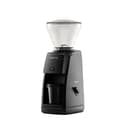 Best first electric · Electric, hopper, stepped 40 mm conical steel (M2, Etzinger) · 40 stepped settings, 1-20 espresso / 21-40 filter · 300 g hopper, 120 g bin · 70 W at 550 rpm · factory-calibrated · 1-year warranty Espresso and filter bands on one dial, factory-calibrated, with real repair support. | Espresso and filter bands on one dial, factory-calibrated, with real repair support.40 mm conical steel (M2, Etzinger) · 40 stepped settings, 1-20 espresso / 21-40 filter · 300 g hopper, 120 g bin · 70 W at 550 rpm · factory-calibrated · 1-year warranty | $199.95In stock, checked October 5, 2026 Check Price on Amazon |
| 2 | 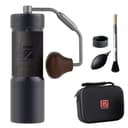 Best value for espresso · Hand, single-dose, stepped 48 mm coated burrs · 8 microns per click, external ring · 35-40 g catch cup · about 700 g · 1-year limited warranty The finest adjustment 1Zpresso publishes, for a fraction of an equivalent electric. | The finest adjustment 1Zpresso publishes, for a fraction of an equivalent electric.48 mm coated burrs · 8 microns per click, external ring · 35-40 g catch cup · about 700 g · 1-year limited warranty | $199.00In stock, checked October 5, 2026 Check Price on Amazon |
| 3 | 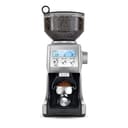 #3 Breville Smart Grinder Pro (BCG820) Best for a household · Electric, hopper, programmable Stainless conical burrs (diameter not published by Breville) · 60 stepped settings · grind time programmable in 0.2-second steps · 18 oz hopper · 165 W · 1-year warranty Widest claimed range plus a saved one-button dose — the lowest-friction routine here. | Widest claimed range plus a saved one-button dose — the lowest-friction routine here.Stainless conical burrs (diameter not published by Breville) · 60 stepped settings · grind time programmable in 0.2-second steps · 18 oz hopper · 165 W · 1-year warranty | $159.95In stock, checked October 5, 2026 Check Price on Amazon |
| 4 | 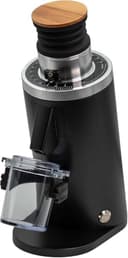 #4 DF54 Single Dose Coffee Grinder Best step up · Electric, single-dose, stepless 54 mm custom flat burrs · stepless micrometric · 25 g single-dose hopper · 150 W at 1,400 rpm · 4.7 kg · 1-year warranty Stepless adjustment and a true single-dose workflow, positioned as all-purpose. | Stepless adjustment and a true single-dose workflow, positioned as all-purpose.54 mm custom flat burrs · stepless micrometric · 25 g single-dose hopper · 150 W at 1,400 rpm · 4.7 kg · 1-year warranty | $260.00In stock, checked October 5, 2026 Check Price on Amazon |
Baratza Encore ESP — if you want one electric and brew both ways
| Type | Electric |
|---|---|
| Burrs | 40 mm conical steel (M2), made by Etzinger in Liechtenstein |
| Adjustment | 40 stepped settings, adjusted by twisting the hopper. Dual range: 1-20 espresso, 21-40 filter. |
| Stepless? | No — it clicks between steps (most grinders described as 'stepless' online aren't) |
| Good for espresso? | Yes, and it is the headline use — Baratza: 'delivers the grind resolution you need to brew creamy, syrupy shots of espresso' |
| Capacity | 300 g hopper, 120 g grounds bin |
| Motor | 70 W, 550 RPM. Grinds 1.3-2.2 g/sec. |
| Dimensions | 13 x 15 x 34 cm (W x D x H) |
| Weight | 7 lb (3.1 kg) |
| Warranty | 1 year |
The answers this fits: I brew espresso and filter, I want an electric, stepped is fine, I want a hopper, and I want support behind it. Baratza splits the dial into a fine espresso band (settings 1-20) and a coarser filter band (21-40) on a 40 mm Etzinger-made conical burr set, and calibrates each unit at the factory so the espresso numbers mean something out of the box. The honest cons: stepped rather than stepless, adjusted by twisting the hopper, and it carries the hopper trade-offs — beans stale in it, and you will purge a little when changing coffees.
1Zpresso J-Ultra — if espresso matters and the budget is finite
| Type | Manual hand grinder |
|---|---|
| Burrs | 48 mm, coated. 1Zpresso does not say whether it is conical or flat for this model, and does not name the coating — so neither do we. |
| Adjustment | External ring, 8 microns per click — the finest of any 1Zpresso. Clicked, not stepless. |
| Stepless? | No — it clicks between steps (most grinders described as 'stepless' online aren't) |
| Good for espresso? | Yes — 1Zpresso: 'optimized for espresso' |
| Capacity | 35-40 g magnetic catch cup |
| Dimensions | 19 x 18.5 x 5.5 cm |
| Weight | About 700 g. 1Zpresso's own product page says 700 g and their own comparison table says 670 g. |
| Warranty | 1 year limited |
The answers this fits: espresso is my main drink, I will crank, I want the finest adjustment I can afford, and single-dosing suits me. At 8 microns per click on an external numbered ring it is the finest-adjusting grinder 1Zpresso publishes, 1Zpresso describes it as optimized for espresso, and the 35-40 g catch cup takes a double with room to spare. This is the grinder that makes the hand-versus-electric argument concrete: it out-adjusts electrics costing considerably more. The honest cons: you are the motor every morning, and it is clicked rather than stepless. If filter is your main brew, the K-Ultra suits you better — that comparison is here.
Breville Smart Grinder Pro — if several people brew several ways
| Type | Electric |
|---|---|
| Burrs | Stainless steel conical |
| Adjustment | 60 stepped settings. Grind time is separately programmable in 0.2-second increments. |
| Stepless? | No — it clicks between steps (most grinders described as 'stepless' online aren't) |
| Good for espresso? | Yes — Breville: '60 precise grind settings from the finest espresso to the coarsest French Press grind' |
| Capacity | 18 oz (Breville publishes ounces only — no gram figure exists) |
| Motor | 165 W. RPM not published. |
| Dimensions | 8.5" W x 6.3" D x 15.3" H |
| Weight | 6.39 lb (2.9 kg) |
| Warranty | 1 year |
The answers this fits: a household brews three or four ways, nobody will weigh beans, and one button per drink is the goal. Sixty stepped settings span, in Breville's words, "the finest espresso to the coarsest French Press grind", the grind time is programmable in 0.2-second increments so each person can save a dose, and it grinds straight into a portafilter with both 50-54 mm and 58 mm cradles in the box. The honest cons: dosing by time is less precise than dosing by weight because bean density varies between roasts, and Breville publishes no burr diameter for this grinder anywhere — so we state none, and neither should anyone else.
DF54 — if you have outgrown your first grinder
| Burrs | 54 mm custom flat |
|---|---|
| Adjustment | Stepless micrometric |
| Hopper | 25 g single-dose |
| Motor | 150 W, 1,400 rpm |
| Weight | 4.7 kg |
| Warranty | 1 year |
The answers this fits: espresso is daily, I keep several bags on the go, stepped adjustment has started to annoy me, and I will happily weigh every dose. Flat burrs, stepless micrometric adjustment and a 25 g single-dose hopper with a bellows — DF Grinders positions it as all-purpose rather than espresso-only, which suits a household that also brews filter. The honest cons: this is a multi-brand platform built in China and sold under several badges — the Amazon listing is badged DF64Coffee rather than MiiCoffee — so support follows the seller, and category quality control is known to vary unit to unit. The bigger-burr sibling and its aftermarket upgrade path are covered in DF64 vs DF54.
The four mistakes people make
Buying a blade grinder to save money. It is not a cheaper grinder, it is a different and worse appliance. Any burr grinder beats every blade grinder.
Buying espresso resolution for filter coffee. If you own a V60 and no espresso machine, 8-microns-per-click adjustment is capability you cannot use. Spend it on beans.
Buying the machine first and the grinder with the change. On an espresso setup this is backwards — the grinder does more for the cup. If the budget only stretches to one good thing, make it the grinder.
Ignoring the workflow. The spec sheet does not tell you whether you will enjoy weighing beans at 6:40 a.m. The grinder people abandon is almost never the one that ground badly; it is the one that asked for a step they came to resent.
The short version
Start with what you brew. If it is filter only, buy burrs, buy evenness, buy a usable coarse range, and stop — a good hand grinder or the Baratza Encore ESP covers you and the money saved does more good as fresher beans. If espresso is your daily drink, that is the one case where fine adjustment is worth paying for, and the 1Zpresso J-Ultra is the cheapest honest route to it.
If a household brews several ways and nobody will weigh anything, the Breville Smart Grinder Pro and its saved one-button dose is the lowest-friction answer. And if you have lived with a stepped grinder long enough to be irritated by it, the DF54 is the step up that changes the daily experience rather than just the spec sheet.
Whatever you choose: burrs, a brew method you have been honest about, and a workflow you will still tolerate in three months. Everything else is detail. Browse by budget or by machine on the grinders hub.
What we know, and how we know it
What we did
- Took the specs from the manufacturer's own documentation — Baratza, Breville, 1Zpresso and DF Grinders product pages for the four grinders. Not from a retailer listing, and not from another blog.
- Priced it from Amazon's API, with the date we checked shown next to the number. If that price is more than 48 hours old, this page stops showing a number at all rather than show you a wrong one.
- Formed a verdict from those specs, the price, and what owners publicly report.
Where we hedged, and why
We have not used any of these grinders and we run no lab, so nothing on this page rests on a grind-consistency test, a brew comparison or a tasting. Three of the four are in our spec database and their tables are generated from it; the DF54 V4 is not, so its table is rendered inline from DF Grinders' published specification.
The claims about brew methods are statements about mechanics, not measurements. Espresso is more grind-sensitive than filter because pressurised water crosses a compressed puck in seconds rather than draining through a bed over minutes; a blade grinder cannot control particle size because it sets a duration rather than a gap. Those follow from how the equipment works. The claim that a hand grinder out-grinds an electric at the same price is an argument about where the money goes — burrs and mechanism versus motor and housing — not a measured comparison of two specific units.
Micron figures on this page are only ever a maker's published adjustment resolution for its own grinder, never an absolute grind size. Where a maker publishes nothing we say so: Breville states no burr diameter for the BCG820, and 1Zpresso does not say whether the J-Ultra's 48 mm burrs are conical or flat. We publish no price in prose — every number is live from Amazon with the date it was checked.
What we did not do
We do not run a lab. We have not pulled thousands of shots on this machine, and we are not going to pretend otherwise. We have not used this unit ourselves. Everything above is sourced research, and it is labeled as such. Where we have used a machine, we say so and show it.
How we're paid
If you buy through a link on this page, we earn a commission. It costs you nothing extra and it does not change what we recommend — we link to the better option for the buyer even when it earns us less. See how we review and our full disclosure.
Frequently asked questions
How do I choose a coffee grinder?
Answer six questions in order: what do you brew, burrs or blades, hand or electric, how fine does the adjustment need to be, hopper or single-dose, and what is the budget. Brew method does most of the work — espresso is the only method that genuinely needs fine adjustment resolution, so if you brew filter you can buy burrs, buy evenness and spend the rest on beans. Budget comes last because what it buys depends on the answers above.
Are burr grinders really better than blade grinders?
Yes, and the reason is mechanical rather than a matter of taste. A burr grinder sets a gap between two cutting surfaces and produces particles sized by that gap — you choose a dimension and get it. A blade grinder chops for however long you hold the button, producing powder and chunks in the same batch, so you choose a duration and guess at the result. That makes espresso impossible to dial in and gives filter brewing exactly the uneven bed it punishes hardest.
Is a hand grinder as good as an electric?
At the same price, usually better. In a manual grinder your money goes into burrs and a mechanism rather than a motor, gearbox and housing, so a capable hand grinder typically out-grinds an electric costing considerably more. The question is not quality but effort: a double shot is roughly 30 to 60 seconds of firm cranking every morning. For one or two drinks a day many people enjoy it; for a household making four, an electric is the answer.
How much should I spend on a coffee grinder?
Enough for your brew method, and no more. The jump from a blade grinder to any decent burr grinder is the biggest improvement you will ever make and it is cheap. The jump from entry to mid-tier is real and clearly audible in espresso. Above that you are buying burr area, stepless adjustment and upgrade paths — genuine, but sharply diminishing unless you pull shots daily. If one budget covers a machine and a grinder, spend it on the grinder first.
Do I need a stepless grinder?
Only if espresso is your daily drink and you have found stepped adjustment limiting. Stepless means continuous adjustment, so you can land exactly on the setting a coffee wants rather than choosing the nearer of two clicks — a real advantage in the narrow espresso window. For filter brewing, repeatability beats resolution: a numbered dial you can return to exactly next week is more useful day to day than infinite adjustment.
What grinder should I buy for a Breville or Gaggia espresso machine?
It depends on the machine, because the portafilter size and the basket change what works. We have pairing guides per machine rather than one generic answer — for a Breville Bambino, a Barista Express, a Gaggia Classic Pro, a Rancilio Silvia, a De'Longhi Dedica or a Stilosa, start with the matching grinder pairing guide on the grinders hub. Those name specific grinders against the machine you own rather than a general tier.
Sources
Specs come from the manufacturer's own documentation. Prices come from Amazon's API. Where a claim comes from what owners report, we link the thread and say so.
- Baratza Encore ESP product page (40 mm Etzinger M2 conical, dual range 1-20 espresso / 21-40 filter, 300 g hopper, factory calibration)
- Breville BCG820 product page (60 settings “from the finest espresso to the coarsest French Press grind”, programmable grind time, 18 oz hopper)
- 1Zpresso J-Ultra — official product page (48 mm coated burrs, 8 microns per click)
- 1Zpresso K-Ultra — official product page (20 microns per click)
- DF Grinders — DF54 V4 published specifications (54 mm flat burrs, stepless micrometric, 25 g hopper, 150 W at 1,400 rpm, 4.7 kg)
- Specialty Coffee Association — coffee research and standards
Keep reading
- Why the grinder matters more than the machineThe argument for spending here first, if one budget has to cover both.
- Burr vs blade grindersQuestion two, in full — the only non-negotiable on the list.
- Hand vs electric grindersQuestion three, and the reason a hand grinder out-grinds an electric at the money.
- Single dose vs hopper grindersQuestion five — the workflow that decides whether you still like it in month three.
- Coffee grind size chartWhere your brew method sits, and why we publish no micron ranges.
- The best grinders for espressoOnce you have your answers, this is the full field ranked.