
Grinders · Comparison
1Zpresso J-Ultra vs K-Ultra
Two hand grinders at nearly the same money, separated by one published number: how far the burrs move per click. That number is the whole decision.
The short answer
Buy the J-Ultra if espresso is your main drink: 8 microns per click is the finest adjustment 1Zpresso publishes, and it is what makes dialing a shot in bearable. Buy the K-Ultra if you brew filter, French press and the occasional shot — 20 microns per click covers a wider range, and a case is included.
We earn a commission if you buy through a link on this page. It costs you nothing extra and it does not change what we recommend. Full disclosure.
The short answer
These two sit so close together on price and look so similar in the hand that the choice feels arbitrary — and it is not. 1Zpresso publishes one figure for each grinder that settles it: how far the burrs move for every click of the adjustment dial. The J-Ultra moves 8 microns per click. The K-Ultra moves 20. Everything else about choosing between them is a consequence of that difference.
If you pull espresso, buy the J-Ultra. Espresso lives in a narrow band of grind settings, and a smaller step means more places to land inside that band, which is the difference between creeping up on a shot and stepping over it. If you brew mostly filter — pour over, French press, AeroPress — and espresso is occasional, buy the K-Ultra. Its wider, coarser steps cover far more range per rotation, it is 1Zpresso's declared do-everything grinder, and it ships with a carrying case.
Both are hand grinders, which means you are the motor. If that is the part you are unsure about, our hand vs electric grinder comparison is the page to read first, and the best hand grinders ranks both of these against the rest of the field.
The one number that decides it
Grind adjustment on a hand grinder is clicked, not continuous: you rotate a ring and it indexes in defined steps. The useful question is not "how many clicks does it have" but "how much does one click actually change the grind" — because that is the resolution you have to work with when a shot runs too fast or too slow.
1Zpresso publishes both numbers. The J-Ultra's external ring moves 8 microns per click, which 1Zpresso states is the finest adjustment of any grinder it makes. The K-Ultra's moves 20 microns per click, with more than 100 clicks to a full rotation of the dial.
Do the arithmetic and the consequence is plain: a K-Ultra click is two and a half times the size of a J-Ultra click. Across the enormous range between espresso and French press, the coarser step is an advantage — you cross the whole range in far fewer turns, and at filter grinds a 20-micron difference is not something you will taste. Inside the espresso window, where small changes in grind move the shot a long way, the finer step is the advantage: the J-Ultra gives you roughly two and a half times as many landing spots in the same stretch of dial.
J-Ultra: the espresso one
| Type | Manual hand grinder |
|---|---|
| Burrs | 48 mm, coated. 1Zpresso does not say whether it is conical or flat for this model, and does not name the coating — so neither do we. |
| Adjustment | External ring, 8 microns per click — the finest of any 1Zpresso. Clicked, not stepless. |
| Stepless? | No — it clicks between steps (most grinders described as 'stepless' online aren't) |
| Good for espresso? | Yes — 1Zpresso: 'optimized for espresso' |
| Capacity | 35-40 g magnetic catch cup |
| Dimensions | 19 x 18.5 x 5.5 cm |
| Weight | About 700 g. 1Zpresso's own product page says 700 g and their own comparison table says 670 g. |
| Warranty | 1 year limited |
The J-Ultra is 1Zpresso's espresso grinder, and 1Zpresso says so in those words — it describes the model as optimized for espresso. The external numbered ring is the feature: at 8 microns a click it is the finest-adjusting grinder in the range, and that is exactly the specification espresso rewards. When your shot runs in 18 seconds instead of 28, you want to go a touch finer, and a touch is what 8 microns buys you. On a grinder with coarser steps you overshoot and end up compensating with dose and tamp, which is a worse way to solve the problem. The deeper version of that argument is in how to dial in espresso, if you want it — though note that even a fine-stepping grinder is clicked rather than stepless, which is a distinction we unpack in stepped vs stepless.
Its burrs are 48 mm and coated. We are deliberately vague there because 1Zpresso is: the company does not state whether this burr set is conical or flat, and does not name the coating, so we do not either. The magnetic catch cup holds 35-40 g, which is a double shot with room to spare, and the whole grinder weighs about 700 g — 1Zpresso's product page says 700 g and its own comparison table says 670 g, a conflict we report rather than resolve.
The honest limitation. Fine steps and a wide range are in tension. Because each click moves so little, getting from an espresso setting out to French press coarseness means a lot of turning. If most of your brewing is immersion or pour over and espresso is rare, you will spend your life winding the dial — which is the precise case the K-Ultra was built for.
K-Ultra: the all-rounder
| Burrs | Stainless conical, 1Zpresso’s “K Burr” set |
|---|---|
| Adjustment | External dial, 20 microns per click, more than 100 clicks per rotation |
| Stepless | No — clicked, like the J-Ultra |
| Capacity | 35–40 g magnetic catch cup |
| Weight | 700 g |
| Warranty | 1 year limited |
| In the box | Carrying case included |
The K-Ultra is the grinder 1Zpresso points at someone who brews more than one way. The conical "K Burr" set and the 20-micron click give it a wide useful span: you can go from a pour-over grind to a French press grind quickly, and the espresso end is still reachable — it is simply coarser-stepped there than the J-Ultra's. More than 100 clicks per rotation on an external dial means the numbers are easy to read and easy to return to, which matters when you are switching methods rather than chasing one perfect shot.
The carrying case is a small thing that tells you something real about the grinder: this is the one 1Zpresso expects you to take places. If your coffee life involves a V60 at home and a French press at a rental, the K-Ultra is the single grinder that handles both without complaint. Its natural home on this site is the filter side — it is our top pick in the best grinder for pour over.
The honest limitation. Espresso is the brew method least tolerant of a coarse adjustment step, and 20 microns is coarse by espresso standards. You can absolutely pull good shots with a K-Ultra — plenty of people do — but you will have fewer usable settings inside the window, and on a difficult coffee you may find the shot you want sits between two clicks. If espresso is your daily drink, that frustration compounds every morning.
Both grinders, compared
Every pick on this page in one view, with the live Amazon price and stock on each row. Specs are the figures the maker or the listing publishes — nothing measured or scored by us. Prices are read from Amazon's API and were last checked October 5, 2026; where we have no verified price, the row says so rather than show you an old number.
| # | Hand grinder | Why you'd pick it | Price & availability |
|---|---|---|---|
| 1 | 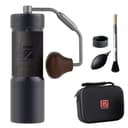 Best for espresso · Espresso-tuned 48 mm coated burrs · 8 microns per click, external ring · 35-40 g catch cup · about 700 g · 1-year limited warranty The finest adjustment 1Zpresso publishes — more landing spots inside the espresso window. | The finest adjustment 1Zpresso publishes — more landing spots inside the espresso window.48 mm coated burrs · 8 microns per click, external ring · 35-40 g catch cup · about 700 g · 1-year limited warranty | $199.00In stock, checked October 5, 2026 Check Price on Amazon |
| 2 | 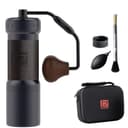 Best all-rounder · Filter and espresso Stainless conical “K Burr” · 20 microns per click, 100+ clicks per rotation · 35-40 g catch cup · 700 g · 1-year limited warranty · carrying case included Covers pour over, French press and espresso in one grinder, and travels in a case. | Covers pour over, French press and espresso in one grinder, and travels in a case.Stainless conical “K Burr” · 20 microns per click, 100+ clicks per rotation · 35-40 g catch cup · 700 g · 1-year limited warranty · carrying case included | $259.00In stock, checked October 5, 2026 Check Price on Amazon |
| 3 | 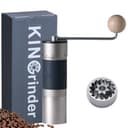 Best value · Espresso-capable Stainless steel burrs (size not published) · 16 microns per click, 60 clicks per rotation, 4 rotations · 25-35 g hopper · 1-year warranty External fine adjustment for less money, if both 1Zpressos are more than you want to spend. | External fine adjustment for less money, if both 1Zpressos are more than you want to spend.Stainless steel burrs (size not published) · 16 microns per click, 60 clicks per rotation, 4 rotations · 25-35 g hopper · 1-year warranty | $109.00In stock, checked October 5, 2026 Check Price on Amazon |
What's identical on both
It is worth being explicit about how much these two share, because it narrows the decision rather than widening it.
- The same stated warranty. 1Zpresso publishes one year limited on both. In this category that is not a given — Timemore publishes no warranty at all for the C3 ESP, which is one reason we keep pointing espresso buyers at 1Zpresso.
- The same capacity. Both use a 35-40 g magnetic catch cup, so neither limits you to a single shot or forces a second grind for a big filter brew.
- The same weight class. Both are stated at 700 g, so neither is meaningfully easier to hold or to pack than the other.
- External adjustment on both. You set the grind from a numbered ring on the outside of the body, rather than unscrewing the catch cup to reach a nut inside. That is the single biggest workflow upgrade a hand grinder can have, and both of these have it.
- Clicked, not stepless. Neither is infinitely adjustable. If you want genuinely stepless adjustment you are looking at electrics like the DF64 and DF54, not at either of these.
So: same maker, same warranty, same capacity, same weight, same style of adjustment. The difference is the step size and the range it serves. That is genuinely the whole comparison.
If both are more than you want to spend
| Burrs | Stainless steel — size not published by Kingrinder |
|---|---|
| Adjustment | External dial, 16 microns per click, 60 clicks per rotation, 4 rotations of range |
| Capacity | 25–35 g hopper |
| Warranty | 1 year |
The K6 is the third name that belongs in this conversation. It sits between the two 1Zpressos on published adjustment — 16 microns a click, finer than the K-Ultra, coarser than the J-Ultra — with external dialing and a stated one-year warranty, for noticeably less money. It is the grinder to buy if the 1Zpresso price makes you hesitate but you still want fine, external espresso adjustment. Kingrinder does not publish a burr size, so we do not state one; that reticence is the honest reason it is the value pick rather than the recommendation.
Which one for which brewer
| If this is you | Buy | Because |
|---|---|---|
| Espresso is your daily drink | J-Ultra | 8 microns a click gives you the most places to land inside the espresso window. |
| You brew pour over or French press most mornings | K-Ultra | 20 microns a click crosses the filter range fast, and the coarse end is where you live. |
| You switch methods constantly and want one grinder | K-Ultra | Wider span per rotation and easy-to-return-to numbers on an external dial. |
| You own an espresso machine and dial in by taste | J-Ultra | Fine steps are what make small, deliberate corrections possible. |
| You travel with your coffee kit | K-Ultra | Same weight as the J-Ultra, but the carrying case comes in the box. |
| Both are more than you want to spend | Kingrinder K6 | 16 microns a click and external adjustment for less, with a stated warranty. |
| You want stepless adjustment and don't want to crank | Neither — look at an electric | Both of these are clicked hand grinders; stepless means a DF54 or DF64. |
The verdict
For an espresso drinker the 1Zpresso J-Ultra is the right buy and it is not close. 1Zpresso built it for espresso, says so, and backs it with the finest adjustment figure it publishes anywhere in the range. Espresso is the one brew method where a coarse click costs you real control, and 8 microns is the specification that keeps that control in your hands rather than in your dose and tamp. Accept the trade — a long wind out to coarse settings — and it is the better tool for the job.
For everyone else the K-Ultrais the smarter grinder. If your week includes a V60, a French press and maybe a shot at the weekend, the J-Ultra's resolution is precision you will not use, and the K-Ultra's wider span, conical K Burr set and included case are the features you will. And if both prices give you pause, the Kingrinder K6keeps external fine adjustment and a stated warranty at a lower number. If the sticking point is the J-Ultra's price rather than its range, the other comparison to read is J-Ultra vs Timemore C3 ESP — the cheapest hand grinder worth putting in front of an espresso machine. See where each lands against the rest of the field in the best hand grinders, or browse the whole category on the grinders hub.
What we know, and how we know it
What we did
- Took the specs from the manufacturer's own documentation — 1Zpresso's own product pages for the J-Ultra and K-Ultra. Not from a retailer listing, and not from another blog.
- Priced it from Amazon's API, with the date we checked shown next to the number. If that price is more than 48 hours old, this page stops showing a number at all rather than show you a wrong one.
- Formed a verdict from those specs, the price, and what owners publicly report.
Where we hedged, and why
We have not used either grinder, and there is no grind-consistency test behind this page. Every figure above is read off 1Zpresso's own product pages — including the 8-micron and 20-micron per-click numbers the whole comparison turns on — or, for the Kingrinder K6, off the manufacturer specifications on its Amazon listing. The J-Ultra is in our spec database and its table is generated from it; the other two are rendered inline because they are not.
The comparison of step sizes is arithmetic, not a measurement. We say a K-Ultra click is two and a half times a J-Ultra click because 20 divided by 8 is 2.5, using the makers' published figures. We do not claim to have measured particle distributions, shot times or taste differences between the two grinders.
Where a maker publishes nothing, we say so rather than borrow a number: 1Zpresso does not state whether the J-Ultra's 48 mm burrs are conical or flat and does not name their coating, its own two sources disagree on the J-Ultra's weight (700 g versus 670 g), and Kingrinder publishes no burr size for the K6. No prices appear in our prose — every number you see is live from Amazon and stamped with the date it was checked.
What we did not do
We do not run a lab. We have not pulled thousands of shots on this machine, and we are not going to pretend otherwise. We have not used this unit ourselves. Everything above is sourced research, and it is labeled as such. Where we have used a machine, we say so and show it.
How we're paid
If you buy through a link on this page, we earn a commission. It costs you nothing extra and it does not change what we recommend — we link to the better option for the buyer even when it earns us less. See how we review and our full disclosure.
Frequently asked questions
Should I buy the 1Zpresso J-Ultra or the K-Ultra?
Buy the J-Ultra if espresso is your main drink and the K-Ultra if filter is. 1Zpresso publishes the figure that decides it: the J-Ultra moves 8 microns per click, the K-Ultra 20. Espresso lives in a narrow band of grind settings, so the finer step gives you more usable places to land. For pour over and French press, the K-Ultra's coarser, wider-ranging steps are an advantage and a carrying case is included.
What does 'microns per click' actually mean on a hand grinder?
It is how far the burrs move apart or together each time the adjustment ring indexes one notch. A smaller number means finer control. The J-Ultra's 8 microns per click is the finest 1Zpresso publishes for any of its grinders; the K-Ultra's 20 microns per click means each notch changes the grind two and a half times as much, which crosses a wide range quickly but gives you fewer settings inside the narrow espresso window.
Can the 1Zpresso K-Ultra make espresso?
Yes, and plenty of people use it that way. The honest caveat is resolution: at 20 microns per click you have fewer usable settings inside the espresso range than the J-Ultra gives you, so on a stubborn coffee the grind you want can sit between two clicks and you end up compensating with dose and tamp. If espresso is occasional, that is a fine trade. If it is your daily drink, the J-Ultra will frustrate you less.
Is the J-Ultra or K-Ultra better for pour over?
The K-Ultra. Its conical K Burr set and 20-micron click are built for a wide range, so moving between pour over, French press and espresso takes far fewer turns of the dial, and at filter grinds a 20-micron step is not something you will taste. The J-Ultra's fine steps are tuned for the espresso end, which means a long wind out to coarse settings every time you switch to a V60 or a press.
Do the J-Ultra and K-Ultra have the same warranty and capacity?
Yes. 1Zpresso publishes a one-year limited warranty on both, and both use a 35-40 g magnetic catch cup — enough for a double shot with room to spare or a full filter brew. Both are stated at 700 g and both adjust from an external numbered ring rather than an internal nut. The difference between them really is the step size and the range it serves, not build, support or capacity.
Is there a cheaper hand grinder that still adjusts finely for espresso?
The Kingrinder K6 is the one to look at. Its published figures put it between the two 1Zpressos on adjustment — 16 microns per click, 60 clicks per rotation, four rotations of range — with external dialing and a stated one-year warranty, for less money. Kingrinder does not publish a burr size, which is why we treat it as the value pick rather than the recommendation, but it is a genuine espresso-capable alternative.
Sources
Specs come from the manufacturer's own documentation. Prices come from Amazon's API. Where a claim comes from what owners report, we link the thread and say so.
- 1Zpresso J-Ultra — official product page (48 mm coated burrs, 8 microns per click, 35-40 g catch cup, warranty)
- 1Zpresso K-Ultra — official product page (stainless conical K Burr, 20 microns per click, 100+ clicks per rotation, 35-40 g catch cup, 700 g, carrying case)
- 1Zpresso — official product information
- KINGrinder K6 — manufacturer specifications on the Amazon listing (16 microns per click, 60 clicks per rotation, 25-35 g hopper, 1-year warranty)
Keep reading
- The best hand grindersBoth of these ranked against the rest of the manual field, espresso capability called out.
- The best grinder for pour overWhere the K-Ultra is the top pick rather than the compromise.
- 1Zpresso J-Ultra vs Timemore C3 ESPThe J-Ultra against the cheapest hand grinder worth owning for espresso.
- Stepped vs stepless grindersBoth of these are clicked. Here is what stepless adjustment actually buys you.
- Hand vs electric grindersBefore you choose between these two, decide whether you want to be the motor at all.
- Coffee grind size chartWhat grind each brew method wants, so you know which end of the dial you'll live at.