
Grinders · Pour over
The Best Grinder for Pour Over
Pour over is forgiving about grind size and brutal about grind consistency. That inverts the espresso shopping list — and it means the grinder you want may cost a lot less than you feared.
The short answer
Buy the 1Zpresso K-Ultra: its conical K Burr set and wide 20-micron-per-click range are built for filter, and a case is included. Prefer an electric? The Baratza Encore ESP's settings 21-40 are a dedicated filter band. The 1Zpresso Q Air is the travel pick, the Timemore C3 ESP the cheapest worth owning.
We earn a commission if you buy through a link on this page. It costs you nothing extra and it does not change what we recommend. Full disclosure.
Key takeaways
- Pour over is forgiving about grind size and unforgiving about consistency. That is the opposite of espresso, and it changes what you should pay for.
- You do not need micron-level adjustment. You need even particles and a usable medium-to-coarse range — which is why a good hand grinder beats a cheap electric here.
- The 1Zpresso K-Ultra is the pick for most people: built as an all-rounder, wide range per rotation, case included.
- For an electric, the Baratza Encore ESP gives you a dedicated filter band (settings 21-40), and the Breville Smart Grinder Pro adds 60 settings and a programmable dose timer.
- Skip blade grinders entirely. A blade chops for a duration you guess at, which produces exactly the uneven grind pour over punishes hardest.
Pour over asks a different job of a grinder
Almost every grinder guide on the internet — including most of ours — is written for espresso, because espresso is the brew method that breaks grinders. Nine bars of pressure through a compressed puck in twenty-five seconds means a hair's difference in grind swings the shot from sour to bitter, which is why espresso buyers obsess over microns per click and stepless adjustment.
Pour over does not work like that. Water passes through a bed of coffee under gravity for two to four minutes, and the brew is far more tolerant of being a little coarser or a little finer than ideal — you adjust and the result moves gently rather than falling off a cliff. What pour over is brutally sensitive to is consistency: a bed containing both boulders and dust channels the water, over-extracts the fines into bitterness and under-extracts the boulders into sourness, and no amount of careful pouring technique will rescue it.
So the shopping list inverts. Fine adjustment resolution, the thing espresso buyers pay most for, matters much less. Particle evenness and a genuinely usable medium-to-coarse range matter most. The good news is that this is cheaper to buy: a well-made hand grinder at a modest price will out-grind an electric costing the same, because you are paying for burrs and a mechanism rather than for a motor. If you want the full case for that, it is in hand vs electric grinders, and the reason the grinder outranks the brewer in the first place is in why the grinder matters more than the machine.
What actually matters
Four things, in this order, and it is a deliberately different order from our espresso guides.
1. Burrs, not blades. This is the only non-negotiable. A burr grinder sets a gap and produces particles sized by that gap; a blade grinder chops for a duration you guess at and produces everything from powder to chunks in the same batch. For pour over, where evenness is the whole game, that difference is decisive. We take it apart properly in burr vs blade.
2. A usable coarse range. Pour over lives in the medium range, French press coarser still, and some espresso-tuned grinders are optimized so heavily for the fine end that reaching filter coarseness means winding the dial a very long way. A grinder that crosses the range in a couple of turns is a grinder you will enjoy using. Our coffee grind size chart lays out where each method sits.
3. Enough capacity for one brew. A single V60 or Chemex dose is larger than an espresso dose, so a 15 g catch cup means two grinds for a big brew. Check the number before you buy.
4. Repeatability. You want to find a setting you like and come back to it reliably. Numbered external adjustment — on a ring, a dial or a display — is what makes that possible. Stepless adjustment is a genuine asset for espresso and close to irrelevant here; clicked settings you can read and return to are better for filter.
All five grinders, compared
Every pick on this page in one view, with the live Amazon price and stock on each row. Specs are the figures the maker or the listing publishes — nothing measured or scored by us. Prices are read from Amazon's API and were last checked October 5, 2026; where we have no verified price, the row says so rather than show you an old number.
| # | Grinder | Why it's here | Price & availability |
|---|---|---|---|
| 1 | 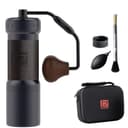 Best overall · Hand, all-round Stainless conical “K Burr” · 20 microns per click, 100+ clicks per rotation · 35-40 g catch cup · 700 g · 1-year limited warranty · carrying case included 1Zpresso's declared all-rounder: wide range per rotation, filter-first character. | 1Zpresso's declared all-rounder: wide range per rotation, filter-first character.Stainless conical “K Burr” · 20 microns per click, 100+ clicks per rotation · 35-40 g catch cup · 700 g · 1-year limited warranty · carrying case included | $259.00In stock, checked October 5, 2026 Check Price on Amazon |
| 2 | 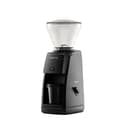 Best electric · Electric, hopper-fed 40 mm conical steel (M2, Etzinger) · 40 stepped settings, 21-40 is the filter band · 300 g hopper, 120 g bin · 70 W at 550 rpm · factory-calibrated · 1-year warranty A dedicated filter band on the dial and Baratza's parts-and-repair support behind it. | A dedicated filter band on the dial and Baratza's parts-and-repair support behind it.40 mm conical steel (M2, Etzinger) · 40 stepped settings, 21-40 is the filter band · 300 g hopper, 120 g bin · 70 W at 550 rpm · factory-calibrated · 1-year warranty | $199.95In stock, checked October 5, 2026 Check Price on Amazon |
| 3 | 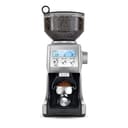 #3 Breville Smart Grinder Pro (BCG820) Most settings · Electric, programmable Stainless conical burrs (diameter not published by Breville) · 60 stepped settings · grind time programmable in 0.2-second steps · 18 oz hopper · 165 W · 1-year warranty Breville spans “finest espresso to coarsest French Press”, and doses by time to a number. | Breville spans “finest espresso to coarsest French Press”, and doses by time to a number.Stainless conical burrs (diameter not published by Breville) · 60 stepped settings · grind time programmable in 0.2-second steps · 18 oz hopper · 165 W · 1-year warranty | $159.95In stock, checked October 5, 2026 Check Price on Amazon |
| 4 | 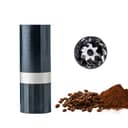 Best for travel · Hand, compact 30 clicks per rotation · 15-20 g capacity · 365 g · compact body (dimensions published by 1Zpresso) Tiny, light and filter-leaning — 1Zpresso aims it at pour over, press and cold brew. | Tiny, light and filter-leaning — 1Zpresso aims it at pour over, press and cold brew.30 clicks per rotation · 15-20 g capacity · 365 g · compact body (dimensions published by 1Zpresso) | $69.00In stock, checked October 5, 2026 Check Price on Amazon |
| 5 | 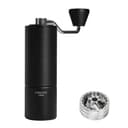 Cheapest worth owning · Hand, budget 38 mm burrs · ESP dial at 0.0233 mm per click · dimensions, weight and warranty not published by Timemore The lowest price at which you still get real burrs and a dial you can return to. | The lowest price at which you still get real burrs and a dial you can return to.38 mm burrs · ESP dial at 0.0233 mm per click · dimensions, weight and warranty not published by Timemore | $68.00In stock, checked October 5, 2026 Check Price on Amazon |
The picks
1Zpresso K-Ultra — the one to buy
| Burrs | Stainless conical, 1Zpresso’s “K Burr” set |
|---|---|
| Adjustment | External dial, 20 microns per click, more than 100 clicks per rotation |
| Capacity | 35–40 g magnetic catch cup |
| Weight | 700 g |
| Warranty | 1 year limited |
| In the box | Carrying case included |
1Zpresso sells the K-Ultra as its do-everything grinder, and "everything" here leans filter. The conical K Burr set and the 20-micron click give it a wide useful span rather than a hair-fine espresso end: you move from a V60 grind to a French press grind in a fraction of a rotation, and with more than 100 clicks per turn on an external numbered dial, finding your setting again next week is trivial. The 35-40 g catch cup takes a full Chemex dose in one grind.
Who it is for: the pour-over drinker who wants one grinder for life and does not want to think about it again — and who would quite like to take it on holiday, since the case is included.
The honest cons.You are the motor: a filter dose is less work than an espresso dose, but it is still cranking, every morning. And if you ever buy an espresso machine, the K-Ultra's 20-micron steps are coarse for that job — we spell out why in J-Ultra vs K-Ultra.
Baratza Encore ESP — the electric to buy
| Type | Electric |
|---|---|
| Burrs | 40 mm conical steel (M2), made by Etzinger in Liechtenstein |
| Adjustment | 40 stepped settings, adjusted by twisting the hopper. Dual range: 1-20 espresso, 21-40 filter. |
| Stepless? | No — it clicks between steps (most grinders described as 'stepless' online aren't) |
| Good for espresso? | Yes, and it is the headline use — Baratza: 'delivers the grind resolution you need to brew creamy, syrupy shots of espresso' |
| Capacity | 300 g hopper, 120 g grounds bin |
| Motor | 70 W, 550 RPM. Grinds 1.3-2.2 g/sec. |
| Dimensions | 13 x 15 x 34 cm (W x D x H) |
| Weight | 7 lb (3.1 kg) |
| Warranty | 1 year |
If you want a motor doing the work, this is the one. The Encore ESP's dial is split into two bands, and the upper one is the point for our purposes: settings 1-20 are fine micro-steps for espresso, and 21-40 are coarser macro-steps for filter. That is a manufacturer-designed filter range on a 40 mm conical steel burr set made by Etzinger, in a unit Baratza calibrates at the factory. The 300 g hopper means you load beans and forget them, and Baratza's long reputation for parts and repairs means this is a grinder you keep running rather than replace.
Who it is for: the pour-over drinker who does not want to crank, values a hopper over single-dose freshness, and wants a grinder with repair support behind it.
The honest cons. It is stepped, not stepless, and it is adjusted by twisting the hopper rather than from a separate dial — fine in practice, slightly less convenient than a numbered ring. Hopper-stored beans go stale faster than beans in a bag, and a hopper leaves a little more retention between grinds than a single-doser does; the trade-off is laid out in single dose vs hopper.
Breville Smart Grinder Pro — the most settings and a dose timer
| Type | Electric |
|---|---|
| Burrs | Stainless steel conical |
| Adjustment | 60 stepped settings. Grind time is separately programmable in 0.2-second increments. |
| Stepless? | No — it clicks between steps (most grinders described as 'stepless' online aren't) |
| Good for espresso? | Yes — Breville: '60 precise grind settings from the finest espresso to the coarsest French Press grind' |
| Capacity | 18 oz (Breville publishes ounces only — no gram figure exists) |
| Motor | 165 W. RPM not published. |
| Dimensions | 8.5" W x 6.3" D x 15.3" H |
| Weight | 6.39 lb (2.9 kg) |
| Warranty | 1 year |
Breville pitches this one as spanning the whole brew spectrum — in its own words, "60 precise grind settings from the finest espresso to the coarsest French Press grind" — and that breadth is genuinely useful if your household brews more than one way. The distinguishing feature for filter is the programmable grind time, adjustable in 0.2-second increments: once you know how long your dose takes, you press one button and walk away. It also grinds straight into a portafilter if you ever add an espresso machine, with 50-54 mm and 58 mm cradles both in the box.
Who it is for: a household that brews filter and espresso, or anyone who wants to dose by a repeatable timer rather than by weighing every time.
The honest cons. Breville publishes no burr diameter for this grinder anywhere — the only millimetre figures on its page are the portafilter cradle sizes — so any burr-size claim you read elsewhere is not manufacturer-sourced, and we will not state one. Dosing by time is less precise than dosing by weight, because bean density varies. And 60 stepped settings sound like a lot but are still steps.
1Zpresso Q Air — the travel pick
| Adjustment | 30 clicks per rotation |
|---|---|
| Capacity | 15–20 g |
| Weight | 365 g |
| Positioning | 1Zpresso aims it at pour over, French press and cold brew — it can be pushed to espresso, but that is not what it is for |
The Q Air is the small, light 1Zpresso — 365 g, genuinely packable — and crucially, it is a filter grinder by design rather than an espresso grinder shrunk down. 1Zpresso aims it at pour over, French press and cold brew, which is precisely the brief of this page. If your pour over happens in hotel rooms, on trains or at a campsite, this is the grinder.
Who it is for: the traveller, and anyone who wants a brilliant little filter grinder and does not own an espresso machine.
The honest cons. The 15-20 g capacity is one brew at a time, and a large Chemex dose means two grinds. Thirty clicks per rotation is a coarse resolution — fine for filter, poor for espresso, and you should not buy it hoping to do both.
Timemore Chestnut C3 ESP — the cheapest worth owning
| Type | Manual hand grinder |
|---|---|
| Burrs | 38 mm S2C660 conical, stainless steel, CNC-machined |
| Adjustment | The ESP dial gives 0.0233 mm per click (30 clicks per rotation). The standard C3's 'Classic' dial is nearly four times coarser at 0.0833 mm per click. For espresso that difference is the entire ballgame — make sure you are buying the ESP. |
| Stepless? | No — it clicks between steps (most grinders described as 'stepless' online aren't) |
| Good for espresso? | Yes, with the ESP dial — Timemore: 'ESP and ESP Pro models feature finer control for espresso dialing' |
| Capacity | 20 g catch cup |
| Dimensions | Not published by Timemore. |
| Weight | Not published by Timemore. (The 530 g figure you'll see quoted everywhere comes from retailers, not from Timemore.) |
| Warranty | Not published — timemore.com has no warranty page at all. |
This is the floor of the category — the least you can spend and still get real steel burrs and a dial you can return to. The ESP version has the finer adjustment, which is more resolution than pour over needs, but it does no harm and makes the grinder usable if you ever buy an espresso machine. For a first grinder replacing a blade chopper, the jump in cup quality is larger than any upgrade you will make after it.
Who it is for: someone leaving a blade grinder behind on the smallest sensible budget.
The honest cons. Timemore publishes remarkably little about it — no dimensions, no weight, and no warranty of its own; the warranty figures you will see are mostly quoted by retailers rather than by Timemore. If published support matters to you, the 1Zpressos state theirs.
The step up, if you also pull espresso
If filter is your main brew but you also own an espresso machine, the honest answer is a grinder built to span both. The DF54 is the one we would look at: 54 mm flat burrs, genuinely stepless micrometric adjustment and a single-dose bellows hopper, and DF Grinders describes it as an all-purpose grinder rather than an espresso-only one. The caveat belongs with it — this is a multi-brand platform built in China and the listing is badged DF64Coffee rather than MiiCoffee, so support follows the seller. We compare it with its bigger sibling in DF64 vs DF54.
What to avoid
Blade grinders. No exceptions for pour over. A blade produces fines and boulders in the same batch, and an uneven bed is the one thing filter brewing cannot tolerate. Spend the least you can on a burr grinder instead of anything on a blade.
Espresso-only electrics. Some grinders are geared so tightly to the fine end that the coarse settings are an afterthought — plenty of travel and range at the espresso end, very little usable room at French press. Check that the maker claims a filter range, as Baratza and Breville both do, before you buy.
Dosing by eye. Not a grinder fault, but the most common reason a decent grinder produces mediocre pour over. Weigh your beans. A cheap coffee scale does more for your brew than trading up a grinder tier.
Which grinder for which brewer
| If this is you | Buy | Because |
|---|---|---|
| You brew pour over and want one grinder, full stop | 1Zpresso K-Ultra | Built as an all-rounder, wide range per rotation, case included. |
| You do not want to crank | Baratza Encore ESP | Settings 21-40 are a maker-designed filter band, and the hopper holds 300 g. |
| Your household brews filter and espresso | Breville Smart Grinder Pro | 60 settings across the whole spectrum, plus a programmable dose timer. |
| You brew pour over away from home | 1Zpresso Q Air | 365 g, packable, and aimed by 1Zpresso at filter rather than espresso. |
| You are replacing a blade grinder on the smallest budget | Timemore C3 ESP | Real burrs and a repeatable dial at the lowest sensible price. |
| Filter is your main brew but espresso is daily too | DF54 | Stepless adjustment and a single-dose workflow, positioned as all-purpose. |
| You are tempted by a cheap blade grinder | None of them — buy burrs | Pour over punishes uneven grinds harder than any other method. |
The verdict
For pour over, buy the 1Zpresso K-Ultra. It is the grinder its maker designed for people who brew more than one way, its conical K Burr set and wide 20-micron-per-click range suit the filter end rather than fighting it, the catch cup takes a full brew in one grind, and the carrying case tells you what else it is good at. You crank it yourself, which for a single filter dose is a minor price.
If you would rather a motor did the work, the Baratza Encore ESP is the electric to buy — its upper band of settings is a filter range by design, and Baratza will help you keep it alive for years. Choose the Breville Smart Grinder Pro instead if you want the widest span of settings and a dose timer, the 1Zpresso Q Air if your coffee travels, and the Timemore C3 ESP if the budget is genuinely tight. Whatever you choose, make it a burr grinder — then put the money you saved on espresso-grade resolution into a proper pour-over setup and fresher beans.
What we know, and how we know it
What we did
- Took the specs from the manufacturer's own documentation — 1Zpresso, Baratza, Breville and Timemore product pages for the five grinders listed. Not from a retailer listing, and not from another blog.
- Priced it from Amazon's API, with the date we checked shown next to the number. If that price is more than 48 hours old, this page stops showing a number at all rather than show you a wrong one.
- Formed a verdict from those specs, the price, and what owners publicly report.
Where we hedged, and why
We have not used any of these grinders and we run no lab, so there is no grind-consistency test, no brew comparison and no tasting behind this page. Three picks — the Baratza Encore ESP, the Breville Smart Grinder Pro and the Timemore C3 ESP — are in our spec database and their tables are generated from it. The two 1Zpressos are not, so their figures are rendered inline from 1Zpresso's own product pages and captioned with the source.
The claim that pour over is more tolerant of grind size and less tolerant of inconsistency is a statement about how the two brew methods work— gravity percolation over minutes versus nine bars through a compressed puck in seconds — not a measured result of ours. Where a maker publishes a positioning claim we attribute it to them: Baratza's 21-40 filter band, Breville's "finest espresso to coarsest French Press", 1Zpresso's filter framing for the Q Air.
Where a maker publishes nothing, we say so: Breville states no burr diameter for the BCG820, and Timemore publishes no dimensions, weight or warranty for the C3 ESP. No price appears anywhere in our prose; every number on this page is live from Amazon and carries the date it was checked.
What we did not do
We do not run a lab. We have not pulled thousands of shots on this machine, and we are not going to pretend otherwise. We have not used this unit ourselves. Everything above is sourced research, and it is labeled as such. Where we have used a machine, we say so and show it.
How we're paid
If you buy through a link on this page, we earn a commission. It costs you nothing extra and it does not change what we recommend — we link to the better option for the buyer even when it earns us less. See how we review and our full disclosure.
More grinder guides — by budget, by machine and by brew method — are on the grinders hub.
Frequently asked questions
What is the best grinder for pour over?
The 1Zpresso K-Ultra for most people. It is 1Zpresso's declared all-rounder: a stainless conical 'K Burr' set, 20 microns per click with more than 100 clicks per rotation so you cross the filter range quickly, a 35-40 g catch cup that takes a full V60 or Chemex dose in one grind, a stated one-year limited warranty and a carrying case in the box. If you would rather not crank, the Baratza Encore ESP is the electric to buy.
Do I need an expensive grinder for pour over?
No — and the reason is that pour over needs different things from a grinder than espresso does. Espresso punishes tiny grind errors, which is why espresso buyers pay for hair-fine adjustment. Pour over is far more tolerant of grind size and far less tolerant of inconsistency, so you are paying for even particles and a usable coarse range rather than for micron-level resolution. A good hand grinder at modest money delivers both.
Is a hand grinder good enough for pour over?
Better than good enough — it is often the best value in the category. With a hand grinder your money goes into burrs and a mechanism rather than into a motor, so at a given price a manual grinder typically produces a more even grind than an electric. A filter dose is also less work to crank than an espresso dose, since the grind is coarser. The trade is that you do it by hand, every morning.
Can I use an espresso grinder for pour over?
Usually yes, but check the coarse end before you buy. Some grinders are geared so tightly for espresso that reaching French press coarseness takes a very long wind of the dial, and a few run out of useful range entirely. Grinders whose makers explicitly claim a filter range — Baratza's settings 21-40, Breville's 'finest espresso to coarsest French Press' — are the safe choices for a household that brews both.
Why are blade grinders bad for pour over?
Because a blade grinder has no way to control particle size. It chops for however long you hold the button and produces powder and chunks in the same batch, while a burr grinder sets a gap and produces particles sized by that gap. An uneven bed channels water, over-extracting the fines into bitterness and under-extracting the boulders into sourness — and no pouring technique rescues it. Pour over punishes uneven grinds harder than any other method.
What grind size should I use for pour over?
Medium — coarser than espresso, finer than French press — and then adjust by taste and by how fast the brew drains. If the water runs through too quickly and the cup tastes thin and sour, go finer; if it stalls and the cup tastes harsh and bitter, go coarser. Our coffee grind size chart sets out where each brew method sits relative to the others, and the brewer's own instructions are the best starting point.
Sources
Specs come from the manufacturer's own documentation. Prices come from Amazon's API. Where a claim comes from what owners report, we link the thread and say so.
- 1Zpresso K-Ultra — official product page (stainless conical K Burr, 20 microns per click, 100+ clicks per rotation, 35-40 g catch cup, 700 g, carrying case)
- 1Zpresso Q Air — official product page (30 clicks per rotation, 15-20 g, 365 g, dimensions)
- Baratza Encore ESP product page (40 mm Etzinger M2 conical, dual range 1-20 espresso / 21-40 filter, 300 g hopper, 70 W)
- Breville BCG820 product page (60 settings “from the finest espresso to the coarsest French Press grind”, programmable grind time, 18 oz hopper)
- Timemore Chestnut C3 series — official specifications (38 mm burrs, ESP dial at 0.0233 mm per click)
- National Coffee Association — how to brew coffee
- Specialty Coffee Association — coffee research and standards
Keep reading
- Pour over, properlyThe method itself — V60, Kalita and Chemex — and the brewer to pair with your grinder.
- Coffee grind size chartWhere pour over sits relative to espresso, press and cold brew on the dial.
- 1Zpresso J-Ultra vs K-UltraIf you might add an espresso machine later, this is the comparison to read.
- Burr vs blade grindersWhy a blade grinder is the one thing pour over genuinely cannot tolerate.
- Hand vs electric grindersWhy a manual grinder out-grinds an electric at the same money.
- Gooseneck kettlesThe other half of a pour-over setup, once the grinder is sorted.