
Grinders · Comparison
1Zpresso Q Air vs Timemore C3 ESP
Two of the best-regarded hand grinders under $100, and they are not alternatives to each other. One was built for filter coffee in a suitcase; the other was built to sit next to an espresso machine. Buying the wrong one is the most common mistake in this bracket.
The short answer
Buy the Timemore Chestnut C3 ESP if you pull espresso: its ESP dial moves 0.0233 mm per click, which is the adjustment the espresso window needs. Buy the 1Zpresso Q Air if you brew filter or travel with a grinder — at 365 g and 15-20 g capacity, 1Zpresso aims it at pour over, French press and cold brew.
We earn a commission if you buy through a link on this page. It costs you nothing extra and it does not change what we recommend. Full disclosure.
Key takeaways
- These two grinders are not competing for the same buyer, even though they sit within thirty dollars of each other.
- The C3 ESP's whole reason to exist is the fine dial: 0.0233 mm per click, which is the resolution espresso dial-in demands.
- The Q Air is a filter grinder by its maker's own positioning — pour over, French press and cold brew — in a 365 g body built to travel.
- Both makers leave real gaps in their published specs: Timemore publishes no warranty or weight, 1Zpresso publishes no microns per click or burr size for the Q Air.
The short answer
If there is an espresso machine on your counter, buy the Timemore Chestnut C3 ESP. It is the cheapest hand grinder we would put in front of one, and the reason is a single published number: the ESP dial moves 0.0233 mm per click. That is fine enough to walk a shot into range instead of jumping over it.
If you brew pour over, French press or cold brew — or you want a grinder that disappears into hand luggage — buy the 1Zpresso Q Air. At 365 g it is the lightest grinder either maker sells in this bracket, and 1Zpresso is explicit that filter brewing is what it is for. It can be pushed toward espresso, but that is a stretch rather than a design goal.
These are not rivals
Search results throw these two together because they are both well-regarded hand grinders under $100, and that framing causes most of the disappointment in this category. Hand grinders are specialised by their adjustment mechanism, and adjustment is the thing you cannot change after purchase.
Espresso occupies a narrow band of grind size where a few microns change the flow rate of the entire shot. Filter brewing occupies a much wider band where contact time absorbs small errors — our grind size chart lays out how different those windows are. A grinder tuned for one is clumsy at the other: too coarse a step and espresso becomes guesswork, too fine a step and you spend a minute turning a dial to get to French press.
Timemore tuned the ESP dial for the narrow band. 1Zpresso tuned the Q Air for the wide one, and for weight. That is the whole comparison, and no amount of reading reviews changes which one suits your brewer.
Timemore C3 ESP: the espresso one
| Type | Manual hand grinder |
|---|---|
| Burrs | 38 mm S2C660 conical, stainless steel, CNC-machined |
| Adjustment | The ESP dial gives 0.0233 mm per click (30 clicks per rotation). The standard C3's 'Classic' dial is nearly four times coarser at 0.0833 mm per click. For espresso that difference is the entire ballgame — make sure you are buying the ESP. |
| Stepless? | No — it clicks between steps (most grinders described as 'stepless' online aren't) |
| Good for espresso? | Yes, with the ESP dial — Timemore: 'ESP and ESP Pro models feature finer control for espresso dialing' |
| Capacity | 20 g catch cup |
| Dimensions | Not published by Timemore. |
| Weight | Not published by Timemore. (The 530 g figure you'll see quoted everywhere comes from retailers, not from Timemore.) |
| Warranty | Not published — timemore.com has no warranty page at all. |
Who it is for: the espresso buyer whose budget stopped at the machine, and who needs a grinder that can actually dial a shot rather than one that merely makes powder.
The C3 ESP is the value benchmark of hand grinders, and it earns the title on the dial. A 38 mm S2C660 conical burr is a published, CNC-machined stainless figure — more than Kingrinder discloses at this price — and 30 clicks per rotation at 0.0233 mm each gives you somewhere to land inside the espresso window. The 20 g catch cup takes a standard double dose. If you own a De'Longhi Stilosa or another entry machine and have been grinding pre-ground coffee, this grinder changes more about your coffee than the machine did.
The honest cons. Timemore publishes remarkably little. There is no warranty page on timemore.com at all, no weight and no dimensions for this grinder — the 530 g figure that appears everywhere comes from retailers rather than from Timemore. It is also a 38 mm burr turned by hand, so a double dose takes real effort compared with an electric.
1Zpresso Q Air: the travel one
| Adjustment | 30 clicks per rotation |
|---|---|
| Capacity | 15-20 g |
| Weight | 365 g |
| Positioning | 1Zpresso aims it at pour over, French press and cold brew — it can be pushed to espresso, but that is not what it is for |
| Microns per click | Not published by 1Zpresso for this model |
| Burr size | Not published by 1Zpresso for this model |
Who it is for: the filter drinker, and anyone who wants 1Zpresso build quality in a grinder light enough to take camping, to a hotel or to an office drawer.
At 365 g the Q Air is less than half the weight of 1Zpresso's espresso grinders, and it brings the company's machining and finish down below $100, which is the real achievement here. For a cup of pour over in a hotel room or a French press at a campsite, it is the obvious choice in this comparison. It pairs naturally with an AeroPress or an electric gooseneck kettle for travel brewing.
The honest cons.The 15-20 g capacity is a single filter dose, not two. 1Zpresso publishes 30 clicks per rotation but no microns-per-click figure and no burr diameter for this model, so we cannot tell you how fine each step is — and we are not going to estimate it. Most importantly: 1Zpresso themselves position it for filter, so if you are buying for espresso, you are buying against the maker's own advice.
Both grinders, compared
Every pick on this page in one view, with the live Amazon price and stock on each row. Specs are the figures the maker or the listing publishes — nothing measured or scored by us. Prices are read from Amazon's API and were last checked October 17, 2026; where we have no verified price, the row says so rather than show you an old number.
| # | Hand grinder | Why it's here | Price & availability |
|---|---|---|---|
| 1 | 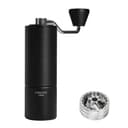 Best for espresso · Under $100 38 mm S2C660 stainless conical · ESP dial, 0.0233 mm per click, 30 clicks per rotation · 20 g catch cup · no published warranty, weight or dimensions The fine dial is the reason to buy it — buy the ESP, not the plain C3. | The fine dial is the reason to buy it — buy the ESP, not the plain C3.38 mm S2C660 stainless conical · ESP dial, 0.0233 mm per click, 30 clicks per rotation · 20 g catch cup · no published warranty, weight or dimensions | $99.00In stock, checked October 17, 2026 Check Price on Amazon |
| 2 | 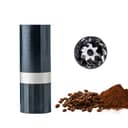 #2 1Zpresso Q Air Manual Coffee Grinder Best for travel · Under $100 30 clicks per rotation · 15-20 g capacity · 365 g · aimed by 1Zpresso at pour over, French press and cold brew · burr size and microns per click not published 1Zpresso build quality at travel weight, for filter brewing. | 1Zpresso build quality at travel weight, for filter brewing.30 clicks per rotation · 15-20 g capacity · 365 g · aimed by 1Zpresso at pour over, French press and cold brew · burr size and microns per click not published | $69.00In stock, checked October 17, 2026 Check Price on Amazon |
| 3 | 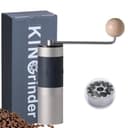 #3 Kingrinder K2 Manual Coffee Grinder Metal-bodied pick · Under $100 Steel burrs · numbered external adjustment · metal body; Kingrinder publishes no burr diameter The other sensible sub-$100 hand grinder if the Timemore is out of stock. | The other sensible sub-$100 hand grinder if the Timemore is out of stock.Steel burrs · numbered external adjustment · metal body; Kingrinder publishes no burr diameter | $88.00In stock, checked October 17, 2026 Check Price on Amazon |
| 4 | 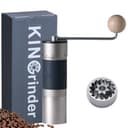 #4 Kingrinder K6 Manual Coffee Grinder Step up · Espresso-capable External numbered dial, 16 microns per click, 60 clicks per rotation, about 4 rotations of range · 25-35 g hopper · 1-year warranty If you can stretch past $100, this is the next real step for espresso. | If you can stretch past $100, this is the next real step for espresso.External numbered dial, 16 microns per click, 60 clicks per rotation, about 4 rotations of range · 25-35 g hopper · 1-year warranty | $109.00In stock, checked October 17, 2026 Check Price on Amazon |
The C3 naming trap
This is the single most common way money gets wasted in this bracket, which is why it has its own section. The same caution applies in reverse: if you only brew filter, the Classic dial is the more pleasant grinder to use, because you are not turning a fine thread across a wide range.
The other two under $100
Two more grinders belong in this budget, and both are covered in full in the best grinders under $100.
The Kingrinder K2 is the metal-bodied budget option with numbered external adjustment — a real alternative to the Timemore at similar money, and the one to buy if the C3 ESP is out of stock. Confirm the variant you are buying is the espresso-capable one; Kingrinder publishes no burr diameter for it.
Just above the budget, the Kingrinder K6 is the first hand grinder that publishes a micron figure — 16 per click, 60 clicks per rotation, roughly four rotations of range. If your espresso habit is daily rather than occasional, the stretch is worth it, and we compare it with the Timemore directly in K6 vs C3 ESP.
Which one for which buyer
| If this is you | Buy | Because |
|---|---|---|
| You own an espresso machine | C3 ESP | 0.0233 mm per click is the adjustment espresso needs. |
| You brew pour over or French press | Q Air | 1Zpresso aims it squarely at filter brewing. |
| You want a grinder for hotels and camping | Q Air | 365 g, and the smallest body here. |
| You grind a double dose every morning | C3 ESP | The 20 g catch cup takes a double; the Q Air holds 15-20 g. |
| Published burr specs matter to you | C3 ESP | 38 mm S2C660 conical is stated; the Q Air's burr is not. |
| You want a stated warranty | Neither — the Kingrinder K6 | Timemore publishes none at all; Kingrinder states one year. |
| Espresso is daily and you are dialing in often | Neither — stretch to the K6 or J-Ultra | 16 and 8 microns per click respectively, both published. |
| You refuse to grind by hand | Neither — the SHARDOR electric | Conical burrs and a timer, but happiest at drip and French press. |
The verdict
For espresso, the Timemore Chestnut C3 ESP wins and it is not close — the ESP dial is the only reason either of these grinders can hold an espresso setting, and Timemore publishes the burr it is attached to. Accept that the company tells you almost nothing else about the grinder, including whether it carries a warranty.
For everything else, the 1Zpresso Q Air is the better object. It is lighter, it is beautifully made, and its maker is honest about what it is for. Buy it as a filter and travel grinder and you will like it for years; buy it as an espresso grinder and you are working against the design.
If you are still deciding whether to put the money into the grinder or the machine, we take that apart in machine or grinder first.
What we know, and how we know it
What we did
- Took the specs from the manufacturer's own documentation — Timemore's official Chestnut C3 series specifications and 1Zpresso's own Q Air product page. Not from a retailer listing, and not from another blog.
- Priced it from Amazon's API, with the date we checked shown next to the number. If that price is more than 48 hours old, this page stops showing a number at all rather than show you a wrong one.
- Formed a verdict from those specs, the price, and what owners publicly report.
Where we hedged, and why
We have not ground coffee with either grinder and we run no lab. Every figure here is the manufacturer's: the 0.0233 mm ESP click and the 38 mm S2C660 burr from Timemore, and 30 clicks per rotation, 15-20 g and 365 g from 1Zpresso.
Both makers leave gaps and we name them rather than filling them. Timemore publishes no warranty page at all, no weight and no dimensions for the C3 ESP — the widely quoted 530 g comes from retailers. 1Zpresso publishes neither a microns-per-click figure nor a burr diameter for the Q Air, so the two grinders cannot be compared on burr size from manufacturer data, and we will not estimate either number. No price appears in our prose; every number here is live from Amazon with the date it was checked.
What we did not do
We do not run a lab. We have not pulled thousands of shots on this machine, and we are not going to pretend otherwise. We have not used this unit ourselves. Everything above is sourced research, and it is labeled as such. Where we have used a machine, we say so and show it.
How we're paid
If you buy through a link on this page, we earn a commission. It costs you nothing extra and it does not change what we recommend — we link to the better option for the buyer even when it earns us less. See how we review and our full disclosure.
Frequently asked questions
Can the 1Zpresso Q Air grind for espresso?
It can be pushed toward espresso, but 1Zpresso positions it for pour over, French press and cold brew, and they publish no microns-per-click figure for it. If espresso is your main drink, the Timemore C3 ESP at similar money is the grinder built for the job, and the Kingrinder K6 just above the budget is the first one here that publishes a micron step.
What is the difference between the Timemore C3 and the C3 ESP?
The dial. The standard C3's Classic dial moves 0.0833 mm per click; the ESP dial moves 0.0233 mm per click — nearly four times finer. For espresso that difference is everything, because the espresso window is narrow enough that a coarse step jumps straight over it. The bodies look almost the same, so check which dial the listing specifies.
Which is better value, the Q Air or the C3 ESP?
Neither is better value in the abstract, because they do different jobs. For an espresso drinker the C3 ESP is the only one of the two that works properly, so it is the better value at any price in this bracket. For a filter drinker or a traveller, the Q Air is lighter, smaller and better finished, and the C3 ESP's fine dial becomes a chore to wind across a wide range.
How much coffee does each one hold?
The C3 ESP's catch cup is 20 g, which covers a standard double espresso dose. The Q Air holds 15-20 g, which is a single filter dose. If you routinely grind for two cups at once, the C3 ESP is the more practical of the two.
Does either come with a warranty?
Kingrinder and 1Zpresso both state one year on their espresso grinders. For the C3 ESP, Timemore publishes no warranty information at all — timemore.com has no warranty page, and the terms you will see quoted come from retailers rather than the manufacturer. If a stated warranty matters to you, that is a real mark against it.
Is a hand grinder under $100 better than an electric at the same price?
For espresso, yes. All of a hand grinder's cost goes into burrs and adjustment rather than a motor and a housing, so a good manual at this price out-grinds the sub-$100 electrics for espresso. The trade is effort: grinding one double is fine, grinding four on a weekday morning is a chore.
Sources
Specs come from the manufacturer's own documentation. Prices come from Amazon's API. Where a claim comes from what owners report, we link the thread and say so.
- Timemore Chestnut C3 series official specifications (38 mm S2C660 conical burr; ESP dial 0.0233 mm per click, 30 clicks per rotation; Classic dial 0.0833 mm per click; 20 g catch cup; no warranty, weight or dimensions published)
- 1Zpresso Q Air official product page (30 clicks per rotation, 15-20 g capacity, 365 g, positioned for pour over / French press / cold brew)
- Kingrinder K6 — manufacturer specifications as published on its Amazon listing, read October 2026 (16 microns per click, 60 clicks per rotation, 1-year warranty)
Keep reading
- The best grinders under $100Every grinder worth buying in this budget, including both of these.
- The best hand grindersThe full field, from the C3 ESP up to the 1Zpresso K-Ultra.
- Kingrinder K6 vs Timemore C3 ESPThe step up from this comparison, for daily espresso.
- Grind size chartWhy espresso needs a fine dial and French press does not.
- Hand grinder vs electricWhat grinding by hand actually costs you in the morning.
- The best grinder for pour overWhere the Q Air fits properly, alongside the K-Ultra.