
Grinders · Comparison
Kingrinder K6 vs Timemore C3 ESP
Two espresso-capable hand grinders at roughly the same money, and the spec that decides between them is not the burrs — it is how small a change each dial can make.
The short answer
Buy the Kingrinder K6 if espresso is the point: 16 microns per click across 60 clicks per rotation is finer adjustment than the Timemore's 23, and the 25-35 g hopper takes a double dose comfortably. Buy the Timemore C3 ESP to spend the least and still grind real espresso.
We earn a commission if you buy through a link on this page. It costs you nothing extra and it does not change what we recommend. Full disclosure.
The short answer
Both of these are metal-bodied hand grinders with steel burrs and an external numbered adjustment, both are sold as espresso-capable, and both land near the same money. The honest difference is resolution and capacity. The Kingrinder K6 adjusts in 16 micron steps, 60 clicks per rotation, across four rotations of range, and holds 25-35 g. The Timemore Chestnut C3 ESP uses 38 mm S2C660 CNC-machined stainless conical burrs with an ESP dial at 0.0233 mm — about 23 microns — 30 clicks per rotation, into a 20 g catch cup.
If espresso is the reason you are buying, the K6 is the better tool: finer clicks give you somewhere to go when a shot pours too fast, and a 25-35 g hopper means a double dose goes in one load. If the goal is the lowest price at which a hand grinder is still worth putting in front of an espresso machine, the C3 ESP is that grinder, and it publishes more about its burrs than Kingrinder does.
Both sit inside the wider field in the best hand grinders, and if you have not settled the manual-versus-electric question at all, hand vs electric grinders is the page to read first.
The spec that decides it
Espresso is the only brew method where grind adjustment resolution is a real constraint rather than a nicety. The reason is simple: a double shot is a 25-to-35-second event, and you steer it almost entirely with grind size. When a shot runs four seconds fast you need to go slightly finer — and "slightly" has to be available to you. If one click moves the grind further than the correction you need, you overshoot into a choked shot, click back, and end up bouncing between two wrong settings.
That is what the micron figures mean in practice. 16 microns per click on the K6 is a smaller minimum move than 23 microns on the Timemore ESP dial, and the K6 also gives you more clicks per rotation (60 against 30) and four full rotations of range. Neither figure is our measurement; both are the makers' published numbers. For filter brewing the whole argument evaporates, because pour over and press tolerate a much wider window — our grind size chart shows how much wider.
Kingrinder K6: the finer dial
| Burrs | Stainless steel (diameter not published by Kingrinder) |
|---|---|
| Adjustment | External numbered dial · 16 microns per click · 60 clicks per rotation · 4 rotations of range |
| Capacity | 25-35 g hopper |
| Warranty | 1 year |
| Positioning | Kingrinder's espresso-capable model with external fine adjustment |
Who it is for: the espresso drinker who wants the finest adjustment available at this price and will accept that the maker is quiet about the burrs.
Kingrinder has built its reputation on delivering most of what the pricier 1Zpresso grinders do for noticeably less money, and the K6 is the model in that range aimed at espresso. The adjustment is the headline: an external numbered dial, 16 microns per click, 60 clicks per rotation and four rotations of usable travel. External numbering matters more than it sounds. It means your espresso setting is a number you can write down and return to, instead of a count of clicks from the burrs touching — which is how the cheaper internal-adjustment grinders work and how people lose their setting after a clean.
The 25-35 g hopper is the other practical win. An 18 g double dose goes in, gets ground, and there is headroom left; you are not splitting a dose across two loads. And Kingrinder publishes a one-year warranty, which sounds unremarkable until you notice that Timemore publishes none.
The honest cons. Kingrinder does not publish a burr diameter anywhere we can find, so the single most important hardware specification is simply unavailable — we are not going to repeat a number from a review somewhere. Fit and finish is a step below the 1Zpresso grinders it undercuts. And it is still a hand grinder: 30 to 60 seconds of cranking per double shot, every morning, forever.
Timemore C3 ESP: the cheapest capable one
| Type | Manual hand grinder |
|---|---|
| Burrs | 38 mm S2C660 conical, stainless steel, CNC-machined |
| Adjustment | The ESP dial gives 0.0233 mm per click (30 clicks per rotation). The standard C3's 'Classic' dial is nearly four times coarser at 0.0833 mm per click. For espresso that difference is the entire ballgame — make sure you are buying the ESP. |
| Stepless? | No — it clicks between steps (most grinders described as 'stepless' online aren't) |
| Good for espresso? | Yes, with the ESP dial — Timemore: 'ESP and ESP Pro models feature finer control for espresso dialing' |
| Capacity | 20 g catch cup |
| Dimensions | Not published by Timemore. |
| Weight | Not published by Timemore. (The 530 g figure you'll see quoted everywhere comes from retailers, not from Timemore.) |
| Warranty | Not published — timemore.com has no warranty page at all. |
Who it is for: someone buying their first espresso-capable grinder who wants to spend as little as possible without buying something that cannot do the job.
The C3 ESP is the cheapest hand grinder we would put in front of an espresso machine, and unlike the Kingrinder it tells you what is inside: 38 mm S2C660 conical stainless burrs, CNC-machined, with the ESP dial at 0.0233 mm per click over 30 clicks per rotation. For a grinder at this price, publishing the burr size and alloy is a meaningful transparency advantage, and it is the reason the C3 ESP shows up in our best grinders under $100 as the pick rather than a compromise.
The honest cons.The 20 g catch cup is tight for a double dose — workable, but you will feel it. The dial is coarser than the K6's at 23 microns against 16. Timemore publishes no warranty page at all, no weight and no dimensions, so the 530 g figure quoted all over the internet comes from retailers rather than from Timemore. And the model trap below is a genuine risk with this one.
Both grinders, compared
Every pick on this page in one view, with the live Amazon price and stock on each row. Specs are the figures the maker or the listing publishes — nothing measured or scored by us. Prices are read from Amazon's API and were last checked October 10, 2026; where we have no verified price, the row says so rather than show you an old number.
| # | Hand grinder | Why you'd pick it | Price & availability |
|---|---|---|---|
| 1 | 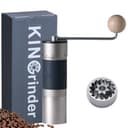 Best for espresso · Espresso-capable Stainless steel burrs (size not published) · 16 microns per click, 60 clicks per rotation, 4 rotations · external numbered dial · 25-35 g hopper · 1-year warranty Finer clicks and a bigger hopper — the better dialing-in tool of the two. | Finer clicks and a bigger hopper — the better dialing-in tool of the two.Stainless steel burrs (size not published) · 16 microns per click, 60 clicks per rotation, 4 rotations · external numbered dial · 25-35 g hopper · 1-year warranty | $109.00In stock, checked October 10, 2026 Check Price on Amazon |
| 2 | 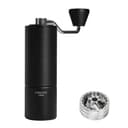 Cheapest capable · Espresso-capable 38 mm S2C660 CNC-machined stainless conical burrs · 0.0233 mm (23 microns) per click, 30 clicks per rotation · 20 g catch cup · warranty not published by Timemore The least you can spend and still grind real espresso — buy the ESP dial. | The least you can spend and still grind real espresso — buy the ESP dial.38 mm S2C660 CNC-machined stainless conical burrs · 0.0233 mm (23 microns) per click, 30 clicks per rotation · 20 g catch cup · warranty not published by Timemore | $99.00In stock, checked October 10, 2026 Check Price on Amazon |
| 3 | 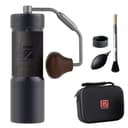 Best step-up · Espresso-tuned 48 mm coated burrs · 8 microns per click on an external ring · 35-40 g magnetic catch cup · about 700 g · 1-year limited warranty Twice the resolution of the K6 and the biggest burrs here, for roughly twice the money. | Twice the resolution of the K6 and the biggest burrs here, for roughly twice the money.48 mm coated burrs · 8 microns per click on an external ring · 35-40 g magnetic catch cup · about 700 g · 1-year limited warranty | $199.00In stock, checked October 10, 2026 Check Price on Amazon |
Buy the ESP, not the C3
This is the single most important sentence on the page if you are leaning Timemore. The standard Chestnut C3 and the C3 ESPlook nearly identical and cost nearly the same, and the dial is the entire difference. The ESP dial moves 0.0233 mm per click. The standard C3's "Classic" dial moves 0.0833 mm per click — nearly four times coarser. For espresso that is not a minor downgrade, it is the difference between being able to dial a shot in and not.
Listings for the two sit side by side and the suffix is easy to miss. Check that the title says ESP before you buy, and if a listing is vague about which dial is fitted, treat that as a reason to buy elsewhere. The same warning applies in reverse to the Kingrinder range, which runs K2, K4, K6 and up with different adjustment specifications — confirm you are buying the espresso-capable model you think you are.
What neither maker publishes
We would rather tell you what is missing than fill the gaps with numbers from elsewhere, so here is the honest state of the spec sheets.
- Kingrinder publishes no burr diameter. Burr size is the hardware specification most likely to predict grinding speed and feel, and it simply is not available for the K6 from the maker. Figures you see quoted come from reviews and retailers.
- Timemore publishes no warranty, weight or dimensions.There is no warranty page on timemore.com at all. For a grinder with moving parts that is a real consideration, especially against Kingrinder's stated year.
- Neither publishes burr alignment or geometry data. Nobody at this price does. Alignment is widely believed to matter more than burr size, and it is the figure the whole category keeps to itself.
None of that makes either grinder a bad buy. Both are genuinely capable at their price. But it does mean the comparison has to be decided on the figures that exist — adjustment resolution, capacity, warranty — rather than on a burr-versus-burr argument we cannot actually make.
If you want to spend more
| Type | Manual hand grinder |
|---|---|
| Burrs | 48 mm, coated. 1Zpresso does not say whether it is conical or flat for this model, and does not name the coating — so neither do we. |
| Adjustment | External ring, 8 microns per click — the finest of any 1Zpresso. Clicked, not stepless. |
| Stepless? | No — it clicks between steps (most grinders described as 'stepless' online aren't) |
| Good for espresso? | Yes — 1Zpresso: 'optimized for espresso' |
| Capacity | 35-40 g magnetic catch cup |
| Dimensions | 19 x 18.5 x 5.5 cm |
| Weight | About 700 g. 1Zpresso's own product page says 700 g and their own comparison table says 670 g. |
| Warranty | 1 year limited |
Who it is for: the drinker who knows espresso is the only job and wants the finest hand-grinder adjustment available before the prices get silly.
The J-Ultra is the obvious step up from both, and the gap is not marketing: 48 mm coated burrs against the Timemore's 38 mm, and 8 microns per click against 16 on the K6 and 23 on the C3 ESP — twice the resolution of the better of the two grinders above. The catch cup is 35-40 g, the warranty is a stated year, and 1Zpresso publishes considerably more about the grinder than either maker here. It costs roughly twice as much, which is the whole argument against it. If you want that comparison in full, read the J-Ultra against the C3 ESP.
Which one for which buyer
| If this is you | Buy | Because |
|---|---|---|
| Espresso is the only thing you brew | Kingrinder K6 | 16 microns per click beats 23 when you are correcting a fast shot. |
| You grind 18 g doubles every morning | Kingrinder K6 | 25-35 g hopper takes the dose in one load; the Timemore's 20 g is tight. |
| A published warranty matters to you | Kingrinder K6 | One year stated, against no warranty page at all from Timemore. |
| You want to spend the absolute minimum | Timemore C3 ESP | The cheapest grinder here that can genuinely dial in espresso. |
| You want to know what the burrs actually are | Timemore C3 ESP | 38 mm S2C660 stainless, CNC-machined, published. Kingrinder says nothing. |
| You also brew pour over and press | Either, comfortably | Filter tolerates a far wider grind window than espresso does. |
| You want the best hand grinder for espresso, full stop | 1Zpresso J-Ultra | 48 mm burrs and 8 microns per click, for about twice the money. |
The verdict
For espresso, buy the Kingrinder K6. Finer clicks, more of them per rotation, four rotations of range, an external numbered dial you can return to, a hopper that takes a double dose and a published warranty — that is a better espresso tool than the Timemore on every figure the two makers both disclose. Accept that Kingrinder will not tell you how big the burrs are.
Buy the Timemore Chestnut C3 ESP if the budget is the binding constraint. It is the cheapest hand grinder that will genuinely let you dial a shot in, it is more honest about its burrs than its rival, and its 23-micron ESP dial is enough resolution to make espresso work — just make absolutely sure the listing says ESP, because the standard C3 is nearly four times coarser and will not.
If neither feels like enough grinder, the honest next move is the 1Zpresso pair, or stay electric and read the best grinders under two hundred.
What we know, and how we know it
What we did
- Took the specs from the manufacturer's own documentation — Timemore's published C3-series specifications and the manufacturer specifications on the Kingrinder K6 listing. Not from a retailer listing, and not from another blog.
- Priced it from Amazon's API, with the date we checked shown next to the number. If that price is more than 48 hours old, this page stops showing a number at all rather than show you a wrong one.
- Formed a verdict from those specs, the price, and what owners publicly report.
Where we hedged, and why
We have not used either grinder and we run no lab, so there is no grind-consistency or taste test behind this page. The Timemore C3 ESP and the 1Zpresso J-Ultra are in our spec database and their tables are generated from it. The Kingrinder K6 is not — Kingrinder publishes no spec page we could find — so its table is rendered inline from the manufacturer specifications on its Amazon listing, read October 2, 2026, and it says "size not published" against the burrs rather than borrowing a number.
The micron comparison is a published-figure comparison, not a measurement. 16 microns per click (Kingrinder), 0.0233 mm per click (Timemore ESP) and 8 microns per click (1Zpresso) are each the maker's own claim. We use them to argue about dialing-in resolution, which is what they describe. We do not claim either grinder produces a measurably more uniform particle distribution or a better-tasting shot, because we have not measured that.
Timemore's missing warranty, weight and dimensions are absences on their own site, not oversights on ours. No price appears in our prose; every number on this page is live from Amazon and carries the date it was checked.
What we did not do
We do not run a lab. We have not pulled thousands of shots on this machine, and we are not going to pretend otherwise. We have not used this unit ourselves. Everything above is sourced research, and it is labeled as such. Where we have used a machine, we say so and show it.
How we're paid
If you buy through a link on this page, we earn a commission. It costs you nothing extra and it does not change what we recommend — we link to the better option for the buyer even when it earns us less. See how we review and our full disclosure.
Frequently asked questions
Is the Kingrinder K6 better than the Timemore C3 ESP?
For espresso, on the published figures, yes. The K6 adjusts in 16-micron clicks with 60 clicks per rotation across four rotations, holds 25-35 g, and carries a stated one-year warranty. The C3 ESP adjusts in 23-micron clicks over 30 clicks per rotation into a 20 g catch cup, and Timemore publishes no warranty. The Timemore's advantage is price and burr transparency.
What is the difference between the Timemore C3 and the C3 ESP?
The dial, and it is the whole decision. The ESP dial moves 0.0233 mm per click; the standard C3's Classic dial moves 0.0833 mm per click — nearly four times coarser. For espresso that difference decides whether you can dial a shot in at all. The two listings look almost identical, so check the title says ESP before you buy.
How big are the Kingrinder K6's burrs?
Kingrinder does not publish a burr diameter for the K6, so we do not state one. The listing specifies stainless steel burrs, 16 microns per click, 60 clicks per rotation, four rotations of range, a 25-35 g hopper and a one-year warranty. Any burr-diameter figure you see quoted for this grinder comes from reviews or retailers rather than the maker.
Can either of these grind for pour over and French press?
Yes, comfortably. Filter brewing tolerates a far wider grind window than espresso, so both grinders have more than enough range and resolution for pour over, press or AeroPress. The espresso-focused argument between them only matters because espresso is the brew method where a single click can be the difference between a sour shot and a balanced one.
Is a hand grinder at this price better than an electric at the same money?
On grind quality, usually yes. A hand grinder spends nothing on a motor, housing or hopper, so more of the price goes into the burrs and the adjustment mechanism. The cost is effort and time: 30 to 60 seconds of cranking per double shot. If that sounds like a chore you will resent, buy the electric and accept smaller burrs.
Which should I buy if I might upgrade later?
Buy the cheaper Timemore C3 ESP. If you suspect you will move to a 1Zpresso J-Ultra or an electric grinder within a year, there is no sense paying up for the middle option — the C3 ESP keeps the outlay low, still lets you dial espresso in, and makes a genuinely useful travel grinder once a bigger one lands on your counter.
Sources
Specs come from the manufacturer's own documentation. Prices come from Amazon's API. Where a claim comes from what owners report, we link the thread and say so.
- Timemore Chestnut C3 series official specifications (38 mm S2C660 CNC-machined stainless conical burrs, ESP dial at 0.0233 mm per click, 30 clicks per rotation, 20 g catch cup; no warranty, weight or dimensions published)
- KINGrinder K6 — manufacturer specifications on the Amazon listing (stainless steel burrs with no published diameter, 16 microns per click, 60 clicks per rotation, 4 rotations, 25-35 g hopper, 1-year warranty), read October 2, 2026
- 1Zpresso J-Ultra official product page (48 mm coated burrs, 8 microns per click, 35-40 g magnetic catch cup, 1-year limited warranty)
Keep reading
- The best hand grindersThe full manual field, including both of these and the 1Zpresso range above them.
- 1Zpresso J-Ultra vs Timemore C3 ESPThe same Timemore against the step-up, if you are weighing twice the money.
- The best grinders under $100Where the C3 ESP sits against everything else at the bottom of the market.
- Hand vs electric grindersSettle this before you choose between two hand grinders.
- Coffee grind size chartHow much wider the filter window is than the espresso one, in numbers.
- The best grinders for espressoWhere both land against the full field, electric and manual.