
Accessories · French press
The Best French Press Under $50
Under $50 is the whole category: nothing above it brews meaningfully better. What separates these three is sediment, parts supply, and how much frame you are paying for.
The short answer
Buy the Espro P3: its double micro-filter catches far more fines than a single mesh, and sediment is the one real complaint about French press coffee. The budget pick is the Bodum Brazil, which uses the same borosilicate carafe and mesh filter as the pricier Chambord with a plastic frame instead of chrome.
We earn a commission if you buy through a link on this page. It costs you nothing extra and it does not change what we recommend. Full disclosure.
All three picks, compared
Every pick on this page in one view, with the live Amazon price and stock on each row. Specs are the figures the maker or the listing publishes — nothing measured or scored by us. Prices are read from Amazon's API and were last checked November 6, 2026; where we have no verified price, the row says so rather than show you an old number.
| # | French press | Who it's for | Price & availability |
|---|---|---|---|
| 1 | 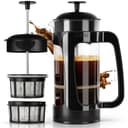 Best overall · Under $50 Double micro-filter catching more fines than a single mesh · glass carafe · two-part filter assembly to keep clean For the drinker who wants French press body without silt in the last mouthful. | For the drinker who wants French press body without silt in the last mouthful.Double micro-filter catching more fines than a single mesh · glass carafe · two-part filter assembly to keep clean | $39.94In stock, checked November 6, 2026 Check Price on Amazon |
| 2 | #2 Bodum Chambord French Press (34 oz) Best classic · Under $50 Borosilicate glass carafe · three-part stainless mesh filter · 34 oz / 8-cup · made in Portugal · replacement beakers and filters widely available For someone who wants a press they can keep re-glassing for a decade. | For someone who wants a press they can keep re-glassing for a decade.Borosilicate glass carafe · three-part stainless mesh filter · 34 oz / 8-cup · made in Portugal · replacement beakers and filters widely available | No verified price right now Check Price on Amazon |
| 3 | #3 Bodum Brazil French Press (34 oz) Budget pick · Under $25 Same borosilicate carafe and mesh filter as the Chambord · plastic frame instead of chrome · 34 oz / 8-cup For the cheapest cup identical to the mid-priced one. The frame is the only difference. | For the cheapest cup identical to the mid-priced one. The frame is the only difference.Same borosilicate carafe and mesh filter as the Chambord · plastic frame instead of chrome · 34 oz / 8-cup | No verified price right now Check Price on Amazon |
Why $50 is the whole category
A French press is a jar and a plunger. There is no pump, no boiler, no electronics and no moving part that can be engineered to extract better — the brewing is done by time and temperature, both of which you control, not the press. That is why this page is capped at $50 rather than ranging up to a flagship: above this band you are buying insulation, stainless styling or a brand, not better coffee.
It also means the sensible way to shop here is to decide which of three things you care about and buy the cheapest press that delivers it. Those three things are sediment, parts supply, and frame material — in that order of impact on what you actually drink.
Every pick below was under $50 at our last price check, and the exact date of that check is stamped on the comparison table and on each buy button above the price. Prices in this category move around with Bodum's and Espro's promotions, so trust the live figure on the button over anything written in prose — including ours.
The three things that actually differ
1. Sediment, which is the filter.All French press coffee carries some fines, because the filter is a mesh and fines are smaller than the mesh. A standard press uses a single mesh screen. The Espro P3 uses a double micro-filter, which catches considerably more on the way out — that is the one genuine functional difference among the three presses here, and it is the reason it leads this page. If the thing you dislike about French press is the gritty last inch of the cup, this is the fix.
2. Parts supply, which decides how long you keep it. French presses die one way: the glass breaks. Bodum has sold the Chambord for decades and replacement borosilicate beakers and filter sets are a commodity, which means a broken press is a cheap part rather than a new purchase. That is a real buying argument for a product otherwise indistinguishable from its rivals, and it is the same logic that makes a Bialetti the default on the stovetop espresso maker page.
3. Frame material, which decides nothing about the coffee. Here is the most useful thing on this page: the Bodum Brazil uses the same borosilicate carafe and the same mesh filter as the pricier Chambord. The difference is a plastic frame instead of a chrome one. If you would rather spend the gap on beans, the Brazil makes identical coffee, and we would not pretend otherwise to justify an upsell.
The three picks
Espro P3 — the cleanest cup under $50
Who it is for: the drinker who likes the heavy body of French press coffee but not the silt in the last mouthful. The P3 pairs a glass carafe with a double micro-filter rather than the single mesh screen every other press in this band uses, and that is the whole pitch: fewer fines through to the cup. In practice it also makes the coffee easier to leave sitting in the carafe for a few minutes without turning bitter, because less of the fine material stays in contact with the brew. The honest trade-offs are both about the filter: a two-part assembly is more to rinse than a single screen, and the plunge is slightly slower because you are pushing liquid through two layers. If neither bothers you, this is the press to buy.
Bodum Chambord — the classic you can keep repairing
Who it is for: someone who wants a press they can keep re-glassing for a decade. The published details are a borosilicate glass carafe, a three-part stainless mesh filter, 34 oz / 8-cup capacity, made in Portugal, with replacement beakers and filters widely available. The chrome frame is the version people picture when they picture a French press, and the parts story is genuinely the reason to pay for it over the Brazil: drop the carafe in year three and you buy a beaker, not a press. On sediment it is a standard single-mesh design, so expect more fines in the cup than the Espro. It is the default recommendation in our French press method guide.
Bodum Brazil — the budget pick
Who it is for: anyone who wants the cheapest press on this page and does not care what the frame is made of. This is the budget pick and it is the cheapest product here by a wide margin, but it is not a downgrade where it counts: it uses the same borosilicate carafe and the same mesh filter as the Chambord, in a plastic frame instead of chrome. Same capacity, 34 oz / 8-cup. Same coffee. The plastic frame is less handsome and will scuff, and that is the entire compromise. If you are buying your first French press, or buying one for an office kitchen or a holiday rental, buy this one and put the difference into better beans— which will change the cup far more than either upgrade on this page.
The upgrade that matters more than the press
If you are spending money to improve French press coffee, the press is not where it goes. The grinder is. French press needs a coarse, even grind, and the reason most home French press tastes muddy has nothing to do with the plunger: a blade grinder or a cheap burr set run coarse produces a wide spread of particle sizes, and the fines in that spread over-extract and slip through the mesh. Fix the grind and the same press makes noticeably cleaner coffee.
We cover exactly which grinders do coarse well, electric and manual, in the best grinders for French press, and the grind-size target is in the grind size chart. If you only ever brewed French press, a capable hand grinder is plenty — the best hand grinders starts well under the price of the presses on this page plus a grinder together.
Two more cheap things that change the cup: a scale so your ratio is repeatable instead of eyeballed, and a kettle you can pour accurately with — see the best gooseneck kettles under $100. The same press, the same beans and a known ratio will beat a more expensive press every time.
And if you are weighing the method itself against the alternatives, AeroPress vs French press is the honest comparison, while espresso machine vs French press answers the bigger spending question. A French press also doubles as the cheapest cold brew vessel there is, which is a genuine second use for every pick on this page.
What we know, and how we know it
What we did
- Took the specs from the manufacturer's own documentation. Not from a retailer listing, and not from another blog.
- Priced it from Amazon's API, with the date we checked shown next to the number. If that price is more than 48 hours old, this page stops showing a number at all rather than show you a wrong one.
- Formed a verdict from those specs, the price, and what owners publicly report.
Where we hedged, and why
None of these presses is in our spec database, which covers pump espresso machines and grinders only. Every figure above is what Bodum or Espro publishes, or what the Amazon listing states — carafe material, filter construction, capacity in ounces and cups, country of manufacture. Neither maker publishes a mesh aperture figure in microns, so we describe the Espro's filter as a double micro-filter that catches more fines than a single mesh rather than quoting a number nobody states.
We have not brewed with these presses ourselves and we have not measured sediment in the cup. The recommendation order comes from the published filter designs, the parts situation, and the fact that two of the three share a carafe and a filter — not from a test we did not run. The "under $50" framing is based on the live price layer at the date stamped on the table above; prices move, so the button is the authority, not this sentence.
What we did not do
We do not run a lab. We have not pulled thousands of shots on this machine, and we are not going to pretend otherwise. We have not used this unit ourselves. Everything above is sourced research, and it is labeled as such. Where we have used a machine, we say so and show it.
How we're paid
If you buy through a link on this page, we earn a commission. It costs you nothing extra and it does not change what we recommend — we link to the better option for the buyer even when it earns us less. See how we review and our full disclosure.
For the brewing itself — ratio, steep time, and the filtering step that is where this method usually goes wrong — read how to brew with a French press. More on the accessories hub.
Frequently asked questions
What is the best French press under $50?
The Espro P3. It uses a double micro-filter instead of the single mesh screen every other press in this band uses, which catches considerably more fines - and sediment is the one real complaint about French press coffee. The trade is a two-part filter assembly to rinse and a slightly slower plunge. For the cheapest route, the Bodum Brazil brews identically to the pricier Chambord.
Is an expensive French press worth it?
No. A French press has no pump, no boiler and no moving part that affects extraction - time and temperature do the work, and you control both. Above about $50 you are buying insulation, stainless styling or a brand rather than better coffee. Decide which of sediment, parts supply or frame material you care about, and buy the cheapest press that delivers it.
What is the difference between the Bodum Brazil and the Bodum Chambord?
The frame, and almost nothing else. The Brazil uses the same borosilicate carafe and the same mesh filter as the Chambord, with a plastic frame instead of chrome, and both are 34 oz / 8-cup. The coffee is identical. The Chambord is better looking and the chrome frame survives knocks better; if that is not worth the gap to you, buy the Brazil and spend the difference on beans.
How do I stop sediment in French press coffee?
Two things, in order. First, grind coarser and more evenly - most sediment is fines produced by a grinder that cannot hold a coarse setting cleanly, not by the press. Second, use a press with a better filter: the Espro P3's double micro-filter catches considerably more fines than a single mesh screen. Also do not press all the way down to the bed, and pour off rather than leaving coffee in the carafe.
How many cups does a 34 oz French press make?
About two generous mugs. A French press 'cup' is roughly 4 oz, so a press sold as 34 oz / 8-cup is right for one or two drinkers rather than a household. Avoid buying a larger press to brew a small amount in - a shallow slurry under the plunger makes a thinner cup, so match the size to what you actually drink.
Can I use a French press for cold brew?
Yes, and it is the cheapest cold brew vessel there is: coarse grounds, cold water, overnight in the fridge, then plunge and pour off immediately. Every press on this page works for it. The one thing to get right is filtering - leaving the coffee sitting on the grounds after plunging is what makes cold brew taste muddy, so decant it into a clean jug.
What grind size do I need for a French press?
Coarse, and - more importantly - even. A wide spread of particle sizes is what makes French press taste muddy, because the fines in that spread over-extract and slip through the mesh. A burr grinder that holds a coarse setting cleanly is the single biggest upgrade available to a French press drinker, and a capable hand grinder is enough if this is the only method you brew.
Sources
Specs come from the manufacturer's own documentation. Prices come from Amazon's API. Where a claim comes from what owners report, we link the thread and say so.
- Bodum - Chambord French press official product page
- Espro - P3 French press official product page (double micro-filter)
- Bodum Brazil, Bodum Chambord and Espro P3 - carafe material, filter construction and capacity as published on the Amazon listings, read November 7, 2026
- Specialty Coffee Association - coffee research and standards
Keep reading
- How to brew with a French pressRatio, steep time, and the filtering step where this method usually goes wrong.
- Best grinders for French pressThe upgrade that changes the cup more than any press on this page.
- Best gooseneck kettles under $100Pour control and a known water temperature, for less than the price of a press.
- AeroPress vs French pressSame money, two very different cups. Which method suits you.
- How to brew cold brewEvery press here doubles as the cheapest cold brew vessel you can buy.
- Coffee scalesA repeatable ratio beats a more expensive press. This is the cheaper upgrade.