
Guides · Comparison
Espresso Machine vs French Press
One applies nine bars of pressure to a tiny bed of fine coffee in half a minute. The other lets coarse coffee sit in hot water for four minutes. Almost everything that follows comes from that difference.
The short answer
Buy a French press if you want excellent black coffee for several people, cheaply, with almost no learning curve. Buy an espresso machine if you want espresso specifically or milk drinks like lattes and cappuccinos — a press cannot make either, because it applies no pressure at all.
We earn a commission if you buy through a link on this page. It costs you nothing extra and it does not change what we recommend. Full disclosure.
Key takeaways
- An espresso machine forces water through fine coffee at around 9 bar in 25-30 seconds. A French press is immersion at zero pressure for about four minutes. Different drinks, not different qualities.
- A press makes several cups at once and needs no skill. An espresso machine makes one drink at a time and needs some.
- A press cannot make a latte or a cappuccino, because there is no espresso and no steam. That alone decides this for many households.
- The grinder requirement is the hidden cost: a press is happy with a cheap burr grinder, espresso is not.
They are not the same drink
It is worth being precise about the mechanisms, because every practical difference falls out of them.
An espresso machine is a pressure brewer. A pump pushes hot water through a finely ground, tamped bed of coffee at around nine bars for roughly 25 to 30 seconds. The pressure emulsifies oils and dissolves carbon dioxide into the liquid, which is what produces crema and the thick, syrupy body espresso is known for. The output is small — 30 to 60 ml — and intense.
A French press is an immersion brewer at atmospheric pressure. Coarse coffee steeps in hot water for about four minutes, then a metal mesh plunger separates the grounds from the liquid. No pressure is applied: the plunger filters, it does not force water through anything. The output is a mug or several, full-bodied because the metal mesh lets oils and fine particles through, and nothing like espresso in concentration.
So "which is better" is the wrong question. The right one is which drink you want in the morning — and after that, what each costs you in money, time and skill. If the underlying distinction interests you, espresso vs coffee goes deeper on why espresso is a method rather than a bean or a strength.
The comparison, line by line
| Espresso machine | French press | |
|---|---|---|
| Mechanism | ~9 bar pressure through a tamped puck | Immersion, no pressure, mesh filter |
| Brew time | 25-30 seconds, plus warm-up | About 4 minutes, unattended |
| Output | One 30-60 ml shot or drink at a time | Three to four mugs in one brew |
| Grind | Fine, exacting — a few microns matter | Coarse, forgiving |
| Skill curve | Real: dose, distribution, tamp, timing | Minimal: ratio, time, do not over-press |
| Milk drinks | Yes — espresso plus a steam wand | No espresso and no steam |
| Counter space | A machine, plus a grinder | A jug in a cupboard |
| Power | 1100-1450 W from a wall outlet | None — just hot water |
| Cleanup | Knock the puck, wipe the group, flush | Dispose of wet grounds, rinse the filter |
| Maintenance | Descaling, backflushing, gaskets over time | A replacement mesh occasionally |
What each really costs
We will not print numbers that rot, so every price on this page is live from Amazon with the date it was checked. But the shape of the two bills is very different and worth stating.
A French press is close to its sticker price. You need the press, a grinder if you want to grind fresh, and beans. That is the whole list — the press needs no power, no descaling, no accessories and no plumbed anything. A good press is one of the cheapest serious brewers in coffee.
An espresso machine is rarely just the machine. Even the cheapest route adds a grinder (fine and consistent, which is the expensive kind), probably a tamper if the boxed one is poor, somewhere to knock the puck, and descaling supplies on a schedule. Our what home espresso really costs guide lays out that arithmetic across every tier, and the gap between the two columns is wider than the machine price alone suggests.
The grinder trap
This is the part most comparisons leave out, and it changes the decision more than any machine feature.
Both methods want burr-ground coffee rather than the dust-and-boulders output of a blade grinder. But what each needs from a grinder is completely different. A press wants a coarse grind and mostly cares about uniformity, so a modest burr grinder is a legitimate end state — our best grinder for French press page explains why that requirement is so much cheaper to satisfy.
Espresso wants a fine grind and fine adjustment resolution, because the shot is steered almost entirely by grind size and a single coarse click can ruin it. That means an espresso-capable grinder, which is a meaningful purchase in its own right — and the reason the standard advice is that the grinder matters more than the machine. A cheap espresso machine with a good grinder makes better coffee than an expensive one with a bad grinder. A press is simply not that sensitive.
Milk drinks settle it for many people
If what you actually want is a latte, a cappuccino or a flat white, this comparison is already over. Those drinks are espresso plus textured milk, and a French press provides neither: no pressure means no espresso, and there is no steam source at all.
You can add hot milk to press coffee and it is pleasant — but it is a café au lait, not a latte, and anyone expecting the latter will be disappointed. The distinctions between the milk drinks themselves are real and worth knowing — wet vs dry cappuccino is the one people are most often ordering without realising it. The honest version: if milk drinks are the goal, buy a machine with a steam wand, and look at a machine that can texture rather than merely froth. Our best machines for lattes page is built around exactly that distinction, and cappuccino vs latte covers what the drinks actually are.
What to buy for each
One pick at each price, both ways
Every pick on this page in one view, with the live Amazon price and stock on each row. Specs are the figures the maker or the listing publishes — nothing measured or scored by us. Prices are read from Amazon's API and were last checked October 10, 2026; where we have no verified price, the row says so rather than show you an old number.
| # | Pick | Why this one | Price & availability |
|---|---|---|---|
| 1 | 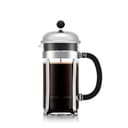 #1 Bodum Chambord French Press (34 oz) Best press · French press Borosilicate glass carafe · three-part stainless mesh filter · polished chrome frame · replacement beakers and filters widely available The archetype, built to a standard rather than to the cheapest possible spec. | The archetype, built to a standard rather than to the cheapest possible spec.Borosilicate glass carafe · three-part stainless mesh filter · polished chrome frame · replacement beakers and filters widely available | $39.69In stock, checked October 10, 2026 Check Price on Amazon |
| 2 | 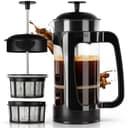 Least sediment · French press Double micro-filter designed to catch far more fines than a standard mesh · borosilicate carafe If silt in the bottom of the mug is your objection to press coffee. | If silt in the bottom of the mug is your objection to press coffee.Double micro-filter designed to catch far more fines than a standard mesh · borosilicate carafe | $39.94In stock, checked October 10, 2026 Check Price on Amazon |
| 3 | 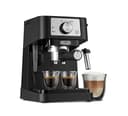 #3 De'Longhi Stilosa (EC260BK) Cheapest espresso · Espresso machine Stainless steel boiler · 15 bar · 1 L tank · 1100 W · 8.61 lb · pannarello frother · 1-year warranty plus 1 with registration The cheapest real espresso machine — but budget for the grinder too. | The cheapest real espresso machine — but budget for the grinder too.Stainless steel boiler · 15 bar · 1 L tank · 1100 W · 8.61 lb · pannarello frother · 1-year warranty plus 1 with registration | $99.95In stock, checked October 10, 2026 Check Price on Amazon |
| 4 | 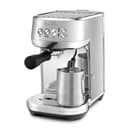 #4 Breville Bambino Plus (BES500) Best espresso start · Espresso machine ThermoJet — extraction temperature in 3 seconds (Breville's figure) · 54 mm portafilter · automatic milk texturing · 2-year warranty Three-second heat-up and milk that textures properly, for real latte drinks. | Three-second heat-up and milk that textures properly, for real latte drinks.ThermoJet — extraction temperature in 3 seconds (Breville's figure) · 54 mm portafilter · automatic milk texturing · 2-year warranty | $399.95In stock, checked October 10, 2026 Check Price on Amazon |
If you choose the press
Who it is for: anyone who wants excellent black coffee for two to four people with no equipment hobby attached.
The Chambord is the archetypal French press: a borosilicate glass carafe, a proper three-part stainless mesh filter and the chrome frame that has looked the same for decades. It is built to a standard rather than to the cheapest possible spec, and replacement beakers and filters are easy to find — which matters for a device whose glass is its weak point. Get the method right in our French press guide; the filtering step is the one people get wrong.
Who it is for: the drinker whose only complaint about press coffee is the sediment.
Silt in the bottom of the mug is the standard objection to a French press, and it comes from fines passing through a single mesh. Espro built the P3 specifically to address that with a double micro-filter that catches far more of them. You give up a little simplicity — more filter to keep clean — for a noticeably cleaner cup.
If you choose espresso
| Type | Semi-automatic, no grinder |
|---|---|
| Portafilter | De'Longhi does not publish a portafilter size for this machine, so we're not going to state one. The figures you'll find online come from third-party sellers of aftermarket portafilters, not from De'Longhi. |
| Boiler | Stainless steel boiler — the only De'Longhi here with a real boiler, not a Thermoblock |
| PID temperature control | No |
| Built-in grinder | No — you'll need a separate grinder |
| Milk | Manual — pannarello-style frother |
| Pump pressure | 15 bar |
| Water tank | 1 L |
| Power | 1100 W |
| Dimensions | 8.07" W x 13.5" D x 11.22" H |
| Weight | 8.61 lb (3.9 kg) |
| Warranty | 1 year, plus 1 more with product registration |
| In the box | Portafilter, tamper, single filter, double filter, measuring spoon, ESE pod filter |
Who it is for: someone who wants to find out whether home espresso is for them without committing real money.
The Stilosa is the cheapest machine we would recommend, and it has one specification that genuinely stands out at the price: a stainless steel boiler rather than a Thermoblock, which is De'Longhi's own claim. It is small, it froths milk with a pannarello, and it will make real espresso. Be clear-eyed about what it is not: no PID, no published portafilter diameter, and the grinder is on you. More options at that money in the best machines under $200.
| Type | Semi-automatic, no grinder |
|---|---|
| Portafilter | 54 mm |
| Boiler | ThermoJet — ideal extraction temperature in 3 seconds |
| PID temperature control | Yes |
| Built-in grinder | No — you'll need a separate grinder |
| Milk | Automatic, hands-free — 3 milk temperatures x 3 foam levels, with auto-purge |
| Pump pressure | 15 bar |
| Pre-infusion | Yes |
| Heat-up time | 3 seconds (Breville's own figure, stated on the product page and in the manual) |
| Water tank | 1.9 L |
| Power | 1560 W |
| Dimensions | 7.5" W x 13.5" D x 12" H |
| Weight | 10.91 lb (4.95 kg) |
| Warranty | 2 years limited |
| In the box | 54 mm tamper, Razor precision dosing tool, 480 ml stainless milk jug, 1- and 2-cup single- and dual-wall baskets, cleaning tool and disc |
Who it is for: the household swapping a press for espresso because they want lattes and flat whites, and want them without a twenty-minute warm-up.
This is the machine we point most first-time espresso buyers at. Breville publishes three seconds to ideal extraction temperature for its ThermoJet heater, which removes the single biggest practical objection to a real machine — the waiting — and the automatic milk texturing makes a latte achievable in week one rather than month three. It has no grinder, so the grinder conversation above still applies. Full detail in the Bambino Plus review.
The case for owning both
These two are not really competitors, and plenty of kitchens run both for good reasons. A press handles the Sunday morning where four people want coffee at the same time and nobody wants to pull four shots back to back on a single-boiler machine — which is a real constraint, not a preference: how many shots a machine can actually make in a row depends on its boiler. An espresso machine handles the weekday flat white that a press cannot produce at all.
If that is the direction you are heading, the sequencing advice is worth hearing: buy the press and a decent burr grinder first, because the grinder carries over and the press is cheap. Then add the machine when you know you want espresso rather than just strong coffee. That order is cheaper and lower-risk than the reverse, and it is the same logic as machine or grinder first.
Which one for which drinker
| If this is you | Buy | Because |
|---|---|---|
| You want lattes, cappuccinos or flat whites | Espresso machine | A press makes neither espresso nor steam. It is not close. |
| Several people want coffee at the same time | French press | Three to four mugs in one unattended four-minute brew. |
| Your total budget is small | French press plus a burr grinder | Better coffee per dollar than cheap espresso with no grinder. |
| You want a hobby you can get good at | Espresso machine | A press has a ceiling you reach in a fortnight; espresso does not. |
| You have no counter space or no outlet | French press | It lives in a cupboard and needs nothing but hot water. |
| You hate sediment in your cup | Espresso machine, or an Espro P3 | A single mesh filter passes fines; both of these address it. |
| Mornings are six minutes long | Either, but pick carefully | A press brews unattended; a ThermoJet machine is ready in seconds. |
The verdict
Choose by the drink, not by the price. If you want espresso, or any drink built on it, a French press is not an alternative — it applies no pressure, so it cannot make the drink at all. Buy a machine, and budget for the grinder in the same breath, because espresso is the unforgiving method and it needs that support.
If you want excellent black coffee, several cups at once, with no power, no descaling, no learning curve and very little money, the French press is one of the best-value purchases in coffee and we would not try to talk you out of it. A good press with a modest burr grinder is a genuine end state rather than a stepping stone.
And if you suspect the real answer is both, start with the press and the grinder — the grinder carries forward, and you will know within a month whether espresso is a thing you want to learn. Next, see how the press compares with the other immersion brewer in AeroPress vs French press, or how espresso stacks up against the drip machine you may also own in espresso machine vs coffee maker. The same comparison against the pod machines runs in espresso machine vs Nespresso and espresso machine vs Keurig, and if you have decided on a machine but not a maker, the brand guide is the next page.
What we know, and how we know it
What we did
- Took the specs from the manufacturer's own documentation — De'Longhi's and Breville's published machine specifications, and the Bodum and Espro listings. Not from a retailer listing, and not from another blog.
- Priced it from Amazon's API, with the date we checked shown next to the number. If that price is more than 48 hours old, this page stops showing a number at all rather than show you a wrong one.
- Formed a verdict from those specs, the price, and what owners publicly report.
Where we hedged, and why
We have not used this equipment and we run no lab, so no side-by-side tasting sits behind this page. The two machines are in our spec database and their tables are generated from it — including Breville's own three-second ThermoJet figure and De'Longhi's own stainless boiler claim. The two presses are described from their listings and from Bodum's and Espro's own product information.
The mechanism comparison is physics, not a test. That espresso runs at around nine bar and a French press applies none, and that pressure is what creates crema and body, describes how the two devices work. We attach no extraction percentages, strength figures or caffeine numbers to either, because we have measured none — if strength is your actual question, is espresso stronger than regular coffee handles it with sourced figures.
The cost comparison deliberately contains no numbers in prose: every price here is live from Amazon and carries its own date. Our claim that a press plus a burr grinder beats a very cheap espresso machine on quality per dollar is an editorial judgement about how unforgiving espresso is, stated as such rather than as a measured result.
What we did not do
We do not run a lab. We have not pulled thousands of shots on this machine, and we are not going to pretend otherwise. We have not used this unit ourselves. Everything above is sourced research, and it is labeled as such. Where we have used a machine, we say so and show it.
How we're paid
If you buy through a link on this page, we earn a commission. It costs you nothing extra and it does not change what we recommend — we link to the better option for the buyer even when it earns us less. See how we review and our full disclosure.
Frequently asked questions
Is a French press better than an espresso machine?
They make different drinks, so neither is better in general. A French press is immersion brewing at no pressure: cheap, unskilled, several mugs at once, full-bodied black coffee. An espresso machine forces water through fine coffee at around nine bars to make a small, intense, crema-topped shot, and with a steam wand it makes milk drinks a press cannot. Choose by the drink you want.
Can you make espresso in a French press?
No. A French press applies no pressure at all — the plunger separates grounds from brewed coffee rather than forcing water through them, and espresso is defined by roughly nine bars of pressure. Grinding fine to compensate only fills the cup with sediment, because a metal mesh filter cannot hold fines back. It is the wrong tool for that job.
Can you make a latte with a French press?
Not a real one. A latte is espresso plus textured milk, and a press provides neither espresso nor steam. Adding hot milk to press coffee makes a pleasant café au lait, which is a different drink. Some people froth milk in a clean press by plunging it rapidly, but without espresso underneath it the result is not a latte.
Which is cheaper to own, a French press or an espresso machine?
The press, by a wide margin, and the gap is bigger than the sticker prices suggest. A press needs no power, no descaling and no accessories — just the press, beans and ideally a grinder. An espresso machine typically adds an espresso-capable grinder, a decent tamper, somewhere to knock the puck and descaling supplies on a schedule.
Do I need an expensive grinder for a French press?
No, and this is the key practical difference. A press wants a coarse grind and mostly cares about uniformity, so a modest burr grinder is a legitimate long-term answer. Espresso wants a fine grind with fine adjustment resolution, which costs considerably more. Both methods do want burrs rather than blades.
Should I buy a French press before an espresso machine?
If you are not certain you want espresso specifically, yes. Buy the press and a decent burr grinder: the press is cheap, the grinder carries forward to whatever you buy next, and within a month you will know whether you want espresso as a hobby or simply wanted stronger coffee. That order risks far less money than the reverse.
Sources
Specs come from the manufacturer's own documentation. Prices come from Amazon's API. Where a claim comes from what owners report, we link the thread and say so.
- Breville BES500 Bambino Plus product page and manual (ThermoJet, 3 seconds to ideal extraction temperature, 54 mm portafilter, automatic milk texturing, 2-year warranty)
- De'Longhi EC260BK Stilosa product page (stainless steel boiler, 15 bar, 1 L tank, 1100 W, pannarello frother)
- Bodum — Chambord French press product information (borosilicate carafe, three-part stainless filter)
- Espro — P3 French press product information (double micro-filter)
- Specialty Coffee Association — coffee research and standards
Keep reading
- The French press guideGrind, ratio, steep and the filtering step that actually goes wrong.
- Espresso machine vs coffee makerThe same comparison against the drip machine most kitchens already own.
- AeroPress vs French pressThe other immersion brewer, and which suits your mornings.
- The best grinder for French pressWhy a press needs far less grinder than espresso does.
- What home espresso really costsThe full bill for the espresso column, including what people forget.
- The best machines for lattesIf milk drinks are the reason you are leaving the press behind.