
Grinders · AeroPress
The Best Coffee Grinder for an AeroPress
The AeroPress is the only brewer on your shelf whose correct grind changes with the recipe you choose. That makes this a different shopping question from espresso or pour over — and it changes which grinder you should buy.
The short answer
Buy the 1Zpresso Q Air: at 365 g with a 15-20 g capacity it matches an AeroPress dose exactly, and 1Zpresso aims it at the filter range AeroPress recipes live in. The Timemore C3 ESP is the cheapest worth owning, the Baratza Encore ESP the electric pick, and the K-Ultra the do-everything choice.
We earn a commission if you buy through a link on this page. It costs you nothing extra and it does not change what we recommend. Full disclosure.
Key takeaways
- AeroPress recipes span a huge grind range: short, fine, near-espresso presses at one end and four-minute coarse steeps at the other.
- So the useful specification is range plus a repeatable setting — not the finest possible adjustment.
- A dose is one scoop, roughly 15-18 g, which means grinder capacity can be small and portability is a real feature.
- A burr grinder matters less dramatically here than for espresso, because a paper filter and a long-ish steep forgive some unevenness. It still produces a cleaner cup.
Why the grind is a moving target
Every other brewer on your counter has one grind band. Espresso is fine and narrow; a moka pot is a little coarser; French press is coarse. The AeroPress is the exception: it is the most versatile brewer you can own, and the published recipes for it disagree with each other on purpose. A one-minute press with a fine grind makes a concentrated, almost espresso-like cup. A four-minute inverted steep with a coarse grind makes something closer to a clean French press. Both are "correct" AeroPress.
That is why the shopping question changes. You are not buying a grinder to sit at one setting; you are buying one that lets you move between settings and come back to a cup you liked last week. Our AeroPress guide covers the method itself — hand pressure makes a few bar at most, so what you are brewing is a concentrate rather than espresso.
What to look for
- Range you can cross quickly. Clicks per rotation on a hand grinder, or a dial with distinct bands on an electric. If moving from a fine press to a coarse steep takes twenty turns, you will stop experimenting — which defeats the point of owning an AeroPress.
- A setting you can record. Numbered clicks or numbered settings. The whole appeal of this brewer is having three or four recipes you rotate through, and that only works if you can return to each grind.
- Capacity around one dose. An AeroPress scoop is roughly 15-18 g. A 15-20 g catch cup is a perfect match; a 300 g hopper is fine but means beans live in the machine.
- Portability, if you travel. The AeroPress is the brewer people take with them. A 365 g grinder keeps that promise; a 15 lb single-doser does not.
- Burrs over blades. Less critical than for espresso — the paper filter catches fines and a longer steep evens things out — but a burr grinder still gives you a cleaner cup and a repeatable one. The mechanics are in burr vs blade.
All four picks, compared
Every pick on this page in one view, with the live Amazon price and stock on each row. Specs are the figures the maker or the listing publishes — nothing measured or scored by us. Prices are read from Amazon's API and were last checked October 17, 2026; where we have no verified price, the row says so rather than show you an old number.
| # | Grinder | Why it's here | Price & availability |
|---|---|---|---|
| 1 | 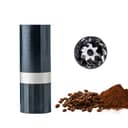 #1 1Zpresso Q Air Manual Coffee Grinder Best overall · Under $100 30 clicks per rotation · 15-20 g capacity · 365 g · positioned by 1Zpresso for pour over, French press and cold brew · burr size and microns per click not published One-dose capacity and travel weight, in the right grind band. | One-dose capacity and travel weight, in the right grind band.30 clicks per rotation · 15-20 g capacity · 365 g · positioned by 1Zpresso for pour over, French press and cold brew · burr size and microns per click not published | $69.00In stock, checked October 17, 2026 Check Price on Amazon |
| 2 | 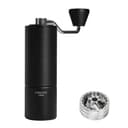 Best budget · Under $100 38 mm S2C660 stainless conical · ESP dial, 0.0233 mm per click, 30 clicks per rotation · 20 g catch cup · no published warranty A published 38 mm burr and a fine dial, for very little money. | A published 38 mm burr and a fine dial, for very little money.38 mm S2C660 stainless conical · ESP dial, 0.0233 mm per click, 30 clicks per rotation · 20 g catch cup · no published warranty | $99.00In stock, checked October 17, 2026 Check Price on Amazon |
| 3 | 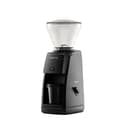 Best electric · Electric, hopper-fed 40 mm Etzinger M2 conical · 40 settings split 1-20 espresso / 21-40 filter · factory-calibrated · 300 g hopper, 120 g bin · 1-year warranty Two numbered ranges cover fine presses and coarse steeps alike. | Two numbered ranges cover fine presses and coarse steeps alike.40 mm Etzinger M2 conical · 40 settings split 1-20 espresso / 21-40 filter · factory-calibrated · 300 g hopper, 120 g bin · 1-year warranty | $199.95In stock, checked October 17, 2026 Check Price on Amazon |
| 4 | 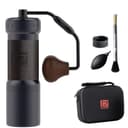 #4 1Zpresso K-Ultra Manual Coffee Grinder Best all-rounder · Hand, all-round Stainless conical 'K Burr' set · external dial, 20 microns per click, 100+ clicks per rotation · 35-40 g magnetic catch cup · 700 g · case included The fastest way to cross the whole range, with a case for travel. | The fastest way to cross the whole range, with a case for travel.Stainless conical 'K Burr' set · external dial, 20 microns per click, 100+ clicks per rotation · 35-40 g magnetic catch cup · 700 g · case included | $259.00In stock, checked October 17, 2026 Check Price on Amazon |
The four picks
1Zpresso Q Air — sized for exactly this brewer
| Adjustment | 30 clicks per rotation |
|---|---|
| Capacity | 15-20 g |
| Weight | 365 g |
| Positioning | 1Zpresso aims it at pour over, French press and cold brew — it can be pushed to espresso, but that is not what it is for |
| Microns per click | Not published by 1Zpresso for this model |
| Burr size | Not published by 1Zpresso for this model |
Who it is for: nearly every AeroPress owner, and especially anyone who brews away from home.
The specification match here is unusually neat. A 15-20 g capacity is one AeroPress dose, so you weigh in, grind, and brew without a second pass or leftovers. At 365 g it is the lightest grinder 1Zpresso makes, which matters because the AeroPress is the brewer people pack — a Q Air plus an AeroPress Go is a complete coffee kit that fits in hand luggage. And the band 1Zpresso aims it at — pour over, French press, cold brew — is precisely the band AeroPress recipes move around in.
The honest cons. 1Zpresso publishes no microns-per-click figure and no burr diameter for this model, so we cannot compare it with the others on burr size, and we are not going to estimate. If you also want to pull espresso with the same grinder, this is the wrong one — see the espresso grinder picks instead.
Timemore Chestnut C3 ESP — the budget answer with published burrs
| Type | Manual hand grinder |
|---|---|
| Burrs | 38 mm S2C660 conical, stainless steel, CNC-machined |
| Adjustment | The ESP dial gives 0.0233 mm per click (30 clicks per rotation). The standard C3's 'Classic' dial is nearly four times coarser at 0.0833 mm per click. For espresso that difference is the entire ballgame — make sure you are buying the ESP. |
| Stepless? | No — it clicks between steps (most grinders described as 'stepless' online aren't) |
| Good for espresso? | Yes, with the ESP dial — Timemore: 'ESP and ESP Pro models feature finer control for espresso dialing' |
| Capacity | 20 g catch cup |
| Dimensions | Not published by Timemore. |
| Weight | Not published by Timemore. (The 530 g figure you'll see quoted everywhere comes from retailers, not from Timemore.) |
| Warranty | Not published — timemore.com has no warranty page at all. |
Who it is for: the buyer who wants a real burr grinder for an AeroPress and wants the maker to tell them what is inside it.
This grinder's claim to the list is transparency plus price: a 38 mm S2C660 stainless conical burr, CNC-machined, with the diameter actually published, and a dial that moves 0.0233 mm per click. For AeroPress that fine step is more resolution than you need — which is fine, because 30 clicks per rotation still crosses the useful range quickly. The 20 g catch cup covers a dose with room to spare. If you also own an espresso machine, this is the cheapest grinder we would put in front of one.
The honest cons. Timemore publishes no warranty page at all, and no weight or dimensions for this grinder — the 530 g you will see quoted comes from retailers, not from Timemore. The fine dial also means more turning to reach coarse settings than the Q Air needs.
Baratza Encore ESP — if you would rather press a button
| Type | Electric |
|---|---|
| Burrs | 40 mm conical steel (M2), made by Etzinger in Liechtenstein |
| Adjustment | 40 stepped settings, adjusted by twisting the hopper. Dual range: 1-20 espresso, 21-40 filter. |
| Stepless? | No — it clicks between steps (most grinders described as 'stepless' online aren't) |
| Good for espresso? | Yes, and it is the headline use — Baratza: 'delivers the grind resolution you need to brew creamy, syrupy shots of espresso' |
| Capacity | 300 g hopper, 120 g grounds bin |
| Motor | 70 W, 550 RPM. Grinds 1.3-2.2 g/sec. |
| Dimensions | 13 x 15 x 34 cm (W x D x H) |
| Weight | 7 lb (3.1 kg) |
| Warranty | 1 year |
Who it is for: the household that brews several cups a morning, or anyone who simply will not hand-grind before coffee.
The split dial suits AeroPress recipes better than it first appears. Settings 1-20 are fine micro-steps — the band for short, concentrated presses — and 21-40 are coarser macro-steps for long steeps. Two numbered ranges means two recipes you can switch between and return to. Add factory calibration, published 40 mm Etzinger M2 burrs and Baratza's parts and repair guides, and it is the electric grinder we would buy in this bracket.
The honest cons. It is a 300 g hopper machine, so beans live on the counter and some grounds stay in the chute. At 70 W and 550 RPM it is slow. And it costs several times what the brewer does.
1Zpresso K-Ultra — one grinder, every method
| Burrs | Stainless conical, 1Zpresso's 'K Burr' set |
|---|---|
| Adjustment | External dial, 20 microns per click, more than 100 clicks per rotation |
| Capacity | 35-40 g magnetic catch cup |
| Weight | 700 g |
| Warranty | 1 year limited |
| In the box | Carrying case included |
Who it is for: the brewer whose AeroPress shares a shelf with a V60, a French press and a moka pot.
More than a hundred clicks per rotation is the number that matters here: it means the whole range is two turns wide, so switching from a fine AeroPress press to a coarse French press is trivial and reversible. The numbered external dial gives every recipe a address you can note down, the 35-40 g cup handles double doses, and the carrying case makes it a travel grinder as well.
The honest cons.It costs five or six times what an AeroPress does, which only makes sense if it is serving several brewers. And it is deliberately coarser per click than 1Zpresso's espresso model, so espresso specialists should read J-Ultra vs K-Ultra first.
How to find your setting
We publish no setting numbers, because the right one depends on your beans, their roast date and the recipe you are copying — a number from us would be a guess with a decimal point. Here is the process instead.
- Pick a recipe first, then grind for it. Short press, fine grind; long steep, coarse grind. Do not try to find one AeroPress grind — there is not one.
- Start between drip and espresso with about a minute and a half of brew time, and press slowly.
- Read the press, not just the cup. If plunging is very hard work, you are too fine for that recipe. If it drops with almost no resistance and the cup is thin, go finer or steep longer.
- Write the setting on the bag. Clicks from zero on a hand grinder, or the number on the Baratza. That is the whole value of a numbered dial.
Paper filters are part of this equation too: the standard micro-filters catch fines and produce a cleaner cup, which is why a slightly uneven grind is more forgivable here than in an espresso basket.
Original or Go?
If you are buying the brewer alongside the grinder, the choice is footprint rather than quality. The AeroPress Original is the full-size version for a kitchen; the AeroPress Go packs into its own mug for travel and pairs naturally with the 365 g Q Air. Both brew the same way.
Which one for which brewer
| If this is you | Buy | Because |
|---|---|---|
| The AeroPress is your main or only brewer | 1Zpresso Q Air | One-dose capacity, 365 g, aimed at exactly this grind band. |
| You travel with the AeroPress Go | 1Zpresso Q Air | The lightest grinder here, by a wide margin. |
| You want published burr specs on a budget | Timemore C3 ESP | 38 mm S2C660 conical, stated by Timemore. |
| You also pull espresso | C3 ESP or Encore ESP | Both have fine ranges intended for espresso. |
| You brew three cups before work | Baratza Encore ESP | Hand-grinding three doses in a row gets old. |
| You rotate between four different brewers | 1Zpresso K-Ultra | 100+ clicks per rotation, numbered, with a case. |
| You want a repairable grinder for the long run | Baratza Encore ESP | Baratza publishes parts and repair guides. |
| You were going to buy a blade grinder | Any of the above | The filter forgives a lot, but not dust and boulders together. |
The verdict
The 1Zpresso Q Air is the best grinder for an AeroPress because it was specified for this kind of brewing: one dose of capacity, 365 g of weight, and a grind band its own maker defines as pour over through cold brew. For most people it is the whole answer, and it costs less than $100.
On a tighter budget with a preference for published specs, the Timemore C3 ESP gives you a stated 38 mm conical burr and a fine dial. If hand-grinding is not for you, the Baratza Encore ESP is the electric to buy and the one you can repair. And if the AeroPress is one of several brewers in rotation, the 1Zpresso K-Ultra crosses the entire range in two turns of a numbered dial.
Still deciding between brewers? We compare this one with the obvious alternative in AeroPress vs French press.
What we know, and how we know it
What we did
- Took the specs from the manufacturer's own documentation — 1Zpresso's own Q Air and K-Ultra product pages, Timemore's Chestnut C3 series specifications and Baratza's Encore ESP product page. Not from a retailer listing, and not from another blog.
- Priced it from Amazon's API, with the date we checked shown next to the number. If that price is more than 48 hours old, this page stops showing a number at all rather than show you a wrong one.
- Formed a verdict from those specs, the price, and what owners publicly report.
Where we hedged, and why
We have not brewed with these grinders side by side, we run no lab, and we have measured no particle distributions. Every figure here is the manufacturer's: 30 clicks per rotation, 15-20 g and 365 g from 1Zpresso for the Q Air; 20 microns per click and 100+ clicks per rotation for the K-Ultra; the 0.0233 mm ESP click and 38 mm S2C660 burr from Timemore; the 1-20 / 21-40 split and 40 mm Etzinger M2 burrs from Baratza.
Two things we deliberately do not do. We publish no grinder setting numbers for AeroPress recipes, because the right setting depends on your beans and the recipe you are following, and because the brewer has no single correct grind by design. And we do not quote a burr size or a microns-per-click figure for the Q Air, because 1Zpresso publishes neither for that model. No price appears in our prose; every number here is live from Amazon with the date it was checked.
What we did not do
We do not run a lab. We have not pulled thousands of shots on this machine, and we are not going to pretend otherwise. We have not used this unit ourselves. Everything above is sourced research, and it is labeled as such. Where we have used a machine, we say so and show it.
How we're paid
If you buy through a link on this page, we earn a commission. It costs you nothing extra and it does not change what we recommend — we link to the better option for the buyer even when it earns us less. See how we review and our full disclosure.
Frequently asked questions
What grind size should I use for an AeroPress?
There is no single answer, which is the point of the brewer. A short one-minute press wants a fine grind closer to espresso; a four-minute inverted steep wants something closer to French press. Start between drip and espresso with about a minute and a half of brew time, then go finer and shorter for a more concentrated cup or coarser and longer for a lighter, cleaner one.
Do I need a burr grinder for an AeroPress?
It matters less than for espresso, because the paper micro-filter catches fines and a longer steep evens out some unevenness. It still matters: a blade grinder produces dust and boulders in the same batch, and the dust over-extracts while the boulders under-extract in the same cup. A burr grinder also lets you return to a setting, which is what makes a recipe repeatable.
Is a hand grinder good enough for AeroPress?
It is ideal. An AeroPress dose is roughly 15-18 g, which is one load of a small hand grinder, and the brewer itself is the one people travel with — so a 365 g grinder like the 1Zpresso Q Air keeps the whole kit portable. The case for an electric is volume: if you brew three cups before work, hand-grinding each one gets tiresome.
Can I use my espresso grinder for AeroPress?
Yes, and it will be fine — you just move it coarser. The practical question is how far you have to wind it: a fine espresso-tuned dial takes many turns to reach a coarse AeroPress setting, which is why grinders with more clicks per rotation feel better for this brewer. The Baratza Encore ESP's split 1-20 / 21-40 dial handles both without much winding.
Which grinder matches the AeroPress Go for travel?
The 1Zpresso Q Air, at 365 g with a 15-20 g capacity. Together they make a complete coffee kit that fits in hand luggage and needs no power. The 1Zpresso K-Ultra also travels — it ships with a carrying case — but at 700 g it is twice the weight and holds more coffee than an AeroPress dose needs.
Does the AeroPress make espresso?
No. Hand pressure makes a few bar at most against the nine bar an espresso machine produces, so what an AeroPress gives you with a fine grind and a short press is a concentrate rather than espresso. It is a genuinely good concentrate, and it is why fine-grind AeroPress recipes exist, but the crema and the texture of a real shot are not available from hand pressure.
Sources
Specs come from the manufacturer's own documentation. Prices come from Amazon's API. Where a claim comes from what owners report, we link the thread and say so.
- 1Zpresso Q Air official product page (30 clicks per rotation, 15-20 g capacity, 365 g, positioned for pour over / French press / cold brew)
- 1Zpresso K-Ultra official product page (20 microns per click, 100+ clicks per rotation, 35-40 g catch cup, 700 g, case included)
- Timemore Chestnut C3 series official specifications (38 mm S2C660 conical; ESP dial 0.0233 mm per click; 20 g catch cup; no warranty, weight or dimensions published)
- Baratza Encore ESP product page (40 mm Etzinger M2 conical; 40 settings split 1-20 espresso / 21-40 filter; factory-calibrated; 70 W, 550 RPM)
- National Coffee Association — how to brew coffee (grind guidance by brew method)
Keep reading
- How to brew with an AeroPressThe method, the ratios and why it is a concentrate, not espresso.
- AeroPress vs French pressIf you are still choosing between the two brewers.
- 1Zpresso Q Air vs Timemore C3 ESPThe two budget picks on this page, head to head.
- Grind size chartWhere AeroPress sits between espresso and French press.
- The best grinders under $100Both budget picks here, in the wider sub-$100 field.
- The best grinder for pour overThe other filter-brewing pairing guide.