
Grinders · Flair levers
The Best Grinder for a Flair Espresso Maker
A lever has no pressurized basket to hide behind and no pump pushing through your mistakes. That makes the grinder the single most consequential purchase a Flair owner makes - more than on any pump machine we cover.
The short answer
Buy the 1Zpresso J-Ultra: at 8 microns per click it is the finest-adjusting hand grinder 1Zpresso makes, which is the resolution a lever actually needs, and its 35-40 g catch cup covers a Flair's 12-18 g dose twice over. The budget pick is the Timemore Chestnut C3 ESP - but only the ESP version, whose dial is 0.0233 mm per click against the standard C3's 0.0833 mm, and that difference is the whole reason it qualifies.
We earn a commission if you buy through a link on this page. It costs you nothing extra and it does not change what we recommend. Full disclosure.
All five picks, compared
Every pick on this page in one view, with the live Amazon price and stock on each row. Specs are the figures the maker or the listing publishes — nothing measured or scored by us. Prices are read from Amazon's API and were last checked November 22, 2026; where we have no verified price, the row says so rather than show you an old number.
| # | Grinder | Who it's for | Price & availability |
|---|---|---|---|
| 1 | 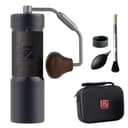 Best overall · Under $200 48 mm coated burrs (1Zpresso does not state conical or flat, or name the coating) · external ring, 8 microns per click · 35-40 g magnetic catch cup · about 700 g · 1-year limited warranty For the Flair owner who wants to match the machine's ceiling. | For the Flair owner who wants to match the machine's ceiling.48 mm coated burrs (1Zpresso does not state conical or flat, or name the coating) · external ring, 8 microns per click · 35-40 g magnetic catch cup · about 700 g · 1-year limited warranty | $159.20In stock, checked November 22, 2026 Check Price on Amazon |
| 2 | 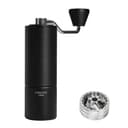 Budget pick · Under $100 38 mm S2C660 CNC-machined stainless conical burrs · ESP dial at 0.0233 mm per click, 30 clicks per rotation · 20 g catch cup · warranty not published by Timemore For a first lever setup on a budget. Buy the ESP dial, not the Classic. | For a first lever setup on a budget. Buy the ESP dial, not the Classic.38 mm S2C660 CNC-machined stainless conical burrs · ESP dial at 0.0233 mm per click, 30 clicks per rotation · 20 g catch cup · warranty not published by Timemore | $68.00In stock, checked November 22, 2026 Check Price on Amazon |
| 3 | 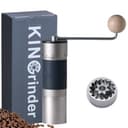 #3 Kingrinder K6 Manual Coffee Grinder Most dose capacity · Under $200 Stainless burrs, diameter not published · external numbered dial, 16 microns per click, 60 clicks per rotation, about 4 rotations of range · 25-35 g hopper · 1-year warranty For the brewer who wants a numbered dial and a bigger catch. | For the brewer who wants a numbered dial and a bigger catch.Stainless burrs, diameter not published · external numbered dial, 16 microns per click, 60 clicks per rotation, about 4 rotations of range · 25-35 g hopper · 1-year warranty | $92.65In stock, checked November 22, 2026 Check Price on Amazon |
| 4 | 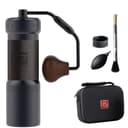 #4 1Zpresso K-Ultra Manual Coffee Grinder Best all-rounder · Under $300 Stainless conical 'K Burr' set · external dial, 20 microns per click, 100+ clicks per rotation · 35-40 g magnetic catch cup · 700 g · carrying case included For a Flair owner who also brews pour over and French press. | For a Flair owner who also brews pour over and French press.Stainless conical 'K Burr' set · external dial, 20 microns per click, 100+ clicks per rotation · 35-40 g magnetic catch cup · 700 g · carrying case included | $207.20In stock, checked November 22, 2026 Check Price on Amazon |
| 5 | 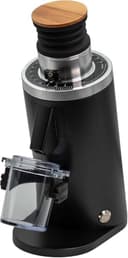 #5 DF54 Single Dose Coffee Grinder Best electric · Under $300 54 mm custom flat burrs · stepless micrometric adjustment · 25 g single-dose hopper · 150 W, 1,400 rpm · 4.7 kg · 1-year warranty For several lever shots a day, with no cranking. | For several lever shots a day, with no cranking.54 mm custom flat burrs · stepless micrometric adjustment · 25 g single-dose hopper · 150 W, 1,400 rpm · 4.7 kg · 1-year warranty | $260.00In stock, checked November 22, 2026 Check Price on Amazon |
Why a lever is harder on a grinder
On a cheap pump machine, a pressurized basket does the work your grinder cannot. It is a basket with a single tiny exit hole that creates back-pressure artificially, so coarse or uneven coffee still produces something with a foamy cap on it. It is a forgiveness device, and it is the reason an entry pump machine can be sold to someone with a blade grinder without immediate complaints.
A Flair does not have one. Flair's levers use real, non-pressurized baskets — the 2GO publishes a 40 mm bottomless portafilter, and retailers list a 12-18 g dose range across Flair's 40 mm family. All the resistance in the puck comes from the coffee itself. That is exactly why a lever can make a better shot than a machine costing three times as much, and exactly why it will make a worse one if the grind is wrong.
There is a second compounding factor, which is that you are the pump. On a Flair you push the lever and read the gauge — the 2GO's is marked 6-9 bar — so the pressure curve is in your hands. If the grind is too coarse, the lever drops through its travel in seconds and you get sour water; too fine and you are leaning on it with your bodyweight. The grinder is what puts that lever in a range where your arm can steer it rather than fight it.
The three specs that decide it
1. Microns per click, which is adjustment resolution. This is the number that matters most and the one the cheap end of the market quietly omits. The J-Ultra moves 8 microns per click; the Kingrinder K6 moves 16; the K-Ultra moves 20. Timemore publishes 0.0233 mm per click for the C3 ESPdial against 0.0833 mm for the standard C3 "Classic" dial — nearly four times coarser. On a lever, one coarse click can be the whole difference between a shot and a disappointment, which is why every pick here publishes a fine figure and why the standard C3 is not on this page.
2. Catch capacity against your dose.A Flair wants 12-18 g in one go. The C3 ESP catch cup holds 20 g, which fits but with no headroom; the K6 takes 25-35 g; the J-Ultra and K-Ultra take 35-40 g; the DF54's single-dose hopper is 25 g. Any of those work. What does not work is grinding in two batches, because the second batch sits on top of the first and the bed stratifies by particle size before it ever reaches the basket.
3. Effort, which is a spec even though nobody prints it. Espresso-fine grinding by hand is genuinely hard work, and it gets harder with darker roasts and with more burr surface. The J-Ultra and K-Ultra are about 700 g of grinder with 48 mm-class burrs; the C3 ESP is smaller at 38 mm and easier to turn. One shot a day, any of these is fine. Three drinks before work, every day, and you should be looking at the electric option rather than buying a hand grinder you will resent by February.
The five picks
1Zpresso J-Ultra — the pairing to buy
Who it is for:the Flair owner who bought a lever because they wanted control, and does not want the grinder to be the thing capping the result. 1Zpresso publishes 48 mm coated burrs, an external adjustment ring at 8 microns per click — the finest in their range — a 35-40 g magnetic catch cup, a weight of about 700 g, and a one-year limited warranty, and describes the grinder as "optimized for espresso". They do not say whether the burr set is conical or flat and do not name the coating, so neither do we. The 8-micron figure is the reason it leads: on a non-pressurized 40 mm basket you are making small corrections, and a grinder that can only move in big ones turns dialing in into guesswork. Honest catches: it is heavy, and fine grinding 18 g of dark roast by hand is a workout. Also note 1Zpresso's own pages disagree about its weight — the product page says 700 g and the comparison table says 670 g.
Timemore Chestnut C3 ESP — the budget pick
Who it is for: someone who has just bought a Flair Classic or 2GO and does not want the grinder to cost more than the machine. This is the cheapest grinder we would put in front of a lever, and the qualifier matters more than the price: buy the ESP version. Timemore publishes 0.0233 mm per click with 30 clicks per rotation for the ESP dial, against 0.0833 mm for the standard C3 Classic dial — nearly four times coarser, and on a lever that is the entire ballgame. The burrs are 38 mm S2C660 CNC-machined stainless conicals, and the catch cup holds 20 g. Timemore publishes no dimensions, no weight and no warranty at all, which is a genuine mark against it; the 530 g figure quoted everywhere comes from retailers, not from Timemore. The 20 g cup is also tight for an 18 g dose — workable, but you will spill some.
Kingrinder K6 — the numbered dial
Who it is for:the brewer who wants to write "3.2" in a notebook and come back to it next month. Kingrinder publishes stainless burrs without stating a diameter, an external numbered dial at 16 microns per click with 60 clicks per rotation and roughly four rotations of usable range, a 25-35 g hopper and a one-year warranty. The numbered external dial is the practical win over grinders adjusted from underneath: you can move between an espresso setting and a filter setting and get back exactly. At 16 microns per click it is twice as coarse a step as the J-Ultra, which on a lever you will notice when you are close to right and want to be righter. The undisclosed burr diameter is the spec we would most like Kingrinder to publish and they do not. There is a direct comparison with the C3 ESP if those two are your shortlist.
1Zpresso K-Ultra — if the Flair is not your only brewer
Who it is for:the Flair owner who also makes pour over at the weekend and takes coffee gear on trips. 1Zpresso publishes a stainless conical "K Burr" set, an external dial at 20 microns per click with 100+ clicks per rotation, a 35-40 g magnetic catch cup, 700 g, a one-year limited warranty, and a carrying case in the box. The reason to choose it over the J-Ultra is range rather than fineness: 100+ clicks per rotation covers espresso through French press on one dial without feeling like a compromise at either end. The reason not to is the 20 microns per click, which is a coarser step than the J-Ultra's 8 exactly where a lever is fussiest. J-Ultra vs K-Ultra settles it properly.
DF54 — the electric answer
Who it is for:the household pulling several lever shots a day, where cranking has stopped being charming. Published specs are 54 mm custom flat burrs, stepless micrometric adjustment, a 25 g single-dose hopper, 150 W at 1,400 rpm, 4.7 kg, and a one-year warranty. Two things make it the right electric pairing for a Flair specifically. Stepless beats clicked for lever dial-in, because you can land between any two positions rather than on the nearest click. And a 25 g single-dose hopper matches how a lever is used: one dose, weighed, nothing retained from yesterday. The trade is the obvious one — you have given up the thing that made a Flair appealing, which is a setup with no cord. Our wider electric shortlist is here.
Dialing a lever in, by feel
A lever gives you a feedback channel a pump machine does not: resistance in your hand. Use it.
- Lever drops quickly and the shot gushes pale. Too coarse. Go finer by two or three clicks on a J-Ultra, one on a K6.
- You are standing on the lever and almost nothing comes out.Too fine. Coarsen, and check the dose — an over-filled 40 mm basket feels identical to an over-fine grind.
- It starts right and then runs fast and thin. That is channeling, not grind size. Distribute the bed before tamping and look at a WDT tool; on a small basket it matters more than on a 58 mm one.
Preheating is the other half of lever consistency: both of the bigger Flairs want the cylinder rinsed with hot water before a shot, and a cold cylinder will make a well-ground dose taste under-extracted anyway. The routine is in the first shot checklist, grind targets are in the grind size chart, and the wider case for spending here rather than on the machine is why the grinder matters more than the machine. If you are still choosing the lever itself, the manual espresso machine roundup covers the whole range including the 49 PRO.
What we know, and how we know it
What we did
- Took the specs from the manufacturer's own documentation. Not from a retailer listing, and not from another blog.
- Priced it from Amazon's API, with the date we checked shown next to the number. If that price is more than 48 hours old, this page stops showing a number at all rather than show you a wrong one.
- Formed a verdict from those specs, the price, and what owners publicly report.
Where we hedged, and why
Three of these grinders are in our spec database and every figure quoted comes from 1Zpresso, Timemore or Kingrinder directly. Where a maker does not publish something we say so: Kingrinder states no burr diameter for the K6, Timemore publishes no dimensions, weight or warranty for the C3 ESP, and 1Zpresso does not say whether the J-Ultra's 48 mm burr set is conical or flat. The Flair figures here are the ones Flair's own listing publishes — the 40 mm bottomless portafilter, the pressure gauge and its 6-9 bar marking — plus a 12-18 g dose range that we report as a retailer figure, because Flair's own spec page was unreachable when the manual-machine pages were written and we have not since verified it.
We have not used these grinders with a Flair and we have not measured particle distribution or shot outcomes. The ranking comes from published adjustment resolution, catch capacity and burr specs set against how a non-pressurized lever basket behaves — not from a test we did not run. Prices and tier labels come from the live price layer at the date stamped on the table above.
What we did not do
We do not run a lab. We have not pulled thousands of shots on this machine, and we are not going to pretend otherwise. We have not used this unit ourselves. Everything above is sourced research, and it is labeled as such. Where we have used a machine, we say so and show it.
How we're paid
If you buy through a link on this page, we earn a commission. It costs you nothing extra and it does not change what we recommend — we link to the better option for the buyer even when it earns us less. See how we review and our full disclosure.
More pairing pages on the grinders hub.
Frequently asked questions
What is the best grinder for a Flair espresso maker?
The 1Zpresso J-Ultra. At 8 microns per click it is the finest-adjusting grinder 1Zpresso makes, which is the resolution a non-pressurized lever basket needs, and its 35-40 g catch cup swallows a Flair's 12-18 g dose in one fill. On a budget, the Timemore Chestnut C3 ESP is the cheapest grinder we would pair with a lever - the ESP dial specifically, not the standard C3.
Do I need a better grinder for a Flair than for a pump machine?
Yes. Cheap pump machines ship with a pressurized basket, which creates back-pressure artificially and forgives a coarse or uneven grind. Flair's levers use real non-pressurized baskets, so all the resistance comes from the coffee itself. That is why a lever can beat a machine three times its price, and why it punishes a poor grinder immediately.
Can I use a hand grinder with a Flair?
Yes, and it is the natural pairing - both are manual, single-dose devices. The limit is physical effort: espresso-fine grinding by hand is real work, worse with dark roasts and larger burrs. One or two shots a day is pleasant. Three drinks every morning is a chore, and at that point an electric single-doser like the DF54 is the better buy.
Is the Timemore C3 ESP good enough for a Flair?
Yes, provided you buy the ESP version. Timemore publishes 0.0233 mm per click for the ESP dial against 0.0833 mm for the standard C3 Classic dial - nearly four times coarser - and on a lever that gap is decisive. The compromises are a 20 g catch cup, which is tight for an 18 g dose, and the fact that Timemore publishes no warranty at all.
What grind setting should I use on a Flair?
Finer than you would for a pressurized basket, and dialed by feel rather than by number. If the lever drops quickly and the shot gushes pale, go finer. If you are leaning on the lever with almost nothing coming out, coarsen and check your dose. A shot that starts well then runs thin is usually channeling in a thin 40 mm puck, not grind size.
Does a stepless grinder help on a lever?
It does. Stepless means a continuous adjustment with no clicks, so you can stop between any two positions instead of on the nearest one - which matters most when you are already close to right. The DF54 and DF64 Gen 2 both work this way. A clicked grinder with a fine enough step, like the J-Ultra's 8 microns, gets you most of the same benefit.
What dose does a Flair take?
Flair publishes a 40 mm bottomless portafilter on the 2GO, and retailers list a 12-18 g dose range across Flair's 40 mm family - we report that range as a retailer figure rather than Flair's own, because we could not retrieve Flair's spec page. The practical point for grinder shopping is that any catch cup here holds a full dose, so you never grind in two batches.
Sources
Specs come from the manufacturer's own documentation. Prices come from Amazon's API. Where a claim comes from what owners report, we link the thread and say so.
- 1Zpresso - J-Ultra product page (48 mm coated burrs, 8 microns per click, catch cup)
- Timemore - Chestnut C3 series specs (38 mm S2C660 burrs, ESP dial 0.0233 mm per click)
- Kingrinder K6 and 1Zpresso K-Ultra - burr description, clicks per rotation and catch capacity as published on the makers' listings, read November 21, 2026
- Flair - 2GO and Classic Amazon listings (40 mm bottomless portafilter, pressure gauge marked 6-9 bar, two portafilters on the Classic). The 12-18 g dose range is a retailer figure, not Flair's own
- DF54 - burr size, stepless adjustment and 25 g single-dose hopper as published on the Amazon listing, read November 21, 2026
- Specialty Coffee Association - coffee research and standards
Keep reading
- The best manual espresso machines under $200The levers this page is a grinder for, with live prices.
- The best manual espresso machinesThe whole lever and hand-powered category, including the 49 PRO.
- J-Ultra vs K-UltraFiner steps or wider range. The decision between the top two picks here.
- Kingrinder K6 vs Timemore C3 ESPIf the budget end is your shortlist, this is the head to head.
- The best electric coffee grindersFor when cranking a fine grind every morning stops being fun.
- Espresso channelingThe fault people blame on the grinder when it is the puck.