
Guides · Comparison
Espresso Machine vs Pour Over
Nine bar of pressure in thirty seconds against gravity in three and a half minutes. These are not competing routes to the same cup — and once you see what each one is for, the purchase decides itself.
The short answer
Buy pour over if you drink black coffee by the mug: a dripper, filters and a kettle cost a fraction of a machine and the method is forgiving. Buy an espresso machine if you want short, concentrated shots or milk drinks — crema and real cappuccino need about nine bar of pressure, which no pour over produces.
We earn a commission if you buy through a link on this page. It costs you nothing extra and it does not change what we recommend. Full disclosure.
Key takeaways
- Espresso is defined by pressure: roughly nine bar forced through a fine, tamped puck in about 25-30 seconds, producing a 1:2 concentrate with crema.
- Pour over is gravity through a paper filter at around a 1:16 ratio over three minutes or so — a clean, aromatic, full mug.
- Only espresso gives you the base for a latte or cappuccino. No pour over, however good, textures milk into a flat white.
- Pour over is far cheaper to start and much easier to do well. Espresso costs more, demands more, and is the only path to the drinks a cafe sells.
- Both are limited by the same component first: the grinder. Spend there before you spend on either brewer.
The short answer
If you drink black coffee in mug-sized quantities and want the clearest, most aromatic version of a good bean, buy pour over. A dripper, a pack of filters and a kettle will cost less than a basket of groceries, the technique takes a weekend to learn, and there is almost nothing to maintain.
If what you want is a short, dense shot — or a cappuccino, a flat white or an iced latte made at home — buy an espresso machine. Crema and milk texture are products of pressure, and pressure is exactly what a pour over does not have. There is no clever technique that makes a V60 produce espresso.
Many people end up with both, and that is not indecision. They are different drinks for different moments, which is the whole point of this page.
They make different drinks
The physics decides the drink, so start there.
Espresso pushes water at roughly nine bar through a finely ground, tamped bed of coffee in about 25 to 30 seconds. The usual target is a 1:2 ratio — something like 18 g of coffee in, about 36 g of liquid out. That pressure emulsifies oils and dissolves CO2 into the liquid, which is what produces crema and the syrupy body you cannot get any other way. It is also why espresso can stand up to steamed milk instead of disappearing into it.
Pour over lets gravity pull water through a much coarser bed sitting in a paper filter. Our pour over guide starts you at a 1:16 ratio — 25 g of medium-fine coffee to 400 g of water at 93-96°C, with a 30-45 second bloom and a finish around 3:00-3:30. The paper traps oils and fines, and the long contact time at atmospheric pressure extracts gently. The result is clarity: you taste the origin of the bean rather than the weight of the brew.
What each one costs to start
The gap is real and it is worth seeing plainly before you shop.
Pour over needs a dripper, paper filters, a kettle you can pour accurately from and a scale. A plastic Hario V60 is the cheapest honest entry point there is, filters cost a few cents each, and while a gooseneck kettle is the component that most improves your pouring, a stovetop one does the job. You can be brewing properly for less than the cost of a month of cafe coffee.
Espresso needs a machine, a grinder capable of espresso-fine adjustment, a scale, and a tamper if one is not in the box. The machine is the headline, but it is not the whole bill — and buying a cheap machine with no grinder budget left is the single most common way home espresso disappoints. We put real numbers on it in what home espresso actually costs and how much to spend.
Running costs are closer than people assume. Both brew methods use roughly 15-25 g of coffee per drink; pour over adds paper filters, espresso adds descaling and cleaning supplies and, on most machines, a water filter.
Time, skill and routine
This is where most of the regret lives, so be honest with yourself about it.
- Pour over takes four or five minutes of your attention and almost no warm-up. It is a ritual you perform while the house wakes up. The skill ceiling is real but the floor is low: a mediocre pour over is still a perfectly nice cup of coffee.
- Espresso takes a few minutes of machine warm-up and then thirty seconds of brewing — but the dial-in is the real cost. Early shots will be bad in ways you have to learn to diagnose, which is what how to dial in espresso exists for. A mediocre espresso is genuinely unpleasant.
- Cleaning splits the same way. A dripper is rinsed; a machine needs the group wiped, the basket cleaned, the wand purged after every milk drink, and descaling on a schedule.
- Volume favours pour over. One pour can fill two mugs. Espresso is made one or two shots at a time, and making four drinks for guests is a project.
The grinder decides both
Whichever path you choose, the same component sets the ceiling. Grind size and uniformity control extraction, and no brewer compensates for a grinder that produces dust and boulders together — which is exactly what a blade grinder does (burr vs blade).
The two methods ask different things of it. Pour over wants a medium-fine grind in a comparatively wide window, so an inexpensive burr grinder is genuinely sufficient. Espresso wants a fine grind inside a narrow window, which means you need small, controllable adjustments — and that is the specification that costs money. This is why we tell espresso buyers to settle the grinder question before the machine question in machine or grinder first.
If you suspect you will end up doing both, buy one grinder that handles both ranges properly; the shortlist is in the best grinder for espresso and pour over.
What to buy for each path
Four purchases cover both routes. Two of them are the pour-over path in its entirety; two of them are the honest minimum for espresso done properly.
Pour over: a dripper and a kettle you can aim
Who it is for: anyone who wants to start pour over this week. The plastic V60 is the cheapest sensible entry to the method and holds heat better than glass or ceramic without preheating — which is why it is the one we point beginners at.
Who it is for: the pour-over drinker who has outgrown guessing. A gooseneck spout is the single biggest improvement available to your pour, because it lets you place water where you intend instead of dumping it, and a variable-temperature kettle removes the other main variable. If the budget is tight, a stovetop gooseneck does the same geometry for much less — the options are in our gooseneck kettle roundup.
Espresso: a machine that can actually steam, and a grinder
| Type | Semi-automatic, no grinder |
|---|---|
| Portafilter | 54 mm |
| Boiler | ThermoJet — ideal extraction temperature in 3 seconds |
| PID temperature control | Yes |
| Built-in grinder | No — you'll need a separate grinder |
| Milk | Automatic, hands-free — 3 milk temperatures x 3 foam levels, with auto-purge |
| Pump pressure | 15 bar |
| Pre-infusion | Yes |
| Heat-up time | 3 seconds (Breville's own figure, stated on the product page and in the manual) |
| Water tank | 1.9 L |
| Power | 1560 W |
| Dimensions | 7.5" W x 13.5" D x 12" H |
| Weight | 10.91 lb (4.95 kg) |
| Warranty | 2 years limited |
| In the box | 54 mm tamper, Razor precision dosing tool, 480 ml stainless milk jug, 1- and 2-cup single- and dual-wall baskets, cleaning tool and disc |
Who it is for: the pour-over drinker crossing over who wants milk drinks without learning to texture milk first. The Bambino Plus is a no-grinder machine, which keeps the money where it belongs — in the grinder — and its automatic milk texturing is the feature that makes a home cappuccino realistic on week one.
| Type | Electric |
|---|---|
| Burrs | 40 mm conical steel (M2), made by Etzinger in Liechtenstein |
| Adjustment | 40 stepped settings, adjusted by twisting the hopper. Dual range: 1-20 espresso, 21-40 filter. |
| Stepless? | No — it clicks between steps (most grinders described as 'stepless' online aren't) |
| Good for espresso? | Yes, and it is the headline use — Baratza: 'delivers the grind resolution you need to brew creamy, syrupy shots of espresso' |
| Capacity | 300 g hopper, 120 g grounds bin |
| Motor | 70 W, 550 RPM. Grinds 1.3-2.2 g/sec. |
| Dimensions | 13 x 15 x 34 cm (W x D x H) |
| Weight | 7 lb (3.1 kg) |
| Warranty | 1 year |
Who it is for:both paths at once. Settings 1-20 are fine micro-steps for espresso and 21-40 are coarser macro-steps for filter, so one grinder serves the V60 on Saturday and the machine on Monday — with a numbered setting for each. Factory-calibrated, with published 40 mm Etzinger conical burrs and Baratza's parts and repair documentation behind it.
The four purchases, compared
Every pick on this page in one view, with the live Amazon price and stock on each row. Specs are the figures the maker or the listing publishes — nothing measured or scored by us. Prices are read from Amazon's API and were last checked October 17, 2026; where we have no verified price, the row says so rather than show you an old number.
| # | Gear | Why it's here | Price & availability |
|---|---|---|---|
| 1 | 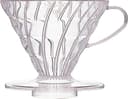 #1 Hario V60 Plastic Dripper (02) Cheapest start · Pour over Plastic V60 cone, size 02 · holds heat without preheating · paper filters sold separately The whole pour-over method for the price of two cafe coffees. | The whole pour-over method for the price of two cafe coffees.Plastic V60 cone, size 02 · holds heat without preheating · paper filters sold separately | $12.14In stock, checked October 17, 2026 Check Price on Amazon |
| 2 | 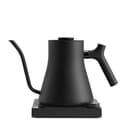 #2 Fellow Stagg EKG Electric Gooseneck Kettle Biggest upgrade · Pour over Electric gooseneck kettle with variable temperature control Pour placement and water temperature, the two variables that matter most. | Pour placement and water temperature, the two variables that matter most.Electric gooseneck kettle with variable temperature control | $179.95In stock, checked October 17, 2026 Check Price on Amazon |
| 3 | 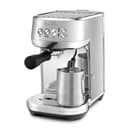 #3 Breville Bambino Plus (BES500) Best crossover · Espresso Semi-automatic, no grinder · automatic milk texturing · 54 mm portafilter · Thermojet heating Milk drinks from day one, with the budget left for a grinder. | Milk drinks from day one, with the budget left for a grinder.Semi-automatic, no grinder · automatic milk texturing · 54 mm portafilter · Thermojet heating | $499.95In stock, checked October 17, 2026 Check Price on Amazon |
| 4 | 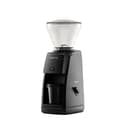 Serves both · Grinder 40 mm Etzinger M2 conical · 40 settings split 1-20 espresso / 21-40 filter · factory-calibrated · 1-year warranty One grinder, two numbered settings, both brew methods. | One grinder, two numbered settings, both brew methods.40 mm Etzinger M2 conical · 40 settings split 1-20 espresso / 21-40 filter · factory-calibrated · 1-year warranty | $199.95In stock, checked October 17, 2026 Check Price on Amazon |
Which one for which drinker
| If this is you | Choose | Because |
|---|---|---|
| You drink black coffee by the mug | Pour over | A 1:16 brew is a full cup; espresso is 36 g of liquid. |
| You want cappuccinos and flat whites at home | Espresso machine | Only pressure makes a base that survives steamed milk. |
| Your budget is under about $100 all in | Pour over | Dripper, filters and a kettle, and you are brewing properly. |
| You want to taste single-origin character | Pour over | Paper filtration gives clarity espresso deliberately does not. |
| You want a 30-second drink before work | Espresso machine | Pour over needs four or five minutes of attention. |
| You make coffee for two or three people at once | Pour over | One brew fills several mugs; espresso is made per shot. |
| You dislike fiddling and troubleshooting | Pour over | A mediocre pour over is fine; a mediocre espresso is not. |
| You already own a good grinder | Either — the hard part is done | The grinder is the component that limits both methods. |
The verdict
Pour over wins on cost, simplicity and clarity. For a black-coffee drinker it is the better first purchase by a wide margin: the gear is cheap, the method is forgiving, and at a 1:16 ratio over three minutes it gives you the cleanest expression of a good bean you can make at home.
An espresso machine wins on one thing that matters enormously if it is what you want: pressure. Nine bar in thirty seconds makes crema, body and a base that stands up to milk, and nothing on the pour-over shelf substitutes for it. Accept the higher cost, the grinder requirement and the learning curve, and it is the only way to make the drinks a cafe sells.
If you are still weighing it up, the cheapest honest test is to buy the grinder first. It improves the coffee you are already making, and it is the component both futures require — which is the argument we make in full in why the grinder matters more than the machine.
What we know, and how we know it
What we did
- Took the specs from the manufacturer's own documentation — Breville's Bambino Plus product page and Baratza's Encore ESP product page, plus standard published brewing parameters for each method. Not from a retailer listing, and not from another blog.
- Priced it from Amazon's API, with the date we checked shown next to the number. If that price is more than 48 hours old, this page stops showing a number at all rather than show you a wrong one.
- Formed a verdict from those specs, the price, and what owners publicly report.
Where we hedged, and why
We have run no side-by-side tasting panel and we have no lab. The brewing parameters on this page are the standard published ones — roughly nine bar and 25-30 seconds at about a 1:2 ratio for espresso, and a 1:16 ratio at 93-96°C over about three minutes for pour over — not measurements we took. They are starting points, and both methods are adjusted by taste.
Machine and grinder specifications are the manufacturers' own, generated from our spec database. We make no claim about which drink tastes better, because that is a preference rather than a finding: what we assert is the mechanical difference, which is that pressure produces crema and a milk-capable base and gravity does not. Cost statements are relative — no price appears in our prose, and every number on this page is live from Amazon with the date it was checked.
What we did not do
We do not run a lab. We have not pulled thousands of shots on this machine, and we are not going to pretend otherwise. We have not used this unit ourselves. Everything above is sourced research, and it is labeled as such. Where we have used a machine, we say so and show it.
How we're paid
If you buy through a link on this page, we earn a commission. It costs you nothing extra and it does not change what we recommend — we link to the better option for the buyer even when it earns us less. See how we review and our full disclosure.
Frequently asked questions
Is pour over better than espresso?
They are different drinks, so neither is better in general. Pour over gives you a clean, aromatic full mug that shows off the origin of a bean, for a fraction of the cost and with a much lower skill floor. Espresso gives you a short, concentrated shot with crema and the only base that survives steamed milk. Choose by the drink you actually want to be holding.
Can a pour over make espresso?
No. Espresso is defined by pressure — roughly nine bar through a fine, tamped puck — and a pour over brews under gravity alone. You can grind fine and brew strong, but you cannot produce crema, the syrupy body, or a base that holds up in a cappuccino. Hand-pressure brewers like an AeroPress get closer and still only make a concentrate.
Which is cheaper to get into?
Pour over, by a wide margin. A dripper, a pack of paper filters and a kettle you can pour accurately from will have you brewing properly, and a plastic V60 is the cheapest honest entry point. Espresso needs a machine plus a grinder with fine, controllable adjustment, plus a scale — and under-budgeting the grinder is the most common reason home espresso disappoints.
Do I need a different grinder for each?
Not necessarily, but you need one that covers both ranges with appropriate step sizes. Pour over wants a medium-fine grind in a fairly wide window; espresso wants a fine grind in a narrow one, which is the expensive requirement. The Baratza Encore ESP is the clearest dual-purpose answer because its dial is split: 1-20 fine micro-steps for espresso, 21-40 coarser steps for filter.
Which takes longer to make?
Pour over takes four or five minutes of active attention per brew but needs no warm-up. Espresso needs a few minutes of machine warm-up and then about thirty seconds of brewing — but the dial-in process costs you real time and coffee while you learn, and milk drinks add steaming and purging. Pour over also scales better: one brew can fill two mugs.
Should I buy both?
Plenty of people do, and it is a sensible endpoint rather than a failure to choose: pour over for a mug of black coffee in the morning, espresso for a cappuccino or an afternoon shot. If you are heading that way, buy one grinder that handles both ranges properly rather than two mediocre ones, and start with the brewer whose drink you want most often.
Sources
Specs come from the manufacturer's own documentation. Prices come from Amazon's API. Where a claim comes from what owners report, we link the thread and say so.
- National Coffee Association — how to brew coffee (ratios and grind guidance by method)
- Specialty Coffee Association — coffee research and standards
- Breville Bambino Plus (BES500) product page (no grinder, automatic milk texturing, 54 mm portafilter, Thermojet heating)
- Baratza Encore ESP product page (40 mm Etzinger M2 conical; 40 settings split 1-20 espresso / 21-40 filter; factory-calibrated)
Keep reading
- How to brew pour over coffeeThe method itself: ratio, bloom, pour pattern and timing.
- Espresso machine vs coffee makerThe same question against automatic drip.
- Espresso machine vs French pressAnd against the other manual brewer people already own.
- Machine or grinder first?Why the grinder question comes before either brewer.
- The best grinder for espresso and pour overOne grinder for both, if you expect to do both.
- Gooseneck kettlesThe pour-over upgrade that changes the most.