
Grinders · Troubleshooting
Coffee Grinder Static: Why It Happens and How to Fix It
Grounds climbing the walls of the bin, sticking to the chute, leaping off the scale. It is not a defective grinder and it is not your technique — it is charge, and there is a free fix that works better than any purchase.
The short answer
Grinder static is triboelectric charge created as beans are crushed and dragged past burrs and plastic surfaces. It worsens with dry beans, dry winter air and fine espresso grinds. The reliable fix is adding a trace of water to the beans before grinding — the Ross Droplet Technique. No grinder is static-free.
We earn a commission if you buy through a link on this page. It costs you nothing extra and it does not change what we recommend. Full disclosure.
Key takeaways
- Static is not a fault. Crushing and dragging dry organic matter past metal and plastic generates charge — it is the same effect as a balloon on a jumper.
- It is worse in winter, worse with very dry or very fresh beans, and worse at espresso-fine settings because fine particles carry charge further.
- The fix that genuinely works is a trace of water on the beans before grinding, known as the Ross Droplet Technique (RDT). One spritz, stirred in.
- No grinder on sale is static-free. Design can reduce retained and scattered grounds; it cannot repeal the physics.
What static actually is
When two dissimilar materials rub together and separate, electrons move from one surface to the other and both end up charged. That is triboelectric charging, and a coffee grinder is an unusually efficient machine for producing it: you are shattering dry, insulating organic material and dragging the fragments across steel burrs, down a plastic chute and into a plastic bin at speed.
The result is grounds that repel each other and cling to everything else. They stand up on the walls of the catch cup, leap off a scale pan, stick to the chute so that the last gram arrives ten seconds late, and clump into little chains that look like clumps of moisture but are not.
Two things follow from that. First, nothing is broken — a brand-new premium grinder does this too. Second, the solution is not a stronger motor or a better chute; it is to make the particles slightly less willing to hold a charge.
Why yours is suddenly worse
Static arrives in waves, which is what makes people suspect the grinder. The variables that change are these.
- Ambient humidity. This is the big one and it is seasonal. Dry indoor winter air lets charge build and stay; humid air lets it leak away. A grinder that was perfectly behaved in August can be a fountain of flying grounds in January.
- Bean moisture. Very dry beans — light roasts, long-stored beans, beans kept somewhere arid — charge more readily than fresher, denser ones.
- Grind size. Espresso-fine grinding makes more small particles with more surface area, and small charged particles travel. If your static appeared when you bought an espresso machine, that is why.
- Dose size and grind speed. More coffee moving faster through the same chute means more charge generated per grind.
- Plastic in the path. Plastic chutes and bins hold charge longer than metal ones, which is why the mess often concentrates in exactly one part of the grinder.
What it actually costs you
Worth being clear-eyed here, because static is more annoying than harmful.
It costs you dose accuracy and tidiness. Grounds left clinging in the chute are grounds that are not in your basket this morning and are in it tomorrow, which blunts the repeatability a scale is supposed to give you. Grounds on the counter are just grounds on the counter.
It does not ruin your coffee by itself. Charge does not change extraction. What it can do indirectly is encourage clumping, and clumps in a basket distribute unevenly, which does feed channeling. If your shots are genuinely inconsistent, work through the usual suspects — distribution, tamp, and grind uniformity — before blaming static.
The fixes, ranked
In order of how well they work, with the free one first — because it is also the best one.
- Add a trace of water to the beans (RDT). Put your dose of whole beans in the cup, give them one light spritz from a fine mist bottle — or touch them with a wet fingertip and stir — then grind. Known in the espresso community as the Ross Droplet Technique, it works because a microscopically damp bean surface lets charge dissipate instead of accumulating. We are talking about a trace of water, not wet beans: too much promotes corrosion and clogging inside the grinder, so use the least that works.
- Ground the metal your grounds land in. Grinding into a metal dosing cup or a metal portafilter rather than a plastic bin gives the charge somewhere to go, especially if you are touching the cup. This is why single-dose grinders with metal cups feel cleaner than hopper machines with plastic bins.
- Raise the humidity near the grinder. You are unlikely to humidify a kitchen for coffee, but it explains the seasonality, and it is why static complaints spike when the heating goes on.
- Tap, wait, then collect. Charge decays. Letting the cup sit for twenty seconds after grinding, then tapping it, recovers a surprising amount of what is standing on the walls.
- Grind a touch coarser, if your brew method allows it. Not an option for espresso, but it genuinely reduces the problem for filter brewing.
What does not work
- Anti-static spray on the grinder.You would be coating a food path with a chemical that is not meant for one, to treat a symptom that a drop of water fixes. Don't.
- Dryer sheets, aluminium foil balls and other folklore. They all share the same two problems: no mechanism that survives scrutiny, and residue in the path of your coffee.
- Buying a more expensive grinder and expecting it to vanish. Charge is generated by grinding, not by cheapness. Better grinders can manage the consequences — they do not avoid the cause.
- Switching to a hand grinder to escape it. Hand grinders generate static too. What they often have is a metal catch cup, which handles the result more gracefully.
What grinder design can and cannot do
If you are shopping rather than troubleshooting, these are the design features that measurably change your experience of static — and we are careful here to describe published design rather than claim measured results.
- A single-dose hopper with bellows. DF Grinders publishes a 50 g single-dose bellows hopper on the DF64 Gen 2: a puff of air pushes grounds out of the path instead of leaving them clinging where charge holds them.
- A metal catch cup. The 1Zpresso hand grinders use a magnetic metal catch cup, which both drains charge and lets you tap the cup without it skittering off the counter.
- A short, steep path from burrs to vessel. The fewer plastic surfaces the grounds slide along, the less static the trip generates — which is the structural reason single-dosers are tidier than hopper grinders.
- A grounds bin rather than a direct-to-portafilter chute. If you accept that grounds will cling somewhere, a bin keeps the mess contained and lets you tap it out. The Baratza Encore ESP pairs a 300 g hopper with a 120 g grounds bin.
Grinders that make less mess
None of these is marketed as static-free, and we would not believe the claim if it were. They are the grinders whose published design handles the consequences best.
DF64 Gen 2 — bellows and a single-dose path
| Type | Electric |
|---|---|
| Burrs | 64 mm flat — stainless, or Red Titanium (TiCN) coated |
| Adjustment | Stepless micrometric |
| Stepless? | Yes — genuinely stepless |
| Good for espresso? | Yes — the stepless adjustment is sold specifically on easier espresso dial-in |
| Capacity | 50 g single-dose bellows hopper |
| Motor | 250 W, 1400 RPM |
| Dimensions | 13 x 22.5 x 30 cm (W x D x H) |
| Weight | 15 lb (6.8 kg) |
| Warranty | 1 year |
Who it is for: the espresso drinker who weighs every dose and is tired of chasing grounds around a chute.
The published 50 g single-dose bellows hopper is the relevant feature: you push air through the grinder after grinding, which moves clinging grounds out instead of leaving them where charge keeps them. Combine that with weighing beans in and grinding into a metal cup and the daily experience of static changes considerably — not because the charge is smaller, but because the grounds do not stay where it put them.
1Zpresso J-Ultra — a metal cup and a short path
| Type | Manual hand grinder |
|---|---|
| Burrs | 48 mm, coated. 1Zpresso does not say whether it is conical or flat for this model, and does not name the coating — so neither do we. |
| Adjustment | External ring, 8 microns per click — the finest of any 1Zpresso. Clicked, not stepless. |
| Stepless? | No — it clicks between steps (most grinders described as 'stepless' online aren't) |
| Good for espresso? | Yes — 1Zpresso: 'optimized for espresso' |
| Capacity | 35-40 g magnetic catch cup |
| Dimensions | 19 x 18.5 x 5.5 cm |
| Weight | About 700 g. 1Zpresso's own product page says 700 g and their own comparison table says 670 g. |
| Warranty | 1 year limited |
Who it is for: the one-or-two-dose household that wants the tidiest possible routine without an appliance.
A hand grinder drops grounds a few centimetres into a 35-40 g magnetic metal catch cup. There is no long plastic chute, no fan of air behind the grounds, and the cup can be tapped on the counter and tipped straight into a basket. Static still happens — tip a cup out in January and you will see it — but there is much less distance for it to make a mess over.
Baratza Encore ESP — a contained bin, and parts if you need them
| Type | Electric |
|---|---|
| Burrs | 40 mm conical steel (M2), made by Etzinger in Liechtenstein |
| Adjustment | 40 stepped settings, adjusted by twisting the hopper. Dual range: 1-20 espresso, 21-40 filter. |
| Stepless? | No — it clicks between steps (most grinders described as 'stepless' online aren't) |
| Good for espresso? | Yes, and it is the headline use — Baratza: 'delivers the grind resolution you need to brew creamy, syrupy shots of espresso' |
| Capacity | 300 g hopper, 120 g grounds bin |
| Motor | 70 W, 550 RPM. Grinds 1.3-2.2 g/sec. |
| Dimensions | 13 x 15 x 34 cm (W x D x H) |
| Weight | 7 lb (3.1 kg) |
| Warranty | 1 year |
Who it is for: the buyer who wants an electric grinder with the mess kept in one box.
This is the pragmatic answer rather than the clever one: a 120 g grounds bin catches what the chute releases, you tap it, you tip it. Settings 1-20 are fine micro-steps for espresso and 21-40 cover filter, so you can also simply grind a touch coarser for filter brewing on the days static is at its worst — which is a real, free mitigation that costs you nothing in the cup.
Three grinders, by how they handle the mess
Every pick on this page in one view, with the live Amazon price and stock on each row. Specs are the figures the maker or the listing publishes — nothing measured or scored by us. Prices are read from Amazon's API and were last checked October 17, 2026; where we have no verified price, the row says so rather than show you an old number.
| # | Grinder | What helps | Price & availability |
|---|---|---|---|
| 1 | 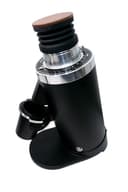 #1 DF64 Gen 2 Bellows hopper · Single dose 64 mm flat · stepless micrometric · 50 g single-dose bellows hopper · 250 W, 1,400 RPM · 15 lb · 1-year warranty A puff of air clears the path the charge wants to hold. | A puff of air clears the path the charge wants to hold.64 mm flat · stepless micrometric · 50 g single-dose bellows hopper · 250 W, 1,400 RPM · 15 lb · 1-year warranty | $389.00In stock, checked October 17, 2026 Check Price on Amazon |
| 2 | 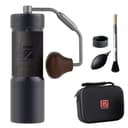 Metal catch cup · Hand grinder 48 mm coated burr · external ring, 8 microns per click · 35-40 g magnetic catch cup · about 700 g · 1-year limited Short drop into metal, then tap and tip. | Short drop into metal, then tap and tip.48 mm coated burr · external ring, 8 microns per click · 35-40 g magnetic catch cup · about 700 g · 1-year limited | $199.00In stock, checked October 17, 2026 Check Price on Amazon |
| 3 | 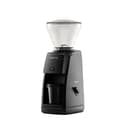 Contained bin · Hopper electric 40 mm Etzinger M2 conical · 40 settings split 1-20 espresso / 21-40 filter · 300 g hopper, 120 g grounds bin · 1-year warranty Keeps the mess in one container you can tap out. | Keeps the mess in one container you can tap out.40 mm Etzinger M2 conical · 40 settings split 1-20 espresso / 21-40 filter · 300 g hopper, 120 g grounds bin · 1-year warranty | $199.95In stock, checked October 17, 2026 Check Price on Amazon |
The short version
Static is charge, generated by the act of grinding, amplified by dry air, dry beans and fine settings. Your grinder is not broken and you are not doing anything wrong. The fix that works is a trace of water on the beans before they go in — one spritz, stirred, ground immediately — and after that, grinding into metal and letting the charge decay for twenty seconds before you collect.
If you are buying, buy for the things that actually matter in a grinder — burrs, adjustment and build, which we cover in how to choose a coffee grinder — and treat a bellows hopper or a metal catch cup as a welcome bonus rather than the reason to choose. No grinder at any price grinds without charge, and anyone who tells you otherwise is selling something.
What we know, and how we know it
What we did
- Took the specs from the manufacturer's own documentation — DF Grinders' published DF64 specifications, 1Zpresso's J-Ultra product page and Baratza's Encore ESP product page. Not from a retailer listing, and not from another blog.
- Priced it from Amazon's API, with the date we checked shown next to the number. If that price is more than 48 hours old, this page stops showing a number at all rather than show you a wrong one.
- Formed a verdict from those specs, the price, and what owners publicly report.
Where we hedged, and why
We have not measured static charge in any grinder. We run no lab, we have no instrument for this, and you will not find a percentage reduction anywhere on this page — because any number we gave you would be invented. Triboelectric charging is standard physics; the variables listed (humidity, bean moisture, grind fineness, plastic in the path) are the mechanism applied to a grinder, not experimental results from our kitchen.
The water technique is long-standing practice in the espresso community, named after Ross; we describe it as practice rather than as a tested protocol, and we deliberately caution against using more than a trace, because excess water in a grinder causes corrosion and clogging. Every grinder feature named here is manufacturer-published — the 50 g single-dose bellows hopper from DF Grinders, the 35-40 g magnetic catch cup from 1Zpresso, the 120 g grounds bin from Baratza — and we make no claim that any of them reduces charge itself, only that they change where the grounds end up. No price appears in our prose; every number here is live from Amazon with the date it was checked.
What we did not do
We do not run a lab. We have not pulled thousands of shots on this machine, and we are not going to pretend otherwise. We have not used this unit ourselves. Everything above is sourced research, and it is labeled as such. Where we have used a machine, we say so and show it.
How we're paid
If you buy through a link on this page, we earn a commission. It costs you nothing extra and it does not change what we recommend — we link to the better option for the buyer even when it earns us less. See how we review and our full disclosure.
Frequently asked questions
Why is my coffee grinder so static?
Because grinding generates triboelectric charge: dry, insulating coffee is shattered and dragged across steel burrs and plastic surfaces, and both ends up charged. Dry indoor air, very dry beans and fine espresso grinds all make it worse, which is why static complaints spike in winter and after people buy an espresso machine.
How do I stop static in my coffee grinder?
Add a trace of water to the whole beans before grinding — one light spritz from a mist bottle, or a wet fingertip stirred through the dose, then grind immediately. This is the Ross Droplet Technique, and it works because a microscopically damp bean surface lets charge dissipate rather than build. Grinding into a metal cup and letting the grounds settle for twenty seconds before collecting them help too.
Does static ruin espresso?
Not directly — charge does not change extraction. What it does is leave grounds clinging in the chute, which blunts dose accuracy, and encourage clumping, which can distribute unevenly in the basket and feed channeling. If your shots are genuinely inconsistent, check distribution, tamp and grind uniformity before blaming static.
Is there a grinder with no static?
No. Every grinder on sale generates charge, because the charge comes from grinding rather than from a design flaw. What varies is how the machine handles the consequences: a single-dose bellows hopper pushes clinging grounds out of the path, a metal catch cup drains charge and can be tapped, and a short path from burrs to cup gives static less distance to make a mess over.
Can I use anti-static spray on a coffee grinder?
We would not. It means putting a chemical that is not intended for food contact into the path your coffee travels, to solve a problem that a trace of water solves for free. The same objection applies to dryer sheets and the other folk remedies: no convincing mechanism, and residue where your coffee goes.
Do hand grinders have less static?
They generate it just the same, but they usually handle it better — a short drop into a metal catch cup rather than a long plastic chute into a plastic bin. The 1Zpresso grinders' magnetic metal cups are a good example: charge has somewhere to go, and you can tap the cup on the counter before tipping it into a basket.
Sources
Specs come from the manufacturer's own documentation. Prices come from Amazon's API. Where a claim comes from what owners report, we link the thread and say so.
- DF Grinders — DF64 technical specifications (64 mm flat burrs, stepless micrometric, 50 g single-dose bellows hopper, 250 W / 1400 RPM)
- 1Zpresso J-Ultra official product page (48 mm coated burr, 8 microns per click, 35-40 g magnetic catch cup)
- Baratza Encore ESP product page (40 mm Etzinger M2 conical, 300 g hopper with 120 g grounds bin, 40 settings split 1-20 espresso / 21-40 filter)
- Specialty Coffee Association — coffee research and standards
Keep reading
- Single dose vs hopperRetention and workflow, the other half of the mess problem.
- How to choose a coffee grinderWhat to buy for, once static stops being the question.
- Espresso channelingWhat clumping actually does to a shot.
- How long do coffee grinders last?Why you keep a grinder dry as well as clean.
- Grind size chartWhy fine espresso grinds are the worst offenders.
- Cleaning and maintenance gearKeeping the burr chamber and chute clear.