
Grinders · Comparison
1Zpresso J-Ultra vs Kingrinder K6
The two hand grinders people put head to head when they want espresso without spending electric-grinder money. One costs roughly twice the other, and the gap is narrower than that ratio suggests — but it is real, and it is published.
The short answer
Buy the 1Zpresso J-Ultra if espresso is your main drink: 8 microns per click is the finest adjustment 1Zpresso publishes, and it makes dialing a shot bearable. Buy the Kingrinder K6 if you want espresso-capable external adjustment for roughly half the money and can live with 16 microns per click.
We earn a commission if you buy through a link on this page. It costs you nothing extra and it does not change what we recommend. Full disclosure.
Key takeaways
- Both are clicked hand grinders with external adjustment — the dial sits outside the body, so you can count clicks without taking anything apart.
- The published difference is resolution: 8 microns per click on the J-Ultra, 16 on the K6. That is how many places you have to land inside the narrow espresso window.
- The K6 has more total range on paper — 60 clicks per rotation across 4 rotations — which makes it the more flexible filter grinder of the two.
- Kingrinder publishes no burr diameter. 1Zpresso publishes 48 mm but will not say conical or flat. Neither gap is a dealbreaker; both are worth knowing before you spend.
The short answer
If you pull espresso most mornings, buy the J-Ultra. Espresso is the one brew method where the grind window is small enough that adjustment resolution is the feature you are actually buying, and 8 microns per click is the finest figure 1Zpresso publishes on anything they make. You will spend less time chasing a shot and more time drinking one.
If espresso is something you do several times a week rather than several times a morning — or if the J-Ultra is simply more than you want to spend on a hand grinder — the Kingrinder K6 is a genuinely espresso-capable grinder with an external numbered dial, and it costs far less. Sixteen microns per click is coarser, so dialing in takes more patience, but it is not the four-times-coarser gap that separates a real espresso hand grinder from a filter one.
The number that separates them
Everything else about these two grinders is similar enough that it does not decide the purchase. Both are clicked rather than stepless. Both put the adjustment on the outside of the body. Both are sold with a one-year warranty. Both will grind fine enough for an espresso machine.
What differs is how far the burrs move each time you hear a click:
- J-Ultra — 8 microns per click. 1Zpresso publishes this figure and describes it as the finest adjustment across their range.
- Kingrinder K6 — 16 microns per click, 60 clicks per rotation, with about four rotations of usable range. Those are the manufacturer specifications on its listing.
That is a factor of two. In practice it means every corrective move you make on the K6 is twice as large as the equivalent move on the J-Ultra, so when a shot runs three seconds fast, the J-Ultra lets you nudge it and the K6 asks you to choose between two settings that straddle what you wanted. Neither is wrong. One is simply more forgiving of a beginner chasing a target, and the other asks you to accept the nearest click and adjust your dose instead.
J-Ultra: the espresso-tuned one
| Type | Manual hand grinder |
|---|---|
| Burrs | 48 mm, coated. 1Zpresso does not say whether it is conical or flat for this model, and does not name the coating — so neither do we. |
| Adjustment | External ring, 8 microns per click — the finest of any 1Zpresso. Clicked, not stepless. |
| Stepless? | No — it clicks between steps (most grinders described as 'stepless' online aren't) |
| Good for espresso? | Yes — 1Zpresso: 'optimized for espresso' |
| Capacity | 35-40 g magnetic catch cup |
| Dimensions | 19 x 18.5 x 5.5 cm |
| Weight | About 700 g. 1Zpresso's own product page says 700 g and their own comparison table says 670 g. |
| Warranty | 1 year limited |
Who it is for: the espresso drinker who wants grind quality that embarrasses cheap electrics, does not want to give up counter space, and dials shots in often enough to care about the size of each adjustment.
The J-Ultra is the grinder 1Zpresso built for this job, and they say so plainly: their own copy calls it "optimized for espresso." The 48 mm burr is the biggest in this comparison, the external ring is the finest-stepping one they publish, and the 35-40 g magnetic catch cup swallows a double dose without a second pass. If you already own a 58 mm machine and have been fighting a coarse dial, this is the grinder that ends the fight.
The honest cons. It is roughly twice the price of the K6, which is real money for a grinder you turn by hand. It clicks rather than running stepless, so you cannot land between two settings. And 1Zpresso will not say whether that 48 mm burr is conical or flat, nor name the coating on it — so we do not either. Their own figures also disagree slightly on weight: the product page says 700 g, their comparison table says 670 g.
Kingrinder K6: the value one
| Burrs | Stainless steel (diameter not published by Kingrinder) |
|---|---|
| Adjustment | External numbered dial · 16 microns per click · 60 clicks per rotation · about 4 rotations of range |
| Stepless | No — clicked, like the J-Ultra |
| Capacity | 25-35 g hopper |
| Warranty | 1 year |
| Positioning | Kingrinder's espresso-capable model with external fine adjustment |
Who it is for: the buyer who wants an espresso-capable hand grinder and would rather put the saved money into beans, a scale or the machine itself.
The K6 is the reason this comparison exists. External numbered adjustment at 16 microns per click is specification you normally pay considerably more for, and the four rotations of range mean the same grinder covers French press at one end and espresso at the other. For a household that pulls a couple of shots a day and brews filter at the weekend, it is a lot of grinder for the money.
The honest cons.Kingrinder publishes no burr diameter anywhere we could find, which means we cannot compare the one component that most determines grind consistency. Sixteen microns per click is twice the J-Ultra's step, so expect dial-in to take more shots. And the 25-35 g hopper is adequate rather than generous. We go deeper on this grinder in Kingrinder K6 vs Timemore C3 ESP.
Both grinders, compared
Every pick on this page in one view, with the live Amazon price and stock on each row. Specs are the figures the maker or the listing publishes — nothing measured or scored by us. Prices are read from Amazon's API and were last checked October 17, 2026; where we have no verified price, the row says so rather than show you an old number.
| # | Hand grinder | Why it's here | Price & availability |
|---|---|---|---|
| 1 | 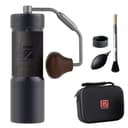 Best for espresso · Espresso-tuned 48 mm coated burr · external ring, 8 microns per click · clicked · 35-40 g magnetic catch cup · about 700 g · 1-year limited warranty The finest published adjustment of any 1Zpresso — built for dialing shots. | The finest published adjustment of any 1Zpresso — built for dialing shots.48 mm coated burr · external ring, 8 microns per click · clicked · 35-40 g magnetic catch cup · about 700 g · 1-year limited warranty | $199.00In stock, checked October 17, 2026 Check Price on Amazon |
| 2 | 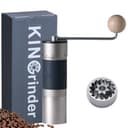 #2 Kingrinder K6 Manual Coffee Grinder Best value · Espresso-capable Stainless burrs, diameter not published · external numbered dial, 16 microns per click, 60 clicks per rotation, ~4 rotations · 25-35 g hopper · 1-year warranty Espresso-capable external adjustment for roughly half the money. | Espresso-capable external adjustment for roughly half the money.Stainless burrs, diameter not published · external numbered dial, 16 microns per click, 60 clicks per rotation, ~4 rotations · 25-35 g hopper · 1-year warranty | $109.00In stock, checked October 17, 2026 Check Price on Amazon |
| 3 | 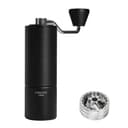 Cheapest that works · Entry espresso 38 mm S2C660 conical · ESP dial at 0.0233 mm per click, 30 clicks per rotation · 20 g catch cup · no published warranty If both of the above are too much — but only the ESP dial version. | If both of the above are too much — but only the ESP dial version.38 mm S2C660 conical · ESP dial at 0.0233 mm per click, 30 clicks per rotation · 20 g catch cup · no published warranty | $99.00In stock, checked October 17, 2026 Check Price on Amazon |
| 4 | 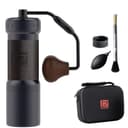 #4 1Zpresso K-Ultra Manual Coffee Grinder Widest range · All-rounder Stainless conical 'K Burr' set · external dial, 20 microns per click, 100+ clicks per rotation · 35-40 g magnetic catch cup · 700 g · carrying case included If filter is the main job and espresso the occasional one. | If filter is the main job and espresso the occasional one.Stainless conical 'K Burr' set · external dial, 20 microns per click, 100+ clicks per rotation · 35-40 g magnetic catch cup · 700 g · carrying case included | $259.00In stock, checked October 17, 2026 Check Price on Amazon |
What each maker will not tell you
We would rather name the gaps than paper over them, because both of these grinders have one.
- Kingrinder does not publish a burr diameter. Burr size is the single biggest structural difference between hand grinders, and on the K6 we cannot quote it. Any figure you read for it elsewhere is not manufacturer-sourced.
- 1Zpresso does not publish the burr geometry. They state 48 mm and that it is coated, but not whether it is conical or flat and not what the coating is.
- Neither maker publishes a particle distribution.No hand grinder in this bracket does. We have no sieve data, no laser diffraction results and no instrumented comparison, so you will not find a "percent fines" claim anywhere on this page.
Cheaper below, wider above
Two grinders bracket this pair, and both are worth a sentence before you commit.
Below: the Timemore Chestnut C3 ESPis the cheapest hand grinder we would put in front of an espresso machine — but only in the ESP version, whose dial moves 0.0233 mm per click against the standard C3's 0.0833 mm. Buy the wrong one and you have a filter grinder.
Above: the 1Zpresso K-Ultra costs more than the J-Ultra and is deliberately coarser per click — 20 microns, with more than 100 clicks per rotation. It is the all-rounder of the family, and it ships with a carrying case. If your mornings are pour over and your weekends are espresso, read J-Ultra vs K-Ultra before you choose.
| Burrs | Stainless conical, 1Zpresso's 'K Burr' set |
|---|---|
| Adjustment | External dial, 20 microns per click, more than 100 clicks per rotation |
| Stepless | No — clicked |
| Capacity | 35-40 g magnetic catch cup |
| Weight | 700 g |
| Warranty | 1 year limited |
| In the box | Carrying case included |
Which one for which buyer
| If this is you | Buy | Because |
|---|---|---|
| Espresso is your main drink, most days | J-Ultra | 8 microns per click is the finest step 1Zpresso publishes. |
| You are new to espresso and still chasing a target | J-Ultra | Smaller steps mean fewer wasted shots while you learn. |
| You want espresso capability for the lowest sane price | Kingrinder K6 | External numbered adjustment at roughly half the money. |
| One grinder has to cover French press and the odd shot | Kingrinder K6 | Four rotations of range covers coarse to fine. |
| Burr diameter being published matters to you | J-Ultra | 48 mm is stated; Kingrinder publishes no figure at all. |
| Your budget stops under $100 | Neither — the C3 ESP | The only sub-$100 hand grinder we would use for espresso. |
| Filter coffee is the main event | Neither — the K-Ultra | Wider range, 100+ clicks per rotation, case included. |
| You grind more than a couple of doses a day | Neither — go electric | Hand grinding four doses a morning gets old fast. |
The verdict
The J-Ultra wins this on the one specification that matters for espresso. Eight microns per click, a published 48 mm burr and a catch cup that takes a double dose add up to the hand grinder we would hand someone who has just bought a 58 mm machine and wants to stop guessing. 1Zpresso built it for this and says so.
The Kingrinder K6 is the better buy for everyone whose espresso habit is occasional. You accept twice the step size and an unpublished burr diameter, and in exchange you keep roughly half the money — enough to cover a decent scale and a month of good beans, both of which will do more for your coffee than four microns of resolution.
Whichever you pick, the grinder is the right place to be spending. If you are still weighing that against a better machine, we argue it out in why the grinder matters more than the machine.
What we know, and how we know it
What we did
- Took the specs from the manufacturer's own documentation — 1Zpresso's own J-Ultra and K-Ultra product pages, and the manufacturer specifications on the Kingrinder K6 listing. Not from a retailer listing, and not from another blog.
- Priced it from Amazon's API, with the date we checked shown next to the number. If that price is more than 48 hours old, this page stops showing a number at all rather than show you a wrong one.
- Formed a verdict from those specs, the price, and what owners publicly report.
Where we hedged, and why
We have not ground coffee with either of these grinders, we run no lab, and we have measured no particle distributions. Every number on this page is the manufacturer's: 8 microns per click and a 48 mm coated burr from 1Zpresso, 16 microns per click and 60 clicks per rotation from the Kingrinder listing.
We also state what is missing. Kingrinder publishes no burr diameter, so the most important structural comparison between these two grinders cannot be made from manufacturer data — and we will not estimate it. 1Zpresso does not say whether the J-Ultra's burr is conical or flat, or name its coating. 1Zpresso's own sources disagree on the J-Ultra's weight (700 g on the product page, 670 g in their comparison table), so we cite both. No price appears in our prose; every number here is live from Amazon with the date it was checked.
What we did not do
We do not run a lab. We have not pulled thousands of shots on this machine, and we are not going to pretend otherwise. We have not used this unit ourselves. Everything above is sourced research, and it is labeled as such. Where we have used a machine, we say so and show it.
How we're paid
If you buy through a link on this page, we earn a commission. It costs you nothing extra and it does not change what we recommend — we link to the better option for the buyer even when it earns us less. See how we review and our full disclosure.
Frequently asked questions
Is the 1Zpresso J-Ultra worth twice the Kingrinder K6?
For a daily espresso drinker, yes — the J-Ultra's 8 microns per click is half the K6's step size, which is exactly the difference you feel when you are trying to land inside the espresso window. For someone who pulls a shot a few times a week and brews filter the rest of the time, no: the K6 does the same job with more patience, and the saved money buys beans and a scale.
Can the Kingrinder K6 grind fine enough for espresso?
Yes. Its external numbered dial moves 16 microns per click with about four rotations of range, and Kingrinder positions it as their espresso-capable model with external fine adjustment. The limitation is resolution rather than fineness — each corrective move is twice the size of the J-Ultra's, so dialing in a new coffee takes more shots.
What burr size does the Kingrinder K6 use?
Kingrinder does not publish a burr diameter for it anywhere we could find — the listing specifies stainless steel burrs without a size. We are not going to invent a figure. If published burr size matters to your decision, the J-Ultra's 48 mm is stated by 1Zpresso.
Is the J-Ultra stepless?
No. It is clicked, at 8 microns per click, and so is the K6 at 16. Plenty of hand grinders described as 'stepless' online are in fact clicked; genuinely stepless adjustment in this category is rare, and in the DF-style electric grinders it is the headline feature.
Which is better for pour over and French press?
The K6, of the two, because four rotations of range covers coarse brewing comfortably. But if filter is the main job, neither is the right answer — the 1Zpresso K-Ultra is the all-rounder of this family at 20 microns per click with more than 100 clicks per rotation, and it ships with a case.
Should I buy a hand grinder at all, or an electric?
Hand grinders win on grind quality per dollar because all of the money goes into the burrs and the adjustment rather than a motor and a housing. They lose on convenience, and the loss compounds: grinding one double is fine, grinding four on a weekday morning is a chore. If you pull more than two or three doses a day, buy an electric.
Sources
Specs come from the manufacturer's own documentation. Prices come from Amazon's API. Where a claim comes from what owners report, we link the thread and say so.
- 1Zpresso J-Ultra official product page (48 mm coated burr, 8 microns per click, 35-40 g catch cup, 1-year limited warranty)
- 1Zpresso K-Ultra official product page (20 microns per click, 100+ clicks per rotation, 700 g, carrying case)
- Kingrinder K6 — manufacturer specifications as published on its Amazon listing, read October 2026 (16 microns per click, 60 clicks per rotation, 25-35 g hopper, 1-year warranty; no burr diameter published)
- Timemore Chestnut C3 series official specifications (ESP dial at 0.0233 mm per click against the Classic dial's 0.0833 mm)
Keep reading
- The best hand grindersBoth of these grinders in the wider field, ranked by job.
- Kingrinder K6 vs Timemore C3 ESPThe K6 against the cheapest hand grinder worth using for espresso.
- 1Zpresso J-Ultra vs K-UltraThe espresso one against the all-rounder, inside the same family.
- The best grinders under $200Where both of these land against the electrics at the same money.
- Hand grinder vs electricThe convenience cost of grinding by hand, honestly accounted.
- Grind size chartHow wide each brew method's window actually is.