
Espresso Machines · Alternatives
Alternatives to Nespresso
People leave Nespresso for one of two reasons: the cost per cup, or the ceiling on how good the coffee can get. Those two complaints point at different machines - so this page answers both rather than pretending there is one replacement.
The short answer
Buy the Breville Bambino Plus: it is ready in a published 3 seconds, it textures milk hands-free to a chosen temperature and foam level, it is 7.5 inches wide, and it pulls real espresso from ground coffee - which is as close as a proper machine gets to the pod experience. The budget pick is the De'Longhi Stilosa: the cheapest machine here, with a real stainless boiler, if you accept doing the milk yourself.
We earn a commission if you buy through a link on this page. It costs you nothing extra and it does not change what we recommend. Full disclosure.
All five alternatives, compared
Every pick on this page in one view, with the live Amazon price and stock on each row. Specs are the figures the maker or the listing publishes — nothing measured or scored by us. Prices are read from Amazon's API and were last checked November 22, 2026; where we have no verified price, the row says so rather than show you an old number.
| # | Machine | Who it's for | Price & availability |
|---|---|---|---|
| 1 | 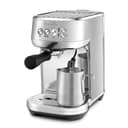 #1 Breville Bambino Plus (BES500) Best overall · Under $500 ThermoJet, 3 seconds to temperature · automatic hands-free milk, 3 temperatures x 3 foam levels with auto-purge · PID · 54 mm · 15 bar · 1.9 L tank · 7.5" wide · 480 ml jug and Razor tool in the box · 2-year limited warranty For the pod owner who wants real espresso and keeps the convenience. | For the pod owner who wants real espresso and keeps the convenience.ThermoJet, 3 seconds to temperature · automatic hands-free milk, 3 temperatures x 3 foam levels with auto-purge · PID · 54 mm · 15 bar · 1.9 L tank · 7.5" wide · 480 ml jug and Razor tool in the box · 2-year limited warranty | $485.00In stock, checked November 22, 2026 Check Price on Amazon |
| 2 | 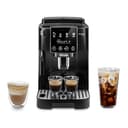 #2 De'Longhi Magnifica Start (ECAM22022) Still one button · Under $500 Super-automatic bean-to-cup · built-in conical burr grinder, 13 settings, 250 g hopper · Thermoblock · 15 bar · 1.8 L tank · 1,250 W (US 120 V) · manual frother, NOT the automatic LatteCrema system For keeping the press-one-button routine, from whole beans. | For keeping the press-one-button routine, from whole beans.Super-automatic bean-to-cup · built-in conical burr grinder, 13 settings, 250 g hopper · Thermoblock · 15 bar · 1.8 L tank · 1,250 W (US 120 V) · manual frother, NOT the automatic LatteCrema system | $449.95In stock, checked November 22, 2026 Check Price on Amazon |
| 3 | 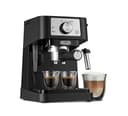 #3 De'Longhi Stilosa (EC260BK) Budget pick · Under $200 Stainless steel boiler, not a Thermoblock · manual pannarello-style frother · 15 bar · 1 L tank · 1,100 W · 3.9 kg · 1-year warranty plus 1 more on registration · De'Longhi publishes no portafilter diameter The cheapest escape from capsules that is still a pump machine. | The cheapest escape from capsules that is still a pump machine.Stainless steel boiler, not a Thermoblock · manual pannarello-style frother · 15 bar · 1 L tank · 1,100 W · 3.9 kg · 1-year warranty plus 1 more on registration · De'Longhi publishes no portafilter diameter | $149.95In stock, checked November 22, 2026 Check Price on Amazon |
| 4 | 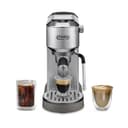 #4 De'Longhi Dedica Duo (EC890M) Smallest footprint · Under $200 Only 15 cm wide · manual 'My LatteArt' cool-touch steam wand · one-touch cold brew · Thermoblock · 15 bar · 1.1 L tank · 4.2 kg · no portafilter diameter or clear warranty term published For the narrowest counter, and for iced coffee as well as hot. | For the narrowest counter, and for iced coffee as well as hot.Only 15 cm wide · manual 'My LatteArt' cool-touch steam wand · one-touch cold brew · Thermoblock · 15 bar · 1.1 L tank · 4.2 kg · no portafilter diameter or clear warranty term published | $199.95In stock, checked November 22, 2026 Check Price on Amazon |
| 5 | 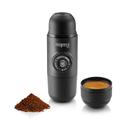 Cheapest escape · Under $50 Hand-powered piston espresso maker for ground coffee · no electricity, no plumbing, no counter space · packs into a bag For testing whether you even like ground coffee, for pod money. | For testing whether you even like ground coffee, for pod money.Hand-powered piston espresso maker for ground coffee · no electricity, no plumbing, no counter space · packs into a bag | $37.52In stock, checked November 22, 2026 Check Price on Amazon |
Which complaint are you actually solving?
Be specific about this before you spend anything, because the two common reasons to leave Nespresso point at opposite machines.
If the complaint is cost per cup, the thing you want is the ability to use whole beans or ground coffee, and almost any machine here delivers that. Capsules price coffee per serving; a bag prices it per kilo, and the gap is large and permanent. What matters then is the cheapest machine that makes coffee you are happy with, which is why the Stilosa and the Minipresso are on this page at all. The arithmetic — including the grinder, which people forget — is in what home espresso actually costs.
If the complaint is the ceiling, you want control: a real basket, a grind you set, a dose you weigh, and milk you texture. That means a pump machine with a manual wand and a grinder, and it means accepting a learning curve that pods were specifically designed to remove. The Bambino Plus is the gentlest version of that and the Dedica Duo is the cheapest.
If the honest answer is "neither, I just want one button", do not buy a pump machine. Buy bean-to-cup. The Magnifica Start grinds and brews at a press and is a genuinely different product from the others here, and we would rather tell you that than sell you a machine you will resent on a Tuesday morning.
What you give up when you leave pods
We earn a commission on these links, so here is the case against the thing we are selling, stated plainly:
- Consistency on day one.A capsule is a sealed, pre-dosed, pre-tamped puck made in a factory. Your first week of ground coffee will be worse than the pods were, because grind, dose and tamp are now yours. It gets better quickly, and it does get better than pods ever were — but not immediately.
- Zero cleanup. Pods go in a bin. Real espresso leaves a wet puck to knock out, a basket to rinse, a wand to purge and wipe, and a machine to descale on a schedule. That is about two minutes a day and a job every month or two. See knock boxes and cleaning and maintenance.
- Counter space and noise. Every machine here except the Minipresso is larger and louder than a pod machine, and a grinder is another object again.
- The up-front cost. You are replacing a cheap appliance with a real one. It pays back through beans rather than through the machine, which means it only pays back if you actually drink enough coffee.
The full version of this argument, with the case for staying, is espresso machine vs Nespresso.
The five alternatives
Breville Bambino Plus — the closest thing to pod convenience
Who it is for: the Nespresso owner who wants better coffee and does not want to inherit a hobby. Three published specs explain why it leads. Breville states a ThermoJet heater reaching extraction temperature in 3 seconds, on the product page and in the manual, so there is no warm-up wait — which is the single biggest behavioural difference between a pod machine and a real one. The milk system is automatic and hands-free: three temperatures by three foam levels, with auto-purge afterwards, so you are not learning to steam on week one. And it is 7.5 inches wide, which fits where the pod machine stood. Around that: PID, a 54 mm portafilter, 15 bar pump, pre-infusion, a 1.9 L tank, 1,560 W, 4.95 kg, a two-year limited warranty, and a 480 ml stainless jug plus the Razor dosing tool in the box. The honest catch: no grinder, so the real cost is this plus a grinder. The full Bambino Plus review covers the rest.
De'Longhi Magnifica Start — if you still want one button
Who it is for:the household whose actual attachment to Nespresso is the single button, not the capsules. A super-automatic grinds and brews from whole beans at a press: published specs are a built-in conical burr grinder with 13 settings and a 250 g hopper, a Thermoblock boiler, a 15 bar pump, a 1.8 L tank and 1,250 W on the US 120 V machine. It solves the cost-per-cup complaint completely while keeping the routine. One thing to be clear about, because it surprises people: De'Longhi's deliberate cost saving on this model is milk. It has a manual frother, not the automatic LatteCrema system, which starts at the pricier Evo tier. So if you drink lattes at a button press, this is not that machine. De'Longhi also publishes no warranty term, no box contents and no reliable weight for it — their stated net weight is heavier than their stated shipping weight, which cannot be right, so we repeat neither. More in the super-automatic roundup.
De'Longhi Stilosa — the budget pick
Who it is for: someone who wants out of capsules for the least money and is willing to do the work. This is the cheapest machine on this page and the cheapest that does the job, and it has one genuinely notable spec for its price: a stainless steel boilerrather than a Thermoblock, which is the only real boiler in De'Longhi's entry range. Also published: a 15 bar pump, a 1 L tank, 1,100 W, 3.9 kg, and one year of warranty plus another on registration. The compromises are real. The milk system is a pannarello-style frother, which makes stiff foam reliably and cannot make pourable microfoam. De'Longhi publishes no portafilter diameter for it anywhere. And De'Longhi notably sells this machine on ease, price and footprint rather than on control — which tells you where its ceiling is. It is still a far better cup than a capsule, for less than a year of capsules.
De'Longhi Dedica Duo — the narrowest counter
Who it is for: the apartment kitchen where the pod machine was chosen for its size in the first place, and the household that drinks iced coffee. At 15 cm wideit is the narrowest machine we cover, and it adds one-touch cold brew, which no other machine here does. The steam wand is manual and cool-touch, and De'Longhi calls it "My LatteArt" — so unlike the Stilosa, this is a machine you can learn to pour on. Published alongside that: a Thermoblock boiler, 15 bar pump, a 1.1 L tank, 1,450 W and 4.2 kg. Two gaps we will not fill: De'Longhi publishes no portafilter diameter — not on the product page and not in the manual's technical data table — and no clear warranty term for this model. See the iced coffee page if the cold brew function is the draw.
Wacaco Minipresso GR — the cheapest escape
Who it is for:the pod owner who wants to find out, for roughly the price of a few sleeves of capsules, whether they actually enjoy making coffee from grounds. The Minipresso GR is a hand-powered piston device for ground coffee: no electricity, no plumbing, no counter space, and it packs into a bag. It is the only thing on this page you can buy without committing to anything. It is also, obviously, not a replacement for a kitchen appliance — it makes one small cup at a time, you pump it yourself, and there is no steam wand, so milk drinks mean frothing separately. Treat it as a test rather than a destination. If it sticks, the rest of the hand-powered category is in the best manual espresso machines under $200.
The part nobody budgets for
Three of these five machines have no grinder, and this is where pod converts most often get caught out. A capsule contains coffee ground to a specification and sealed from air. Replacing that with a bag of supermarket pre-ground is a downgrade in freshness that will make a good machine taste mediocre, and it is the most common reason someone concludes real espresso "isn't worth it".
So budget for a grinder with the machine, not a year later. The entry options are genuinely affordable — grinders under $100 and the electric shortlist cover the ground, and why the grinder matters more than the machine is the argument for spending there first. The Magnifica Start sidesteps this entirely by having a grinder built in, which is a real part of its value.
The other two things to buy on day one are a scale, so your dose is repeatable rather than a surprise, and nothing else. For the full transition, upgrading from pods to espresso is the step-by-step, and the first shot checklist is what to do the morning the box arrives. If Keurig rather than Nespresso is what you are replacing, that comparison is here.
What we know, and how we know it
What we did
- Took the specs from the manufacturer's own documentation. Not from a retailer listing, and not from another blog.
- Priced it from Amazon's API, with the date we checked shown next to the number. If that price is more than 48 hours old, this page stops showing a number at all rather than show you a wrong one.
- Formed a verdict from those specs, the price, and what owners publicly report.
Where we hedged, and why
Four of these five machines are in our spec database and every figure above was read from Breville's or De'Longhi's own product pages and manuals. Where a maker publishes nothing, we say so rather than borrowing from a retailer: De'Longhi publishes no portafilter diameter for the Stilosa or the Dedica Duo, no warranty term for the Magnifica Start, and no reliable weight for it either. The Wacaco Minipresso GR is described only as Wacaco describes it, with no capacity or pressure figure quoted here.
We have not used any of these machines against a Nespresso and we have not measured cost per cup, extraction or milk quality. The ordering comes from published specs, the behaviour each machine asks of its owner, and price — not from a test we did not run. We hold no position on Nespresso's own machines beyond what they publish, and we do not earn anything on capsules. Prices and tier labels come from the live price layer at the date stamped on the table above.
What we did not do
We do not run a lab. We have not pulled thousands of shots on this machine, and we are not going to pretend otherwise. We have not used this unit ourselves. Everything above is sourced research, and it is labeled as such. Where we have used a machine, we say so and show it.
How we're paid
If you buy through a link on this page, we earn a commission. It costs you nothing extra and it does not change what we recommend — we link to the better option for the buyer even when it earns us less. See how we review and our full disclosure.
More on the espresso machines hub.
Frequently asked questions
What is the best alternative to a Nespresso machine?
The Breville Bambino Plus. It is ready in a published 3 seconds, textures milk hands-free across three temperatures and three foam levels, and is 7.5 inches wide, so it behaves like a pod machine while pulling real espresso from ground coffee. If what you actually want is to keep pressing one button, buy a bean-to-cup machine like the De'Longhi Magnifica Start instead.
Is it cheaper to make espresso than to buy Nespresso pods?
Per cup, yes, and permanently - capsules price coffee per serving while a bag prices it per kilo. The catch is the up-front cost: you are replacing a cheap appliance with a real one, plus a grinder if the machine does not have one. It pays back through beans rather than through the machine, so it only pays back if you drink enough coffee.
What is the cheapest way to replace a Nespresso machine?
The De'Longhi Stilosa is the cheapest pump machine here, and it has a real stainless steel boiler rather than a Thermoblock, which is unusual at its price. Below that, the Wacaco Minipresso GR is a hand-powered piston device for ground coffee that costs roughly a few sleeves of capsules - a good way to test whether you enjoy making coffee before buying an appliance.
What do you give up by switching from Nespresso to a real espresso machine?
Four things: consistency on day one, because grind, dose and tamp are now yours; zero cleanup, because a real machine leaves a wet puck, a basket, a steam wand and a descaling schedule; counter space and noise; and the up-front cost. The coffee gets better than pods ever were, but not in the first week.
Is there a one-button alternative to Nespresso?
Yes - a super-automatic, or bean-to-cup, machine. The De'Longhi Magnifica Start grinds and brews from whole beans at a press, with a built-in conical burr grinder, 13 grind settings and a 250 g hopper. Be aware that De'Longhi's cost saving on this model is milk: it has a manual frother rather than their automatic LatteCrema system, which starts at the Evo tier.
Can an espresso machine replace a Nespresso Vertuo for large cups?
Not directly. Vertuo brews mug-sized coffee as well as espresso, and no machine on this page is a drip coffee maker. If your household drinks filter coffee from the pod machine, plan on an espresso machine plus a separate brewer, or look at machines set up for lungos and americanos rather than expecting one box to do both well.
Do I need a grinder if I switch away from pods?
Unless you buy a bean-to-cup machine, effectively yes. A capsule is coffee ground to a specification and sealed from air; replacing it with supermarket pre-ground is a freshness downgrade that makes a good machine taste mediocre. It is the most common reason people conclude real espresso was not worth it. Budget for a grinder with the machine, not a year later.
Sources
Specs come from the manufacturer's own documentation. Prices come from Amazon's API. Where a claim comes from what owners report, we link the thread and say so.
- Breville - BES500 Bambino Plus product page (ThermoJet 3 seconds, automatic milk, width)
- Breville - BES500 official instruction manual (PDF)
- De'Longhi - ECAM22022B Magnifica Start product page (grinder, Thermoblock, manual frother)
- De'Longhi - EC260BK Stilosa product page (stainless boiler, pannarello frother, warranty)
- De'Longhi - EC890M Dedica Duo product page (15 cm width, 'My LatteArt' wand, cold brew)
- Wacaco Minipresso GR - hand-powered piston operation and ground-coffee use as published on the Amazon listing, read November 21, 2026
Keep reading
- Espresso machine vs NespressoThe general argument, including the case for staying with pods.
- Upgrading from pods to espressoThe step-by-step transition, once you have picked a machine.
- Breville Bambino Plus reviewThe long version on this page's top pick.
- What home espresso actually costsThe arithmetic against capsules, including the grinder people forget.
- The best super-automatic espresso machinesIf the thing you want to keep is the single button.
- Grinders under $100The purchase that decides whether any of this was worth it.