
Grinders · Conical burrs
The Best Conical Burr Grinders
A cone spinning inside a ring is the cheapest way to make a genuinely good grinder - which is why almost everything under $300 is conical. Here is which one to buy, and what you give up against a flat.
The short answer
The Baratza Encore ESP is the conical burr grinder to buy for most people: 40 mm Etzinger conical burrs with settings 1-20 reserved for espresso micro-steps. The budget pick is the SHARDOR conical, best at drip rather than espresso; the Timemore Chestnut C3 ESP is the best hand-powered conical, and the Baratza Sette 30 the fastest.
We earn a commission if you buy through a link on this page. It costs you nothing extra and it does not change what we recommend. Full disclosure.
The conical grinders, compared
Every pick on this page in one view, with the live Amazon price and stock on each row. Specs are the figures the maker or the listing publishes — nothing measured or scored by us. Prices are read from Amazon's API and were last checked November 22, 2026; where we have no verified price, the row says so rather than show you an old number.
| # | Grinder | Who it's for | Price & availability |
|---|---|---|---|
| 1 | 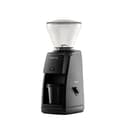 Best overall · 40 mm conical, electric 40 mm conical steel M2 burrs by Etzinger · 40 stepped settings, split 1-20 espresso / 21-40 filter · 300 g hopper, 120 g bin · 70 W, 550 rpm · 7 lb · 1-year warranty One grinder that dials espresso properly and still makes filter. | One grinder that dials espresso properly and still makes filter.40 mm conical steel M2 burrs by Etzinger · 40 stepped settings, split 1-20 espresso / 21-40 filter · 300 g hopper, 120 g bin · 70 W, 550 rpm · 7 lb · 1-year warranty | $199.95In stock, checked November 22, 2026 Check Price on Amazon |
| 2 | 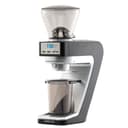 Fastest, lowest retention · 40 mm conical, electric 40 mm conical S1 burrs by Etzinger (Baratza does not state the material) · 31 steps on a single macro adjustment · the ring burr spins and the cone stays fixed, so coffee drops straight into the portafilter · 200 W, 650 rpm, 2.9-4.0 g/sec · 1-year warranty For espresso-first users who hate retention and waiting. | For espresso-first users who hate retention and waiting.40 mm conical S1 burrs by Etzinger (Baratza does not state the material) · 31 steps on a single macro adjustment · the ring burr spins and the cone stays fixed, so coffee drops straight into the portafilter · 200 W, 650 rpm, 2.9-4.0 g/sec · 1-year warranty | $299.95In stock, checked November 22, 2026 Check Price on Amazon |
| 3 | 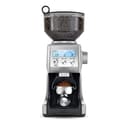 #3 Breville Smart Grinder Pro (BCG820) Most settings · Conical, electric Stainless steel conical burrs - Breville publishes no diameter · 60 stepped settings plus grind time programmable in 0.2-second steps · 50-54 mm and 58 mm portafilter cradles in the box · 18 oz hopper · 165 W · 1-year warranty For a Breville machine, or anyone who wants dosing by time. | For a Breville machine, or anyone who wants dosing by time.Stainless steel conical burrs - Breville publishes no diameter · 60 stepped settings plus grind time programmable in 0.2-second steps · 50-54 mm and 58 mm portafilter cradles in the box · 18 oz hopper · 165 W · 1-year warranty | $199.95In stock, checked November 22, 2026 Check Price on Amazon |
| 4 | 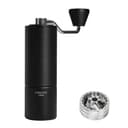 #4 Timemore Chestnut C3 ESP Manual Coffee Grinder Best hand-powered · 38 mm conical, manual 38 mm S2C660 conical stainless burrs, CNC-machined · the ESP dial steps 0.0233 mm per click against the standard C3's 0.0833 mm · 20 g catch cup · no warranty published by Timemore Espresso-grade adjustment for the price of a budget electric. | Espresso-grade adjustment for the price of a budget electric.38 mm S2C660 conical stainless burrs, CNC-machined · the ESP dial steps 0.0233 mm per click against the standard C3's 0.0833 mm · 20 g catch cup · no warranty published by Timemore | $68.00In stock, checked November 22, 2026 Check Price on Amazon |
| 5 | 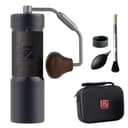 #5 1Zpresso J-Ultra Manual Coffee Grinder Step-up manual · 48 mm burrs, manual 48 mm coated burrs - the Amazon listing calls them conical, 1Zpresso's own page states no geometry · external ring, 8 microns per click, the finest of any 1Zpresso · 35-40 g catch cup · 1-year limited warranty The finest adjustment here, if you will turn a handle. | The finest adjustment here, if you will turn a handle.48 mm coated burrs - the Amazon listing calls them conical, 1Zpresso's own page states no geometry · external ring, 8 microns per click, the finest of any 1Zpresso · 35-40 g catch cup · 1-year limited warranty | $159.20In stock, checked November 22, 2026 Check Price on Amazon |
| 6 | 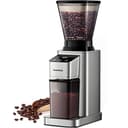 #6 SHARDOR Conical Burr Coffee Grinder Budget pick · Conical, electric Conical burrs and 48 settings per the listing, with a timer and an anti-static claim · no manufacturer spec sheet, so no burr diameter · happiest at drip and French press The cheapest conical electric we would point anyone at. | The cheapest conical electric we would point anyone at.Conical burrs and 48 settings per the listing, with a timer and an anti-static claim · no manufacturer spec sheet, so no burr diameter · happiest at drip and French press | $59.99In stock, checked November 22, 2026 Check Price on Amazon |
What a conical burr actually changes
A conical burr set is a cone spinning inside a matching ring. Beans fall into the gap under gravity and are crushed progressively as the gap narrows on the way down. A flat burr set, by contrast, is two parallel rings facing each other, throwing coffee outwards to leave at the rim. That difference in geometry is the entire reason this page exists, and it has three practical consequences.
A broader particle spread, which reads as body and forgiveness.Because beans take varied paths through a cone, conicals are generally credited with a wider range of particle sizes than flats. In the cup that tends to read as more body and a rounder, less separated flavor — and at the machine it means a dose that is a gram out or a tamp that is slightly uneven does less damage to the shot. If you are still learning distribution and timing, that forgiveness is worth real money. The full comparison is in conical vs flat burrs.
Lower retention. Grounds fall out of a cone rather than having to be swept from a chamber, so a conical of a given size typically holds less coffee inside itself than a comparable flat. That is why flat-burr grinders built for home espresso arrive with bellows and dosing cups and conicals often do not need them. The Sette 30 takes the idea furthest: Baratza spins the outer ring burr and fixes the inner cone, so coffee drops straight down into the portafilter instead of winding through a chute.
Price.A conical set is cheaper to manufacture and align than a flat set of equivalent quality, which is why essentially every grinder worth owning under $300 is conical and why the flat-burr page starts where this one ends. If your budget is the constraint rather than your palate, a conical is not the compromise — it is the correct answer.
One honest caveat before the picks: no maker on this page publishes a particle-distribution figure, and we have not measured one. The characterization above is how the geometry is understood in the trade and how these makers position their own products, not a result from a bench we do not have.
The two specs that decide it
Within conicals, two published numbers do almost all of the work, and a third thing that is never published matters more than people expect.
Burr diameter. A bigger burr does more work per rotation, runs cooler for the same dose and clears faster. The conicals here run 38 mm to 48 mm: the Encore ESP and Sette 30 at 40 mm, the J-Ultra at 48 mm, the C3 ESP at 38 mm. Breville publishes noburr diameter at all for the Smart Grinder Pro — the only millimeter figures on its page are the portafilter cradle sizes — and SHARDOR publishes no spec sheet we can fetch, so for those two we state no diameter rather than repeat a number from a retailer. For scale: a 64 mm flat, like the one in the flat burr roundup, is a genuine step change in mechanism rather than a marketing tier.
Adjustment resolution.This is the spec that decides whether a grinder can do espresso at all, and it is where this page splits. Espresso lives in a narrow window, so what matters is how small a step the grinder can take inside it. The Encore ESP gives the espresso range half its dial (settings 1–20) instead of a few clicks at the bottom. The C3 ESP steps 0.0233 mm per click where the standard C3 steps 0.0833 mm — nearly four times coarser, and the reason the ESP suffix is not optional. The J-Ultra steps 8 microns, the finest here. The Smart Grinder Pro has 60 steps across the whole range plus time-based dosing. SHARDOR's 48 settings cover drip through French press and the espresso end of its range is coarse.
And the unpublished one: clumping.Conicals clump. The crushing action and static charge send grounds into the basket as small clusters, and a clumped bed channels. Nobody puts that on a spec sheet, which is exactly why the two cheapest accessories on this site exist — see WDT tools and why your grinder is full of static. Budget about twenty dollars for a needle tool with any grinder on this page and most of the complaint disappears.
The picks
Baratza Encore ESP — the one to buy
Who it is for: the reader who wants one electric grinder that dials espresso properly and still makes filter coffee without a fight. Baratza re-engineered its entry-level classic specifically for espresso, and the way it did that is the pick: 40 mm conical steel M2 burrs made by Etzingerin Liechtenstein — a named burr manufacturer at a price where most grinders name nobody — and a dial split into two ranges, with settings 1–20 as fine espresso micro-steps and 21–40 as coarser filter steps. Each unit is factory-calibrated, and the 300 g hopper with a 120 g grounds bin means it works as a daily driver rather than a single-dose-only device. It is also the grinder this site recommends more often than any other, which is why it eventually got a full review of its own.
The honest cons.It is stepped, not stepless, so there is no landing between two espresso settings — with some beans you will be choosing the lesser of two shots. It clumps, like every conical. It is slow by modern standards at 1.3–2.2 g/sec on Baratza's own figures, so a double takes a noticeable pause. And a documentation problem worth knowing: Baratza's current product page publishes almost no specifications at all, so the figures above come from our dated capture of that page, and retailers now disagree with each other on hopper size, grind rate and wattage. There is also a dearer Encore ESP Prowith stepless adjustment and single-dose modes, which contaminates spec sheets for this model across the web — make sure the listing you buy says what you think it does.
Baratza Sette 30 — the fastest, with the least left behind
Who it is for: an espresso-first household that is tired of retention and waiting. The mechanism is the story: in the Sette, the outer ring burr spinsand the inner cone stays fixed, so coffee falls straight down into the portafilter rather than traveling through a chute. Baratza says that roughly doubles the throughput of similarly-sized grinders and leaves almost nothing behind, and its published grind rate of 2.9–4.0 g/sec is about twice the Encore ESP's. The burrs are 40 mm conicals in the S1 set, also made by Etzinger — the same burr geometry as the pricier Sette 270.
The honest cons.Baratza does not state the burr material for this model, so neither do we. Adjustment is a single macro ladder of 31 steps, which is coarser inside the espresso range than the Encore ESP's dedicated 20 — this grinder is faster, not finer. The Sette platform is famously loud, and it is the one grinder here whose mechanism people report as the least robust over years of use; Baratza's parts and repair support is the mitigation rather than a denial. It also costs meaningfully more than the Encore ESP, and it is a worse all-rounder: the step down to filter grinds is abrupt.
Breville Smart Grinder Pro — the programmable all-rounder
Who it is for: anyone with a Breville machine, and anyone who wants to dose by pressing one button. Breville pitches it as spanning the full brew spectrum rather than as an espresso specialist: stainless steel conical burrs, 60 stepped settings, and a grind time that is separately programmable in 0.2-second increments, so your morning dose becomes a single press. Crucially it grinds straight into a portafilter, with both 50–54 mm and 58 mm cradles in the box, which is why it pairs so naturally with a Bambino or a Gaggia. If you own a 54 mm Breville, the pairing page is the best grinders for the Breville Bambino.
The honest cons.Breville publishes no burr diameter anywhere for this grinder, which for a $200 grinder is a real transparency gap — any "40 mm" figure you read for it is not manufacturer-sourced. Dosing by time drifts as beans age and the grind setting changes, so it is a convenience rather than a scale. Sixty settings sound like more resolution than they are, because they cover espresso through French press. And its hopper capacity is published in ounces only (18 oz), with no gram figure in existence. If you are weighing this grinder against a machine that has one built in, that trade is laid out in alternatives to the Breville Barista Express. Head-to-head with our top pick: Encore ESP vs Smart Grinder Pro.
Timemore Chestnut C3 ESP — the best hand-powered conical
Who it is for: the reader who wants espresso-grade adjustment for the price of a budget electric. The C3 ESP uses 38 mm S2C660 conical stainless burrs, CNC-machined, and the dial is the entire reason it is here: the ESP version steps 0.0233 mm per click, where the standard C3's Classic dial steps 0.0833 mm — nearly four times coarser. For espresso that difference is the whole ballgame, and it is the thing roundups get wrong, so read the listing title and make sure it says ESP. At its price it out-grinds every electric near it.
The honest cons.You turn it by hand, and an espresso-fine grind is the hardest work a hand grinder does — expect 30 to 50 seconds of real effort per double. The catch cup holds 20 g, so it is one or two shots at a time. And Timemore publishes very little: no dimensions, no weight (the 530 g figure quoted everywhere comes from retailers) and no warranty page at all. Compared with the other hand grinder here: J-Ultra vs C3 ESP.
1Zpresso J-Ultra — the finest adjustment on this page
Who it is for:someone who has decided grind resolution is what they are buying, and will turn a handle to get it. The J-Ultra is 1Zpresso's espresso-tuned hand grinder and its finest-adjusting model: an external ring that moves 8 microns per click, which is the kind of resolution you actually need to chase a shot rather than approximate it, on 48 mm coated burrs with a 35–40 g magnetic catch cup. It is the grinder to buy if you want hand-grinder quality without stepping up to a $300 electric, and it sits in the hand grinder roundup as well.
The honest cons, and a geometry caveat.The Amazon listing describes the J-Ultra's burrs as conical, which is why it is on this page — but 1Zpresso's own product page does not state whether they are conical or flat, and does not name the coating, so we will not state either as fact. Treat its inclusion here as the retailer's description, not the maker's. Beyond that: it costs about what the Encore ESP costs while asking you to do the work, 1Zpresso's own sources disagree on its weight (700 g on the product page, 670 g in their own comparison table), and clicked adjustment is still clicked — fine clicks, but not stepless.
SHARDOR conical — the budget pick
Who it is for:the reader who will not grind by hand and cannot stretch to the Encore ESP. The SHARDOR is the sub-$100 electric burr grinder we would actually point someone at: it has conical burrs rather than blades, 48 settings and a timer per its listing, plus an anti-static claim. Against a blade grinder it is an enormous upgrade — see burr vs blade grinders for why that gap is mechanical rather than a matter of degree.
The honest cons.Be realistic about what it is: it is happiest at drip and French press, and its adjustment is coarser than a dedicated espresso grinder's, so hitting and holding a fine espresso setting is a struggle rather than a pleasure. SHARDOR publishes no spec sheet we can fetch, so every figure above is read off the live listing and there is no burr diameter to quote. If espresso is the point and the budget is this one, the C3 ESP above is the better buy; this pick exists for the reader who has ruled hand grinding out.
The conical people ask about that we cannot price
The Fellow Opus is the other 40 mm conical home grinders shop for, and it is worth saying plainly why there is no price button for it: when we checked the Amazon listing on November 16, 2026, it came back "Currently unavailable", which means there is no buyable offer for the price layer to read. A tagged search is all we will show for it, and it will show no number at all rather than a wrong one:
If the Opus is what brought you here, the two comparisons we already have are Encore ESP vs Fellow Opus and alternatives to the Baratza Encore ESP, which covers the same tier from the other direction.
When to buy a flat burr instead
We are not going to pretend conical is always right. Three cases where the money belongs in a flat burr set instead.
You drink light single origins and want clarity. The narrower particle spread of a flat set is credited with more separation between flavors, which is why specialty cafes grinding light roasts almost all run flats. If what you want from espresso is to taste the fruit in a washed Ethiopian rather than a thick, rounded shot, that is the geometry to buy.
You want stepless adjustment.Every conical on this page is clicked or stepped. The two stepless grinders this site covers are both flats: the DF64 Gen 2 and the Eureka Mignon range. If you have outgrown choosing between two settings, that is the real upgrade — and it is the argument in stepped vs stepless grinders.
You are spending more than about $300 anyway. Above that, flats dominate the market and the conical options thin out fast. The full list is the best flat burr grinders, and if you want the decision rather than the shortlist, read conical vs flat burrs first.
What we know, and how we know it
What we did
- Took the specs from the manufacturer's own documentation. Not from a retailer listing, and not from another blog.
- Priced it from Amazon's API, with the date we checked shown next to the number. If that price is more than 48 hours old, this page stops showing a number at all rather than show you a wrong one.
- Formed a verdict from those specs, the price, and what owners publicly report.
Where we hedged, and why
Four of these six grinders are in our spec database with figures traced to the manufacturer: the Encore ESP, the Sette 30, the Smart Grinder Pro and the C3 ESP. Where a maker publishes nothing, we say so rather than borrow a number from a retailer — Breville publishes no burr diameter for the Smart Grinder Pro, Baratza does not state the Sette 30's burr material, Timemore publishes no dimensions, weight or warranty for the C3 ESP, and SHARDOR publishes no spec sheet at all, so its figures are read off the live Amazon listing and attributed as such.
Two specific hedges matter on a page sorted by burr geometry. The 1Zpresso J-Ultrais here because its Amazon listing describes its burrs as conical; 1Zpresso's own product page states no geometry and names no coating, so we attribute that to the retailer and not to the maker. And the Baratza Encore ESP'sown product page has been stripped of almost all specifications since we first captured it, so its figures are a dated manufacturer capture rather than current manufacturer copy — retailers now disagree on hopper size, grind rate and wattage, and a separate Encore ESP Pro muddies the search results further.
We have not run particle-size analysis on any of these grinders, and nobody who makes them publishes a distribution figure. The conical-versus-flat characterization on this page is how the geometry is understood in the trade, not a measurement of ours. Availability for every pick was checked against Amazon's Product Advertising (Creators) API on November 16, 2026, and the prices on the buttons come from that same layer with the date stamped beside them.
What we did not do
We do not run a lab. We have not pulled thousands of shots on this machine, and we are not going to pretend otherwise. We have not used this unit ourselves. Everything above is sourced research, and it is labeled as such. Where we have used a machine, we say so and show it.
How we're paid
If you buy through a link on this page, we earn a commission. It costs you nothing extra and it does not change what we recommend — we link to the better option for the buyer even when it earns us less. See how we review and our full disclosure.
If you came here to pair a grinder with a specific machine instead, the best grinders for espresso is sorted that way, and why the grinder matters more than the machine is the argument for spending here first. More on the grinders hub.
Frequently asked questions
What is the best conical burr grinder?
The Baratza Encore ESP, for most people. It uses 40 mm conical steel M2 burrs made by Etzinger and splits its dial so settings 1-20 are fine espresso micro-steps and 21-40 are coarser filter steps, which is far more espresso resolution than a grinder at this price usually offers. The Timemore Chestnut C3 ESP is the best hand-powered conical, and the SHARDOR is the budget electric.
Are conical or flat burrs better for espresso?
Neither is better; they aim at different cups. Conicals produce a broader particle spread, which reads as more body and forgives an uneven dose or tamp - useful while you are learning. Flats produce a narrower spread, credited with more clarity and separation, which is why specialty cafes grinding light roasts run them. Conicals also retain less coffee and cost less to build, so they dominate every budget under $300.
What size conical burr do I need for espresso?
Diameter matters less than adjustment resolution at this end of the market. The conicals on this page run 38 mm to 48 mm and all of them can grind fine enough for espresso; what separates them is how small a step the dial takes inside the espresso range. The Encore ESP gives espresso half its dial, the Timemore C3 ESP steps 0.0233 mm per click, and the 1Zpresso J-Ultra steps 8 microns.
Why does my conical grinder produce clumps?
Because the crushing action plus static charge sends grounds into the basket as small clusters - it is a characteristic of the geometry rather than a fault, and no maker lists it on a spec sheet. A clumped bed channels, so plan for it: a WDT needle tool costs about twenty dollars and breaks the clumps up before you tamp, which removes most of the complaint.
Is a hand grinder with conical burrs good enough for espresso?
Yes, and under about $120 it is usually the better buy. A manual grinder spends nothing on a motor or hopper, so almost all of its cost goes into the burrs and the adjustment mechanism. The Timemore Chestnut C3 ESP and 1Zpresso J-Ultra both out-grind electrics at their price. The catch is effort: an espresso-fine grind means 30 to 50 seconds of real work per double, and small catch cups mean one or two shots at a time.
Is the Breville Smart Grinder Pro a conical burr grinder?
Yes - Breville specifies stainless steel conical burrs. What Breville does not publish anywhere is the burr diameter, so any millimeter figure you see quoted for it comes from a retailer rather than the manufacturer. Its distinguishing features are 60 stepped settings, a grind time programmable in 0.2-second increments, and portafilter cradles for both 50-54 mm and 58 mm baskets in the box.
Can I use a conical burr grinder for pour over as well as espresso?
Yes, and that is one of the strongest arguments for a conical. The Encore ESP is built around exactly this split, with settings 21-40 reserved for filter grinds, and the Smart Grinder Pro's 60 settings span espresso to French press. A dedicated espresso grinder gives you finer control inside the espresso range; a conical all-rounder gives you one grinder for the whole house.
Sources
Specs come from the manufacturer's own documentation. Prices come from Amazon's API. Where a claim comes from what owners report, we link the thread and say so.
- Baratza Encore ESP product page (40 mm conical steel M2 burrs by Etzinger, 40 stepped settings split 1-20 espresso and 21-40 filter, 300 g hopper and 120 g bin, 70 W at 550 rpm, 1.3-2.2 g/sec, 7 lb, 1-year warranty). Captured for our spec database; the page as published now carries almost no specifications, which is noted on this page.
- Baratza Sette 30 product page (40 mm conical S1 burrs by Etzinger, burr material not stated, 31 steps, spinning ring burr dropping straight into the portafilter, 200 W at 650 rpm, 2.9-4.0 g/sec, 1-year warranty)
- Breville Smart Grinder Pro (BCG820) product page (stainless steel conical burrs with no diameter published, 60 stepped settings, grind time in 0.2-second increments, 50-54 mm and 58 mm portafilter cradles, 18 oz hopper, 165 W, 1-year warranty)
- Timemore Chestnut C3 series official specifications (38 mm S2C660 conical stainless burrs; ESP dial 0.0233 mm per click against the Classic dial's 0.0833 mm; no dimensions, weight or warranty published)
- 1Zpresso J-Ultra product page (48 mm coated burrs with no geometry or coating stated, external ring at 8 microns per click, 35-40 g catch cup, 1-year limited warranty; 700 g on the product page against 670 g in 1Zpresso's own comparison table)
- SHARDOR conical burr grinder: conical burrs, 48 settings, timer and anti-static claim read off the live Amazon listing on November 16, 2026. SHARDOR publishes no fetchable spec sheet, so no burr diameter is stated here.
- Availability for every pick, and the Fellow Opus's "Currently unavailable" status, checked against the Amazon Product Advertising (Creators) API on November 16, 2026.
Keep reading
- Conical vs flat burrsThe explainer behind this page: what each geometry does to the cup, with no products.
- Best flat burr grindersThe counterpart roundup, for clarity-first buyers and stepless adjustment.
- Baratza Encore ESP reviewOur top pick in full, including the spec-sheet problem Baratza has created.
- Best hand grindersThe two manual picks here, plus the rest of the hand-grinder field.
- Best grinders for espressoThe same decision sorted by machine fit instead of by burr geometry.
- WDT toolsThe twenty-dollar accessory that fixes the one thing every conical does wrong.